Google Jules Officially Launches: How Critical Agents Are Redefining AI Programming

Google's AI coding agent Jules officially launches with asynchronous task handling and critical code review.
Google's AI coding agent Jules has exited Beta and is now available to all developers. This upgrade brings several core features: native Bundler support and environment snapshots to simplify project configuration, seamless Pull Request creation to reduce context switching, frontend visual screenshot feedback for improved efficiency, a Critical Agent that shifts from passive execution to proactive code review, and web browsing capability to address outdated training data. With its asynchronous processing model and deep GitHub integration, Jules carves out a differentiated position in the AI coding tools landscape.
Google's asynchronous coding agent Jules recently received a major upgrade, officially exiting Beta and becoming available to all developers. This AI coding agent, deeply integrated with GitHub, brings a series of practical features including asynchronous task processing, critical code review, and environment snapshots—fundamentally changing how developers work day to day.
What Is Jules? Why Should Developers Pay Attention
Jules is an AI coding agent developed by Google. Its core positioning isn't a simple code completion tool, but rather an intelligent assistant capable of handling programming tasks asynchronously. You can hand off heavy-lifting work like fixing bugs, adding comments, and building new features to Jules while you focus on other higher-value tasks.
The concept of an "asynchronous coding agent" represents a new paradigm distinct from traditional real-time code completion tools. Traditional tools require developers to wait in real-time for AI responses during coding—essentially a synchronous interaction. An asynchronous agent, on the other hand, allows developers to submit a complete task to the AI and immediately walk away. The AI independently completes the entire task chain in the background—including understanding requirements, reading relevant code, writing solutions, and running tests for verification—ultimately delivering results in the form of a Pull Request. This model borrows from the delegation mechanism of real-world team collaboration, transforming developers from "watching AI write code" to "assigning tasks and focusing on other work."
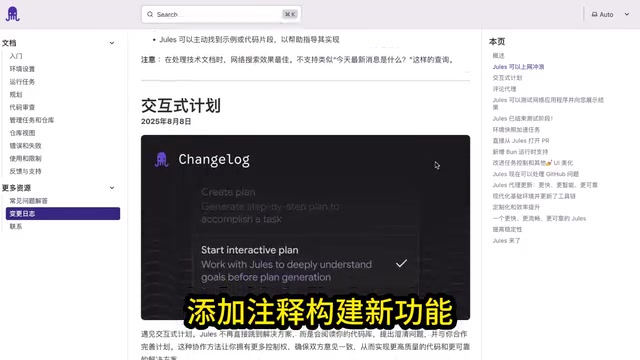
Seamless integration with GitHub is one of Jules' core advantages. Developers don't need to switch between multiple tools—Jules can directly read repository code, understand project context, and automatically submit results after completing tasks. This "hand it off and forget about it" asynchronous work model provides a noticeable boost to development efficiency.
Key Highlights of This Upgrade
Native Bundler Support and Environment Snapshots
In this upgrade, the Jules developer experience has been comprehensively improved. It now natively supports Bundler implementation, enabling more accurate understanding and handling of dependency relationships for projects using various package management tools.

Bundler was originally a dependency management tool in the Ruby ecosystem, used to ensure projects use consistent gem versions across different environments. In a broader context, it also refers to packaging and dependency management mechanisms for various projects, including npm/yarn/pnpm in the JavaScript ecosystem, pip/poetry for Python, Maven/Gradle for Java, and more. Modern software projects often depend on dozens or even hundreds of third-party libraries with complex version constraints and interdependencies. Jules' native Bundler support means it can automatically parse lock files and understand dependency trees, avoiding incompatible library imports or calls to non-existent APIs when generating code.
Even more noteworthy is the new environment snapshot feature. Developers can save complex project configurations with a single click, completely eliminating repetitive initialization work. For large projects with cumbersome environment configurations, the efficiency gains from this feature are immediately apparent—no more building development environments from scratch every time.
Development environment configuration has long been a pain point in software engineering, captured by the famous phrase "Works on my machine." A typical project environment might include specific runtime versions (e.g., Node.js 18, Python 3.11), system-level dependencies, environment variables, database configurations, and third-party service credentials. The environment snapshot feature is similar to virtual machine snapshot technology—saving the entire configured runtime environment state as a reusable image. The AI agent can restore directly from the snapshot next time it executes a task, skipping the time-consuming environment setup process. This is especially critical for frequently triggered automated tasks.
Seamless Pull Request Creation
After completing coding, developers can create and push merge requests (Pull Requests) directly without leaving Jules' interface. The flow from coding to submission is seamless, significantly reducing efficiency loss from context switching.
Pull Request (PR) is the core collaboration mechanism based on Git in modern software development. After completing modifications on an independent branch, developers initiate a merge request to the main branch via PR, where team members can conduct code reviews, discussions, and automated testing. A typical PR workflow includes: creating a branch, committing code, pushing to a remote repository, creating a PR on GitHub, waiting for CI checks to pass, requesting review, and merging. Jules' ability to create PRs directly after completing coding means it's not just a code generator—it's deeply integrated into a team's standard development process, and its output can directly enter the normal review and merge pipeline without developers manually executing git operations.
Visual Feedback for Frontend Development
For frontend development scenarios, Jules provides an extremely practical feature: it can automatically test web applications and return intuitive UI screenshots, giving developers immediate visibility into the effects of their changes.

Frontend developers no longer need to manually launch browsers or repeatedly refresh pages to see the visual effects of each code change. Jules automatically handles rendering and screenshots, presenting results directly—making the entire feedback loop much more efficient.
Critical Agent: From Passive Execution to Proactive Code Quality Review
The most noteworthy feature of this update is the Critical Agent.

Traditional AI coding assistants are often just "code executors"—you tell them what to write, and they write it. Jules' Critical Agent, however, acts more like a senior code review expert built into the workflow. It will:
- Proactively scrutinize the quality and logic of every line of code
- Challenge potential security risks and performance bottlenecks
- Optimize code structure to ensure it's robust, secure, and efficient
Code Review is a key practice in software engineering for ensuring code quality. It typically involves senior developers performing line-by-line inspections of others' submitted code, focusing on logical correctness, security vulnerabilities, performance issues, code style, and maintainability. Traditional static analysis tools (like SonarQube, ESLint) can only detect pattern-based issues and cannot understand business logic. Jules' Critical Agent combines the semantic understanding capabilities of large language models to review code at a higher level—for example, determining whether an implementation has race conditions, whether a SQL query has injection risks, or whether an algorithm's time complexity is reasonable. This essentially decouples "AI generation" and "AI review" into two independent agents, forming an internal adversarial verification mechanism.
This shift from "passive execution" to "proactive review" means AI coding tools are entering a new phase. Developers gain not only a coding assistant but also a "second pair of eyes" that helps guard code quality.
Web Browsing Capability: Helping AI Coding Agents Move Beyond Outdated Code
Beyond the Critical Agent, Jules also adds web browsing capability. When it encounters uncertain technical issues during coding, it can proactively consult the latest technical documentation and resources to solve problems, rather than relying solely on knowledge from training data that may already be outdated.
Large language models have a training data knowledge cutoff, meaning models know nothing about new APIs, new framework versions, or new best practices released after training. This problem is particularly acute in rapidly evolving domains (such as frontend frameworks like React and Next.js that undergo major updates every few months)—models may generate deprecated API calls or discouraged patterns. Web browsing capability (also a form of Tool Use or Retrieval-Augmented Generation/RAG) allows AI agents to actively access the internet during task execution, consulting official documentation, Stack Overflow, GitHub Issues, and other resources to ensure generated code complies with the latest specifications. This is a critical step for AI agents moving from a "closed knowledge system" to an "open knowledge system."
This capability is especially important in rapidly iterating frontend frameworks and emerging technology domains. With technical documentation updating frequently and APIs changing rapidly, Jules can retrieve the latest materials in real-time, significantly reducing the risk of generating outdated code.
Jules Subscription Plans and Early User Benefits
To support these new features, Jules has launched two subscription tiers:
- Core Plan: A basic version for everyday development needs
- Ultra Plan: A premium version for power users and teams
Notably, to thank early users for their support, all Beta testers will receive three months of free Core access. If you participated in the testing phase, this is a nice perk.
Jules' Differentiated Positioning in the AI Coding Agent Space
Jules' leap from Beta to general availability represents not just a product update, but Google's continued investment in the AI coding agent space. From asynchronous task processing to critical code review, from environment snapshots to web browsing, Jules is building an increasingly complete intelligent development workflow.
The current AI coding tool market has formed a multi-layered competitive landscape. GitHub Copilot, as a first mover, leverages the VS Code ecosystem and GitHub platform advantages to dominate, with Copilot Workspace also exploring agentic development. Cursor has entered with an AI-native IDE positioning, deeply embedding AI into the editor experience. There's also Devin (a fully autonomous AI software engineer from Cognition Labs), Windsurf (Codeium's agent product), Amazon Q Developer, and others. Jules' differentiation lies in the fact that it doesn't try to replace the developer's IDE—instead, it operates as a background asynchronous agent running in parallel with the developer's main workflow. This positioning is closer to an "AI teammate" rather than an "AI tool," suited for developers who want to delegate repetitive work rather than receive real-time assistance during coding.
In a fiercely competitive landscape with GitHub Copilot, Cursor, and other rivals, Jules has carved out a differentiated path through its unique asynchronous processing model and deep GitHub integration. For developers pursuing efficiency, Jules is well worth serious attention and experimentation.
Related articles
 Tech Frontiers
A Rare Quiet Day in AI: Recursive Self-Improvement Stirs Beneath the Surface
A rare quiet day in AI sees multiple sources go silent simultaneously. Behind the calm, Recursive Self-Improvement (RSI) research continues. What this means for the industry.
 Tech Frontiers
Reve 2 vs. Ideogram 4: A Deep Dive into Layout Control in AI Image Generation
A deep comparison of Reve 2 and Ideogram 4's layout control capabilities, covering technical approaches, real-world use cases, and industry trends for designers and creators.
 Tech Frontiers
In the Weights: Check Your Influence Score in the AI World
In the Weights is an AI influence search engine that quantifies your presence in the AI world with a score. Explore how it evaluates practitioners and what it means for digital identity.