Google Launches CC, a Family AI Assistant for Managing Schedules and Household Tasks

Google repositions AI agent CC as a family digital household manager integrating calendars, email, and tasks.
Google has strategically repositioned its AI agent CC from a personal productivity tool into a family-wide coordination assistant. With authorization from family members, CC accesses shared email, calendars, and tasks to proactively handle scheduling, form-filling, shopping lists, and meal planning — reducing the coordination overhead caused by scattered household information. The family use case is both competitively underserved and naturally high-stickiness, making it a strong fit with Google's existing Gmail and Google Calendar ecosystem. However, the biggest barrier to adoption isn't technical — it's privacy trust, as sharing sensitive family data (including that of minors) with an AI demands robust safeguards and user control.
Google is refocusing its AI agent CC on family coordination. Rather than serving as a personal productivity tool, CC is now positioned as a "digital household manager" for the entire family — using shared email, calendars, and tasks to proactively help family members manage schedules, fill out forms, generate shopping lists, plan meals, and more.
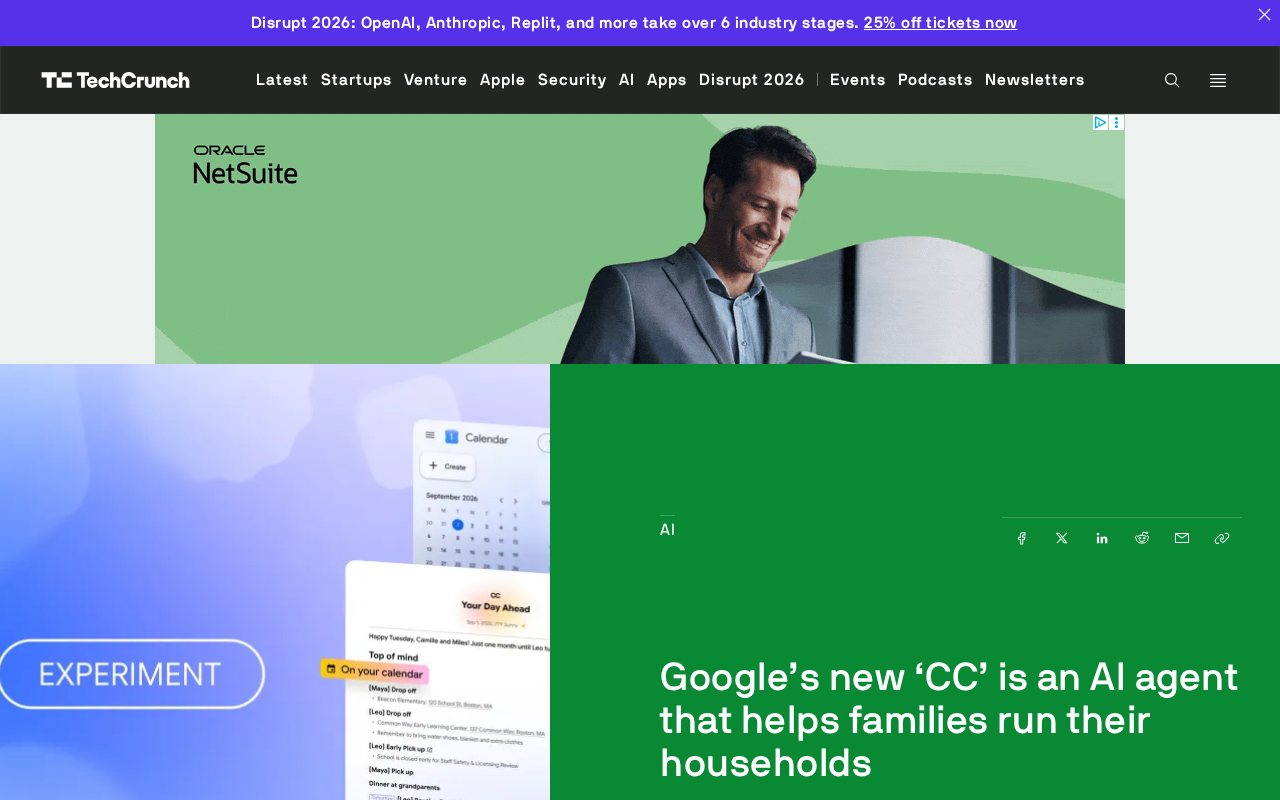
What Exactly Is CC
Based on what Google has disclosed, CC is an AI agent whose core capability lies in "agentic execution" rather than simple Q&A. Unlike traditional chatbots, the value of an AI agent is its ability to proactively complete a series of operations across apps and tasks. By repositioning CC around the "family coordination" use case, Google is betting on the high-frequency, fragmented, and deeply coordination-dependent nature of everyday household life.
Family tasks are defined by multiple participants and scattered information: one person's calendar holds the kids' after-school schedule, another person mentally tracks the grocery list, and school forms are buried somewhere in an email thread. What CC aims to solve is exactly this kind of coordination overhead caused by information silos.
The core difference between an AI agent and a standard AI assistant lies in autonomous action. Chatbots follow the pattern of "user asks → AI answers," while agents operate on "user sets a goal → AI independently plans steps and uses tools to complete the task." This is made possible by tool use (function calling) and multi-step reasoning: an agent can read calendars, write tasks, send reminders, and search emails — merging operations that would otherwise require manual coordination into a single authorized automated workflow. Google, OpenAI, Anthropic, and others are all aggressively pushing agent products, with the industry widely viewing this as the pivotal transition from AI as an "information tool" to AI as an "action tool." CC is Google's attempt to find a concrete real-world foothold for agentic capabilities through the family use case.
What CC Can Do for Families
According to Google's description, once CC is granted authorization and given access to shared email, calendars, and tasks from family members, it can handle a range of specific responsibilities:
Schedule and Reminder Management
CC can centrally manage a family calendar, consolidating plans scattered across different members' schedules to reduce conflicts and missed events. For dual-income households or families with multiple children, this kind of coordination is often the most mentally draining part of daily life.
Handling Routine Tasks
Filling out forms, generating shopping lists, and planning weekly meals are all high-frequency chores that still carry non-trivial decision costs. CC aims to hand these "low-creativity, high-repetition" tasks off to AI, freeing up time for the people involved.
Information Aggregation
By reading shared emails, CC can automatically identify hidden to-dos — such as deadlines buried in school notices or event registration details — and convert them into actionable tasks or calendar entries.
Why Google Is Betting on the Family Use Case
Anchoring an AI agent to the family context is a strategically deliberate choice. The personal productivity AI space is already intensely competitive, while "family coordination" remains relatively underexplored — and is inherently high-stickiness by nature. Once a family entrusts their schedules, emails, and shopping to an AI, the switching cost becomes very high.
More importantly, the family use case aligns closely with Google's existing product ecosystem. Gmail, Google Calendar, Google Tasks, Google Keep — these are tools many families already rely on daily. CC effectively adds an "active execution" intelligence layer on top of these products, connecting fragmented features into a coherent service loop.
From a product strategy perspective, this approach of "layering intelligence onto an existing ecosystem" is commonly referred to as platform extension or super-app-ification. Google's logic closely mirrors Microsoft embedding Copilot into Office 365 and Apple integrating Apple Intelligence into its system apps: using AI capabilities to activate retention and usage frequency among existing users, rather than building new user relationships from scratch. Gmail and Google Calendar collectively serve hundreds of millions of users worldwide — CC is essentially a bridge for converting that installed base into AI agent service users, while using deep integration to fend off competitive pressure from standalone AI assistant products.
Privacy and Trust Are the Biggest Challenges
For CC to truly deliver, family members must be willing to share their emails, calendars, and tasks — which happen to be some of the most sensitive personal data people have. Allowing AI to read family emails and learn everyone's schedules and spending habits sets an extremely high bar for privacy protection.
Family data also involves minors. How to balance convenience and safety, and how to keep parents in control and able to audit AI's automated actions, will directly determine whether users feel comfortable enough to actually adopt the product. For Google, technical capability may not be the biggest barrier — earning families' trust is.
Conclusion
CC's repositioning reflects the broader industry trend of AI evolving from "general-purpose assistants" toward "vertical use case agents." Family coordination may seem mundane, but it's a genuine daily pain point for every household. If Google can deliver both reliable execution and meaningful privacy controls, CC has a real shot at becoming the hub of a family's digital life. That said, there's still a long road between concept and actual integration into daily routines — execution quality and the specifics of privacy policy will be the critical things to watch.
Related articles

@ai-sdk/vue 3.0.306 Patch Release Syncs with [email protected] Update
@ai-sdk/vue 3.0.306 released, synced with [email protected]. A routine patch release for the Vercel AI SDK ecosystem with no public API changes; the Vue adapter layer stays version-aligned with the core package.

Gemini 4 Argon API Launches: The Era of Million-Token Output Begins
Google launches Gemini 4 Argon with sparse MoE architecture, up to 1M output tokens, and a 68.90% Vals Index score, available across API, AI Studio, and the Gemini app.

DukaanAI: Turning Product Photos into Inventory Lists with Open-Source AI
DukaanAI is an AI inventory tool for small retailers that turns product photos into inventory entries using the open-source Gemma 3 model, with local inference, editable fields, and CSV export.