Google Launches Gemini 3.8 Live Dual Models: Speech-to-Speech Benchmarks and Pricing Explained
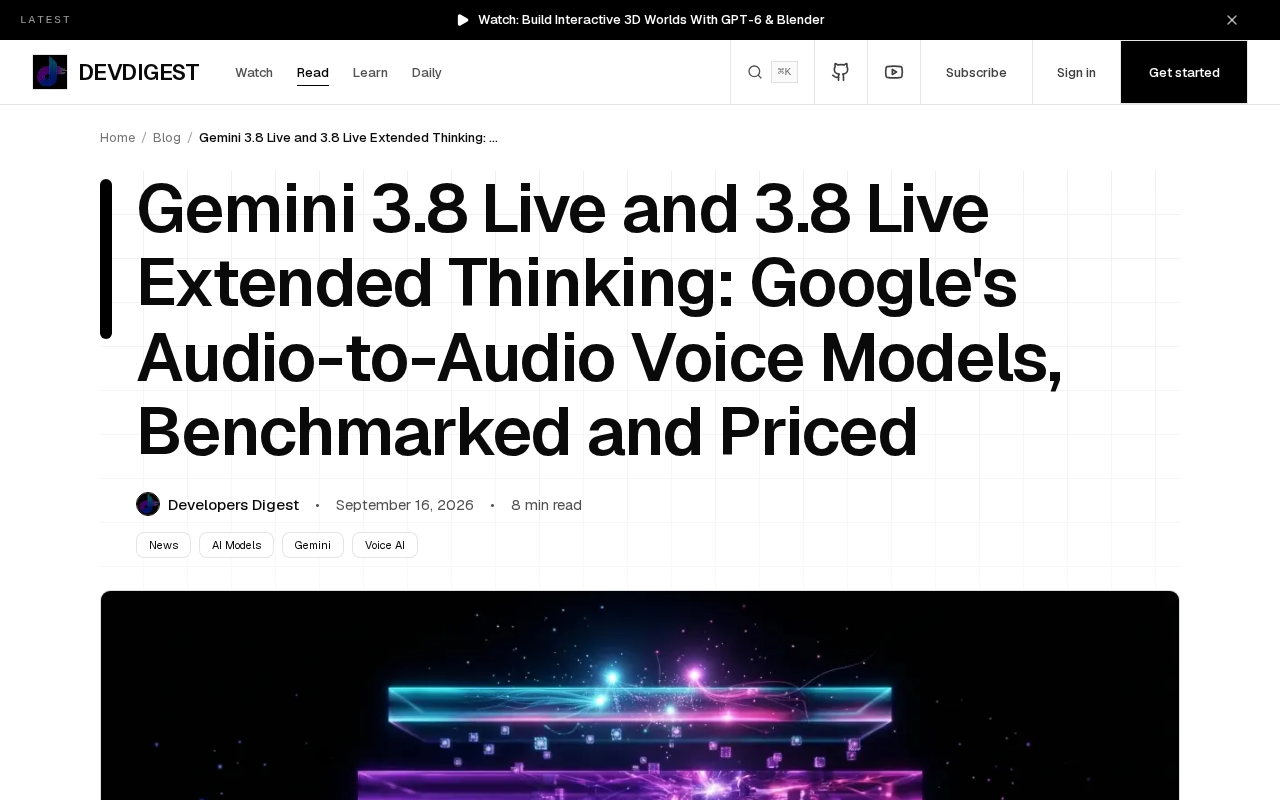
Google launches dual audio-to-audio voice models topping the Speech-to-Speech leaderboard with background tool execution.
Google released Gemini 3.8 Live and Gemini 3.8 Live Extended Thinking on September 15 — two audio-to-audio voice models targeting different use cases with low latency and deep reasoning respectively. The standard version delivers 1.18-second first-audio latency and a 76.0 Speech-to-Speech Index score; the Extended Thinking version scores 82.6 to top the leaderboard. Both support background tool execution, eliminating conversational gaps by running external API calls in parallel. Google uses per-minute pricing aligned with voice app cost structures, and developers can access both via the Live API.
Google launched two audio-to-audio voice models on September 15 — Gemini 3.8 Live and Gemini 3.8 Live Extended Thinking. The former prioritizes low-latency real-time interaction, while the latter delivers stronger reasoning capabilities, topping the Speech-to-Speech benchmark leaderboard. Both models support background tool execution, meaning they can call external tools while a conversation is ongoing without interrupting the voice stream.
How the Two Models Differ
Google's strategy this time is to cover different use cases with two distinct models: one optimized for speed, and one for depth.
Gemini 3.8 Live scores 76.0 on the Speech-to-Speech Index, with a time-to-first-audio-output latency of just 1.18 seconds. For latency-sensitive applications like real-time voice assistants, customer service bots, and voice navigation, a 1.18-second first-token latency is close to the rhythm of natural human conversation — users will barely notice any wait.
Gemini 3.8 Live Extended Thinking pushes the Speech-to-Speech Index to 82.6, claiming the top spot on the leaderboard. As the name suggests, this model introduces an "extended thinking" mechanism that performs more thorough reasoning before generating a voice response. The trade-off is increased latency, but the payoff is more accurate and logically coherent answers — making it well-suited for voice scenarios that require complex reasoning or multi-step tasks.
What Is "Audio-to-Audio"?
Traditional voice interaction typically follows a three-stage pipeline: speech recognition → text processing → speech synthesis. Each stage introduces latency and information loss. Audio-to-audio models handle understanding and generation directly at the audio level, skipping the intermediate text conversion step — giving them advantages in latency, prosody preservation, and emotional expressiveness. This is the technical foundation that allows Gemini 3.8 Live to achieve sub-second first-token latency.
Another core advantage of the audio-to-audio architecture is its ability to retain paralinguistic information in speech — including the speaker's tone, emotion, pauses, rhythm, and speaking pace. In a traditional three-stage pipeline, all of this information is discarded at the speech recognition stage when audio is converted to "plain text," and must be guessed at or defaulted to when speech is synthesized again. End-to-end audio models preserve these details between input and output, making responses feel more emotionally natural. The industry is moving quickly in this direction — OpenAI's GPT-4o voice mode and ElevenLabs' real-time conversation API follow a similar approach — and audio-to-audio is evolving from a research frontier into an engineering standard.
The Value of Background Tool Execution
Both models ship with built-in background tool execution, an engineering feature worth highlighting in this update.
Previously, when a voice model needed to call an external tool — such as checking the weather, querying a database, or making an API call — it typically had to pause its voice output, wait for the tool to return a result, and then continue. This caused noticeable conversational gaps. Background tool execution allows the model to process tool calls in parallel while it's "talking," hiding the wait time within the natural rhythm of conversation and significantly improving interaction fluency.
For developers, this means it's now possible to build truly "talk-and-act" voice agents — for example, confirming order details with a user while simultaneously running inventory checks and placing orders in the background.
Benchmark Performance and Pricing
Based on published benchmark data, the Extended Thinking version claims first place with an 82.6 Speech-to-Speech Index score, while the standard version's 76.0 also places it in the top tier. The gap between the two primarily reflects the trade-off between reasoning depth and latency.
Google has adopted a per-minute pricing model for both, which differs from the common per-token billing approach and is better suited to the real-world economics of voice applications. Voice app costs tend to correlate directly with call duration, so per-minute pricing makes it easier for developers to estimate and control expenses.
How to Build Applications on the Live API
Developers can access both models through the Live API. When building voice applications, the key is choosing based on your scenario:
- Prioritizing real-time responsiveness (customer service, voice assistants, real-time translation): Go with Gemini 3.8 Live and take advantage of its 1.18-second low latency.
- Prioritizing accuracy (complex consultations, educational tutoring, multi-step tasks): Choose the Extended Thinking version, trading a bit of latency for higher-quality responses.
- Leveraging background tool execution: Move time-consuming API calls to run in parallel in the background, keeping the conversation uninterrupted.
Note on benchmarks and pricing: The Speech-to-Speech Index (S2S Index) is an evaluation benchmark specifically designed to measure the overall capability of speech-to-speech models. It typically covers a weighted composite of speech comprehension accuracy, response relevance, naturalness scores, and time-to-first-output latency. Unlike pure-text benchmarks (such as MMLU or HumanEval), the S2S Index must assess both the model's auditory comprehension and speech generation quality, making it a better reflection of real user experience in voice applications. The leaderboard is maintained and published by Google; Extended Thinking's 82.6 score at the top means it outperforms all previously public models in combined reasoning quality and speech naturalness. As for per-minute pricing versus per-token pricing: for high-frequency, short-utterance scenarios (such as customer service dialogues), per-minute billing may end up costing more. Developers should model their own call duration distribution before making a final decision.
Industry Significance
Google launching both a speed-optimized and a reasoning-optimized voice model simultaneously reflects a broader shift in the voice interaction market — from "functional" to "genuinely good." Latency and reasoning quality have always been in natural tension, and until now developers had to pick one. Vendors are now beginning to resolve this through product-line segmentation, letting developers choose based on their needs.
As audio-to-audio architectures become mainstream and engineering optimizations like background tool execution become standard, the practical boundaries of voice agents are expanding rapidly. For teams currently evaluating their voice technology stack, the Gemini 3.8 Live series offers a new option that balances speed, quality, and cost predictability.
Related articles

The Siberian Ice Maiden and the Archaeological Mysteries of the Scythian World
The Siberian Ice Maiden is a Scythian female mummy from the Ukok Plateau. Her tattoos, silk garments, and grave goods reveal ancient nomadic art, social hierarchy, and cross-regional trade — alongside ongoing repatriation controversies.
SQL Row Pattern Matching: Implementing "Row-Level Regex" with MATCH_RECOGNIZE
MATCH_RECOGNIZE gives SQL regex-like power over row sequences. Detect brute-force attacks, fraud patterns, and user behavior flows with clean, declarative syntax — no more messy self-joins.
Hackers Break Into Flock Surveillance Cameras, Exposing the Inner Workings of License Plate Recognition Systems
Hackers breached Flock Safety's ALPR cameras, exposing how license plate recognition systems collect data and the privacy and security risks they pose.