Google Launches Gemini 4 Argon: A Powerhouse Model Built for Coding and Cybersecurity

Google's Gemini 4 Argon targets coding and cybersecurity as a dedicated workhorse model for demanding professional use.
Google has launched Gemini 4 Argon, positioning it as a "workhorse" model built for coding and cybersecurity rather than a general-purpose flagship. The "workhorse" label signals a strategic shift toward stable, high-throughput professional task handling. Both domains are among the most commercially valuable for AI deployment — coding has proven developer willingness to pay, while cybersecurity represents a fast-growing enterprise opportunity. The "Argon" codename suggests a vertically optimized model branch. Key details on benchmarks, pricing, and integration with the existing Gemini ecosystem have yet to be disclosed, but Google's strategic bet on these two domains is unmistakable.
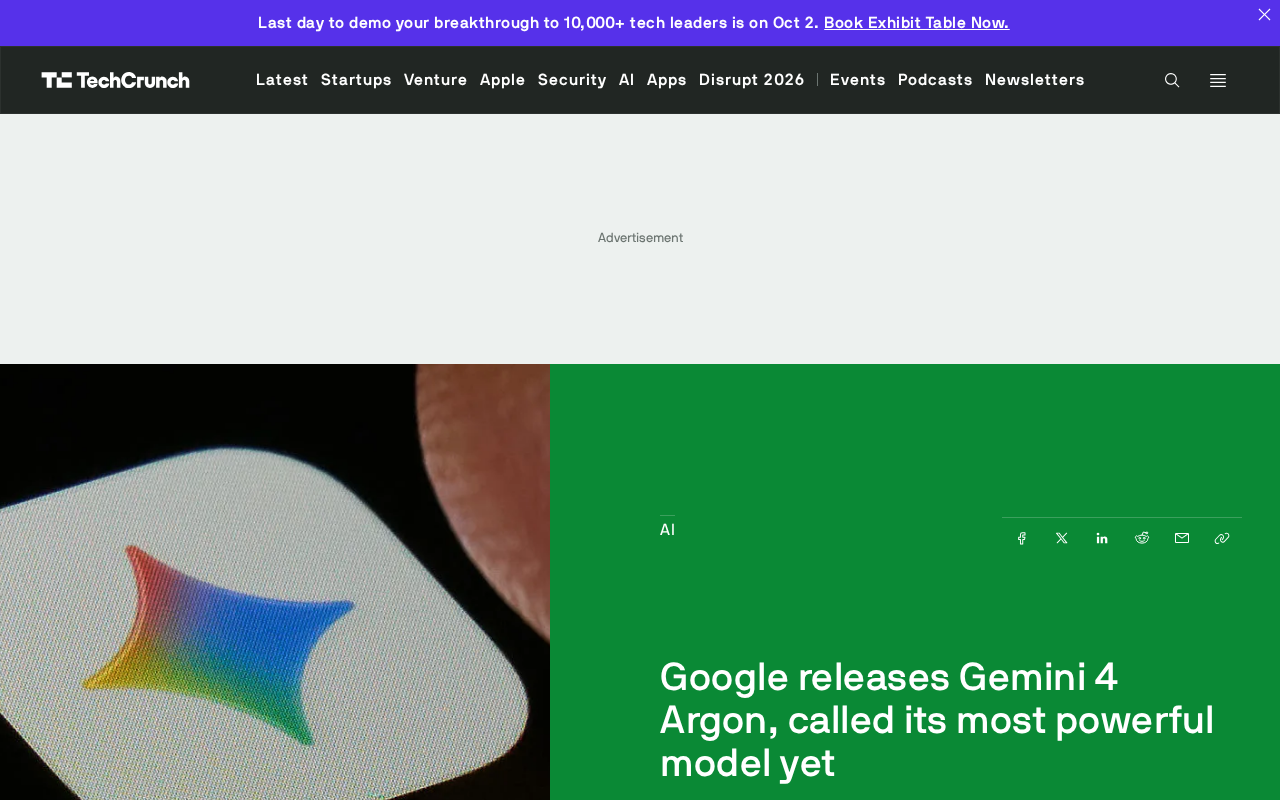
Google has officially introduced its latest model — Gemini 4 Argon — positioning it as a "workhorse" built specifically for coding and cybersecurity tasks. The company claims it is the most capable Gemini model released to date.
Positioning: A Productivity Tool for Developers
Based on Google's marketing language, Gemini 4 Argon is not a flagship showpiece chasing general conversational ability. Instead, it has been explicitly labeled a "workhorse" — a term that signals a strategic shift. The focus isn't on flashy demo scenarios, but on handling high-volume, real-world workloads reliably and efficiently.
Google has highlighted two primary use cases: coding and cybersecurity. Both domains demand rigorous reasoning, long-context processing, and precise handling of technical details — and they also happen to be among the most commercially valuable and competitive arenas for AI model deployment today.
Why Coding and Cybersecurity?
The choice to lead with coding and security has a clear business rationale. Coding assistance has become one of the most mature monetization paths for large language models, with products like GitHub Copilot, Cursor, and Claude Code demonstrating that developers are willing to pay for high-quality code generation and debugging capabilities.
Cybersecurity is a newer and potentially even larger battleground. AI applications in vulnerability detection, threat analysis, and malicious code identification are growing rapidly. By explicitly targeting security workflows, Google is signaling an intent to break into the enterprise security market — either complementing or competing with specialized security tooling.
What the Name "Argon" Signals
The codename "Argon" — element 18 on the periodic table, a noble gas — is worth noting. Google doesn't typically use periodic table naming in the Gemini lineup. This kind of specific codename usually indicates a model branch optimized for a particular vertical use case, rather than a broad generational upgrade.
From a technical standpoint, coding and cybersecurity pose remarkably similar core challenges for large models: long-context understanding (tracing causality across thousands of lines of code or log files), precise symbolic reasoning (variable names, function call chains, instruction set semantics), and an extremely low tolerance for hallucination — a wrong API call in generated code or a false-positive vulnerability in a security analysis carries far higher costs than an error in casual conversation. This explains why models that excel at general conversation don't always perform best in real coding assistance, and why purpose-built, task-specific model branches tend to be preferred by professional users.
In AI model naming conventions, using chemical element names as codenames is a common version management strategy, suggesting the release belongs to a specific "family" rather than a linear iteration. For example, Anthropic's Claude series uses Haiku, Sonnet, and Opus to differentiate capability tiers, while OpenAI's GPT-4 lineup uses suffixes like o1 and o3 to denote reasoning-optimized branches. Google's choice of "Argon" may foreshadow a broader "elements series" of vertically specialized models running parallel to the main Gemini line.
Industry Context and Competitive Landscape
The release of Gemini 4 Argon lands squarely in the middle of an intensifying AI arms race. Competitors like OpenAI and Anthropic are continuously iterating on developer-focused models. Google's decision to target coding and security — two high-value domains — is a direct response to where market demand is concentrating.
For developers and enterprise users, model selection is shifting from "which one is smartest?" to "which one fits my specific workflow?" A dedicated "workhorse" model focused on code quality and security analysis may offer more practical value than an all-purpose flagship.
SWE-bench is one of the most widely accepted benchmarks for evaluating coding ability — it requires models to generate code patches that pass unit tests based on real GitHub issue descriptions, a far more demanding task than simple code completion. In the security domain, CTF (Capture The Flag) performance and CVE vulnerability reproduction are common metrics for evaluating a model's security analysis capabilities. Results on these benchmarks will be the primary basis for assessing Gemini 4 Argon's real-world abilities and for comparing it against competitors like OpenAI's o3 and Anthropic's Claude Sonnet.
Key Questions to Watch
Official disclosures remain limited. The following points deserve follow-up:
- Concrete performance benchmarks: How does it actually perform on leading coding evaluations (e.g., SWE-bench) and security tasks?
- Pricing and availability: Is it accessible to individual developers, or primarily targeted at enterprise customers?
- Relationship to existing Gemini models: Is this an independent branch, or will it be integrated into the broader Gemini ecosystem?
Until more technical details and independent evaluations emerge, claims of "most powerful ever" remain to be validated through real-world use. But Google's clear commitment of resources to coding and security — two commercially high-value domains — sends an unambiguous signal about the product direction ahead.
Related articles

Felix Rieseberg Personal Homepage
Felix Rieseberg's personal homepage sparks attention on Hacker News. This article covers the Slack engineer's technical background, the rise and fall of nativefier, and the value of a developer homepage as a tech calling card.

@ai-sdk/vue 3.0.306 Patch Release Syncs with [email protected] Update
@ai-sdk/vue 3.0.306 released, synced with [email protected]. A routine patch release for the Vercel AI SDK ecosystem with no public API changes; the Vue adapter layer stays version-aligned with the core package.

Gemini 4 Argon API Launches: The Era of Million-Token Output Begins
Google launches Gemini 4 Argon with sparse MoE architecture, up to 1M output tokens, and a 68.90% Vals Index score, available across API, AI Studio, and the Gemini app.