Google Launches Gemini Agent: Cross-Platform Work Automation Across Workspace

Google launches Gemini agent, unifying Workspace and external enterprise software into a goal-oriented cross-platform AI work agent.
Google launched Gemini agent at the Gemini at Work conference, positioning it as a unified AI work entry point spanning Google Workspace and external enterprise software. Users simply provide a goal, and the agent can invoke context, connect tools, and coordinate sub-agents to complete tasks. Its integration scope covers Microsoft 365, Slack, Confluence, Jira, Salesforce, ServiceNow, Git, BigQuery, Snowflake, and other systems. Core capabilities include tool and skill registry, persistent memory, multi-agent orchestration, model routing, and identity, permission, and audit controls. The launch is gradual, with financial services and legal leading, and government, healthcare, and retail coming soon. No fixed per-feature pricing was announced, with emphasis on intelligent routing and real-time spend caps.
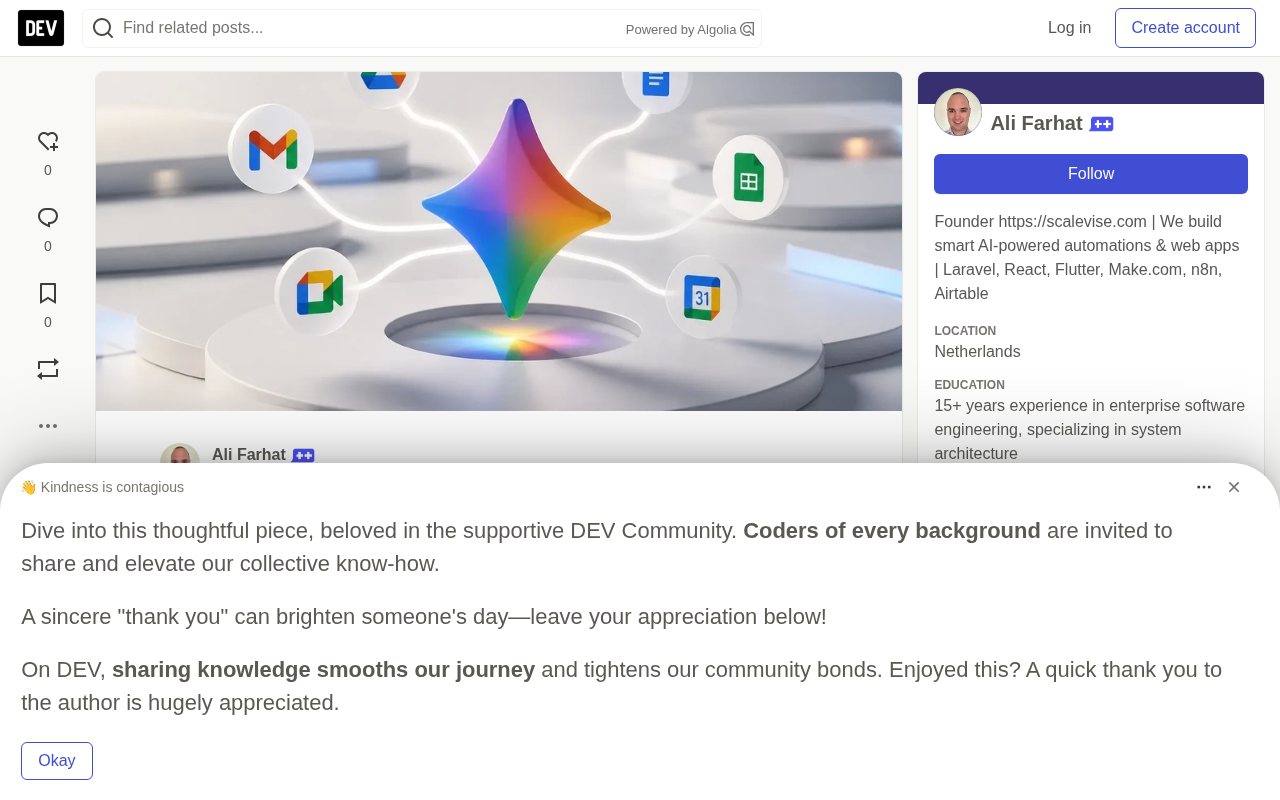
Google Cloud officially launched Gemini agent at the latest Gemini at Work conference, positioning it as a unified AI work entry point spanning Google Workspace and external enterprise software. Users no longer need to switch between multiple applications or break tasks into separate instructions — they simply provide a goal, and the agent can invoke context, connect tools, and coordinate sub-agents to complete the work. This marks Gemini's shift from scattered chat assistance features to a persistent work layer.
From Chat Assistant to Persistent Work Layer
Unlike previous AI features embedded in individual applications (such as Gmail's smart reply or Docs' writing suggestions), Gemini agent is designed as a cross-device universal interface covering Web, iOS, Android, Windows, and Mac. According to Google's official announcement, it can answer questions, perform knowledge work tasks, generate media content, and write or run code, while retaining context across sessions.
The core of this shift is goal orientation. In the past, users had to manually move information between emails, documents, and spreadsheets, then ask AI separately; now the agent can transform a single request into a multi-step workflow based on persistent memory. For organizations already using Workspace, this could significantly reduce the time information spends moving between tools. However, Google also emphasizes that the product uses a gradual rollout, and not all capabilities will be available to all customers on day one.
Coverage: Third-Party Systems and Cross-Platform Collaboration
Gemini agent's integration scope far exceeds Google's own ecosystem. According to official materials, it can run in Google Workspace applications (Gmail, Drive, Docs, Sheets, Slides, Chat, Calendar) while connecting to collaboration platforms like Microsoft 365 and Slack. At the business systems level, Google named tools including Confluence, Jira, Salesforce, ServiceNow, Git, BigQuery, and Snowflake.
| Work Area | Gemini Agent's Role | Google Examples |
|---|---|---|
| Google Workspace | Operate in everyday apps with a unified command interface | Gmail, Drive, Docs, Sheets, Slides, Chat, Calendar |
| Cross-platform collaboration | Extend agent access across devices and collaborative environments | Web, iOS, Android, Windows, Mac, Microsoft 365, Slack |
| Business systems and data | Connect existing software and data services through registered tools and skills | Confluence, Jira, Salesforce, ServiceNow, Git, BigQuery, Snowflake |
This cross-suite positioning is particularly important for teams using multiple productivity tools and communication channels simultaneously. It means the agent's value doesn't depend on whether users are fully locked into the Google ecosystem, but on whether it can gain meaningful, authorized access within the systems where users actually work.
Tool and Skill Registry is the infrastructure for the agent's interaction with external systems. In the context of AI agents, "tools" typically refer to specific APIs or functions the agent can call, such as sending emails, querying databases, or creating Jira tickets; "skills" are higher-level encapsulations that may combine multiple tool calls, such as "prepare a project status report." The registry's purpose is to enable the agent to discover, understand, and safely invoke these capabilities without writing hardcoded logic for each integration. For enterprises, the registry's design directly determines the agent's scalability and governance difficulty: a good registry should support permission binding, version management, call auditing, and rate limiting. Google's emphasis on the tool and skill registry in Gemini agent indicates its goal is to make the agent a pluggable platform rather than a closed single application. However, the announcement does not disclose the registry's specific technical standards or whether it supports custom skills from third-party developers — a key point for enterprises evaluating its long-term flexibility.
Key Capabilities: Tool Registry, Persistent Memory, and Multi-Agent Orchestration
Google described several capabilities that define Gemini agent's product direction:
- Tool and Skill Registry: Provides connection points for existing software rather than requiring all work to stay within a single application.
- Persistent Context and Memory: Allows the agent to carry relevant information across sessions rather than treating each prompt as an independent interaction.
- Sub-agents and Colleague Agents: Supports multi-agent task coordination and team collaboration.
- Model Routing: Can select appropriate models within the Gemini family, and according to Google, can also connect to other models like Anthropic's Claude, with plans for further expansion.
- Knowledge Catalog Grounding: Supports data work, including generating SQL, Python, Spark code, and dashboard-related work.
Google also described controls for identity, permissions, auditing, sandboxing, and policy management. When an agent needs access to company knowledge or operational tools, these features are fundamental prerequisites, not just nice-to-haves.
What It Means for Workspace Users
The most direct change is AI assistance shifting from "passive Q&A" to "proactive execution." For example, a manager can ask to investigate a business issue, and the agent will gather information from files, conversations, and data systems rather than a human collecting inputs tool by tool and then asking separately. The announcement does not specify which particular workflows will be available to every customer at launch, but Workspace integration is clearly central to the Gemini agent strategy.
The real value for teams depends on whether the agent can obtain useful, permitted access within the systems where real work happens. Connecting only document storage may be sufficient for retrieval and drafting; connecting collaboration tools, customer systems, issue tracking, and approved data sources could support more complete workflows, such as preparing status updates based on project information or providing context for customer service responses.
Multi-Agent Orchestration and Model Selection
Google's approach goes beyond a single model responding to a single request. Gemini agent is designed to orchestrate sub-agents, allowing different components to handle parts of larger tasks. Google also states the orchestration layer is model-agnostic, capable of routing work to the most appropriate model within Gemini and other supported models.
For enterprises evaluating AI by outcomes rather than model brands, this distinction may matter. A workflow might involve research, document creation, coding, and data analysis, each with different requirements. However, the announcement does not publicly specify which models, routing options, or integrations will be available at each release stage. Therefore, buyers should evaluate based on the specific systems and tasks they need to support rather than assuming every named capability will be immediately available in all environments.
Multi-Agent Orchestration is a key trend in current AI agent architecture. Traditional large language model (LLM) applications typically follow a "single model—single request" pattern, where the user asks a question and the model gives one answer. Multi-agent orchestration instead has a "main agent" act as coordinator, dispatching work to specialized "sub-agents" based on different task stages. For example, a research task might first have a search agent collect material, then a writing agent draft the document, and finally a data agent generate charts. Each sub-agent can have independent tool permissions, context, and model selection, improving the quality and efficiency of complex task completion. The challenges of this architecture include communication protocols between agents, accuracy of task decomposition, control of error propagation, and optimization of overall latency and cost. Google's description of Gemini agent as supporting sub-agents and colleague agents means it attempts to solve these problems at the orchestration layer rather than relying solely on a single model's reasoning capability.
Model Routing refers to the system dynamically selecting the most appropriate underlying model to execute a request based on task type, complexity, cost, or latency requirements, rather than calling the same model for all tasks. For example, simple text summarization might route to a lightweight model to save cost, while complex code generation or data analysis routes to a stronger large model. Google states Gemini agent's orchestration layer is "model-agnostic" and plans to support third-party models like Anthropic's Claude. This means two things for enterprises: first, it avoids lock-in to a single model vendor; second, it allows flexible resource allocation based on budget and performance needs. But model routing also brings new management issues, such as behavioral consistency across models, output format differences, and cross-model security and compliance policies. Enterprises should evaluate whether routing rules are transparent, configurable, and whether they support setting model preferences by workflow.
Availability, Pricing, and Implementation Advice
Google describes this launch as gradual, with expanded availability to follow. It also lists financial services and legal as industry specialization directions, with government, healthcare, and retail announced as "coming soon." These specialization directions indicate Google expects the agent to be adapted to specific work scenarios, but enterprises should confirm product availability and scope for their industry and region.
On pricing, the announcement materials focus on cost management mechanisms rather than fixed public prices for individual Gemini agent features. Google emphasizes intelligent routing and real-time spend caps as ways to manage AI costs. This gives organizations tools to control consumption, but it is not equivalent to a publicly available all-inclusive price for specific workflows or deployments.
Before connecting the agent to business tools, teams should establish a pragmatic starting point:
- Choose a workflow with a clear goal, such as preparing periodic internal summaries, finding approved information, or assisting with routine data questions.
- Determine the authoritative systems required for that workflow, then decide which tools and data should be available to the agent.
- Confirm the permission, audit, and sandbox expectations for those connections.
- Measure workflow quality, time savings, and spending before expanding to more systems or higher-impact tasks.
This is particularly relevant for companies that have adopted Google Workspace but still rely on a combination of CRM, project management, support, data, and collaboration tools. Gemini agent's potential lies in connecting work across this combination; its practical usefulness will depend on release availability, integration quality, and careful choices about access permissions and workflow design.
Real-time Spend Caps and Intelligent Routing are two cost management mechanisms Google emphasizes in Gemini agent's pricing description. Traditional SaaS pricing typically charges by seat or feature on a monthly basis, but AI agent cost structures are closer to "usage-based billing" because each model call, data access, or code execution may incur costs. Real-time spend caps allow administrators to set budget thresholds for specific agents, teams, or workflows, triggering limits or alerts once approached or exceeded to prevent unexpectedly high bills. Intelligent routing optimizes spending by distributing requests to lower-cost models or caching results. Both mechanisms are important for enterprise finance and IT governance, but they are not equivalent to a transparent pricing table. Before procurement, enterprises should ask Google to provide specific billing dimensions (such as per token, per tool call, per agent runtime), budget control granularity, and behavior after exceeding limits. Otherwise, cost management mechanisms may only provide after-the-fact control rather than predictable upfront budget planning.
Frequently Asked Questions
What is Gemini agent?
Google describes Gemini agent as a general-purpose work AI agent that can answer questions, perform knowledge work tasks, generate media content, and write or run code through a unified command interface.
Which applications does Gemini agent work with?
Google lists Workspace applications including Gmail, Drive, Docs, Sheets, Slides, Chat, and Calendar, and also describes integrations with Microsoft 365, Slack, and business tools such as Confluence, Jira, Salesforce, ServiceNow, Git, BigQuery, and Snowflake.
Is Gemini agent widely available now?
Google states the launch is gradual, with expanded availability to follow. Enterprises should confirm availability for their region, industry, and required integrations.
How is Gemini agent priced?
The announcement materials do not list fixed per-feature pricing. Google emphasizes intelligent routing and real-time spend caps as mechanisms for managing AI costs.
Conclusion
Gemini agent is a significant expansion of Google's workplace AI strategy, integrating Workspace access, persistent context, connected tools, and multi-agent orchestration into a single product direction. The announcement is ambitious, but for specific enterprises, value depends on the availability of relevant integrations, disciplined permission management, and a workflow suited to agent assistance.
One-line Summary
Google launches Gemini agent, unifying Workspace and external enterprise software into a goal-oriented cross-platform AI work agent.
Paragraph Summary
Google launched Gemini agent at the Gemini at Work conference, positioning it as a unified AI work entry point spanning Google Workspace and external enterprise software. Users simply provide a goal, and the agent can invoke context, connect tools, and coordinate sub-agents to complete tasks, transforming from scattered chat assistance into a persistent work layer. Its integration scope covers Microsoft 365, Slack, Confluence, Jira, Salesforce, ServiceNow, Git, BigQuery, Snowflake, and other systems. Core capabilities include tool and skill registry, persistent memory, multi-agent orchestration, model routing, and identity, permission, and audit controls. The launch is gradual, with financial services and legal leading, and government, healthcare, and retail coming soon. No fixed per-feature pricing was announced, with emphasis on intelligent routing and real-time spend caps. Enterprises should first select a workflow with a clear goal, confirm authoritative systems, permission and audit requirements, and measure quality, time, and spending before expanding.
Related articles

JobRunner MCP Server: AI Agents Can Now Fix Failed Java Jobs
JobRunner launches an open-source MCP server enabling AI agents to view cluster status, diagnose failures, and recover Java jobs—incident response from any cloud coding environment or existing agent.

MLAI Digital Launches 9 Security Agents: MCP Server Safeguards the Full Lifecycle of Agentic AI
MLAI Digital launches Security MCP Server with nine built-in specialized security agents covering vulnerability discovery, attack simulation, prompt injection detection, API and infrastructure assessment, and accelerated remediation—embedding security validation across the full Agentic AI lifecycle from development to production.

Running Isaac Lab on H100 GPUs: Exploring Better Approaches
Exploring optimization methods for running Isaac Lab on NVIDIA H100 GPUs, including MIG configuration, mixed precision, TensorRT acceleration, and community experience to improve robotics simulation and reinforcement learning efficiency.