Google Mandates Foldable Screen Support for Android Apps, Making It Mandatory by 2027

Google mandates Android apps to support foldables starting 2027, making foldable adaptation mandatory.
Google announced that starting April 2027, Android developers must provide baseline support for foldable devices or be unable to publish or update apps. The direct catalyst is Apple's upcoming first foldable device, and Google wants to ensure the Android camp's app experience does not fall behind. Baseline support likely covers layout continuity when switching between folded and unfolded states, multi-window usability, and responsive adaptation to screen ratios. The policy will increase compliance costs for small and medium-sized developers but help reduce long-standing fragmentation in the Android ecosystem. The article argues that this marks foldables' transition from experimental products to ecosystem maturity, with platform rules beginning to define baseline experience, and the foldable "app drought" era entering its countdown.
The Turning Point for the Foldable Ecosystem: From "Optional" to "Mandatory"
Foldable phones are no longer just a gadget for geeks. With Apple's first foldable device on the horizon, industry-wide expectations for the foldable experience have been raised. Google recently announced that starting in April 2027, Android developers must ensure their apps provide "baseline" support for foldable devices, or they will be unable to publish or update their apps. This policy marks the official transition of foldable adaptation from a "bonus" for manufacturers to a "must-answer" question for developers.
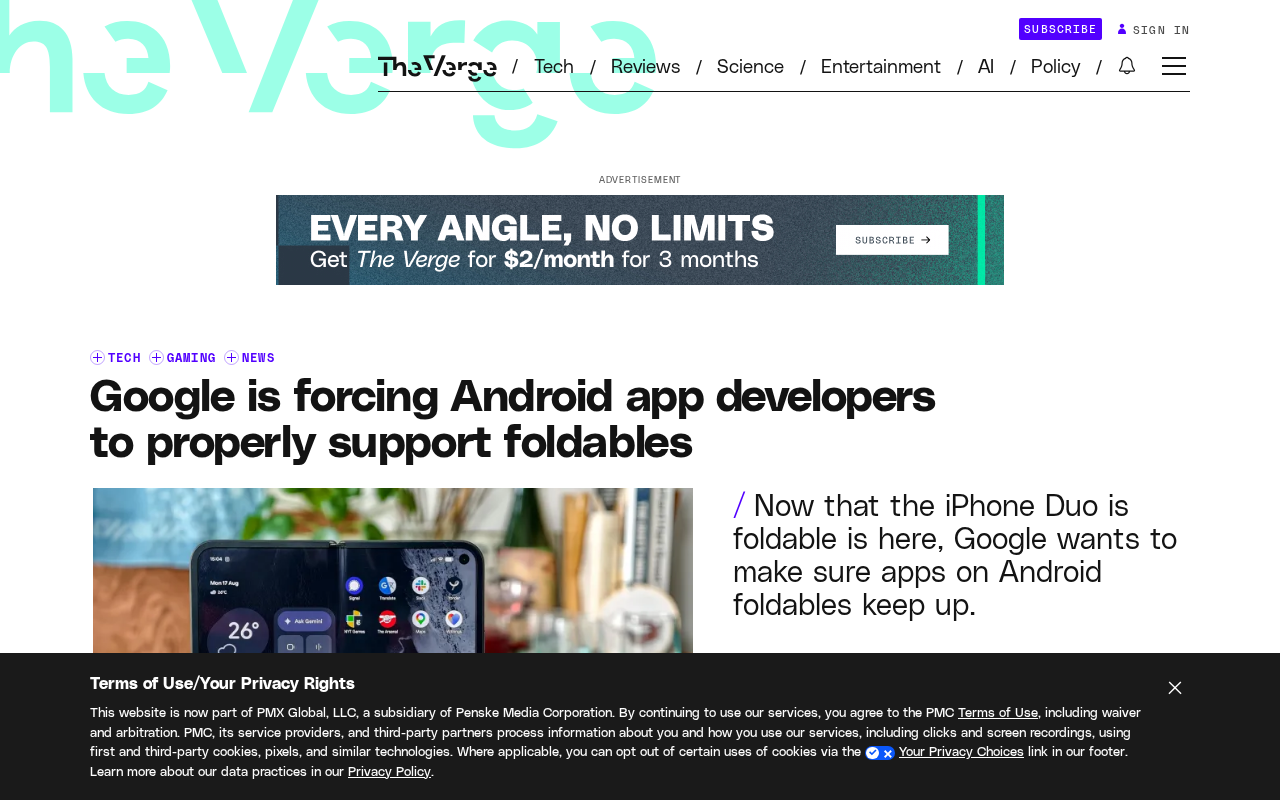
According to the original report, the direct motivation for Google's move is that "Apple's foldable has arrived," and Google wants to ensure that the app experience on Android foldables does not fall behind. The logic is clear: when major platforms start taking foldable form factors seriously, a fragmented app ecosystem will become the trigger for user churn.
Policy Details: What Does Baseline Support Mean?
Google has not yet published a specific technical checklist for "baseline support," but based on past practices in the Android ecosystem, it likely covers layout continuity when switching between folded and unfolded states, usability in multi-window mode, and responsive adaptation to different screen ratios and sizes. For developers, this means they can no longer rely on simply stretching a phone interface to placate foldable users.
One detail worth noting: the policy sets a clear deadline—April 2027. The window for developers is not generous, especially for large apps that have long maintained multiple versions and carry heavy technical debt. Adapting to foldables requires re-examining responsive layout strategies from the design stage.
Responsive layout is the core concept for understanding foldable adaptation. It refers to the ability of an app's interface to automatically adjust its layout structure based on available screen space, device orientation, window size, and other conditions, rather than simply scaling. In the traditional phone era, developers typically designed interfaces for fixed sizes; but in a landscape where foldables, tablets, and multi-window modes coexist, the same app needs to remain usable in large unfolded states (close to tablet size), folded states (regular phone size), and split-screen half-window modes. Android provides tools like WindowSizeClass and ConstraintLayout to help developers implement responsive layouts, but real implementation requires redesigning at the UI architecture level, not just patching. This is why Google emphasizes "baseline" support—it demands structural adaptability, not superficial stretching.
Why Did Google Choose This Moment to Act?
The foldable market has moved past the early adopter phase. Manufacturers such as Samsung, Huawei, Honor, and OPPO continue to iterate on products, hinge craftsmanship and screen crease issues are gradually improving, and prices are coming down. But lagging app experiences have always been the core pain point criticized in foldables—many apps simply enlarge when unfolded on a large screen, layouts become chaotic in multitasking split-screen, and black bars or truncated content even appear.
Apple's entry is a key catalyst. Apple has always been strict about controlling its app ecosystem, and once its foldable device is released, third-party apps will likely be required to provide full foldable adaptation. Google clearly does not want the Android camp to fall behind in experience comparisons. By forcing developers to follow through with a mandatory policy, Google is using platform rules to compensate for the shortcomings of market self-regulation.
App ecosystem fragmentation is a systemic issue that the Android platform has long faced. Because Android device form factors, screen sizes, and system versions are highly diverse, developers often optimize only for the most mainstream configurations, leading to uneven experiences on niche form factors such as tablets and foldables. Compared with iOS, Android lacks a unified mandatory adaptation mechanism, and the platform side has historically relied more on spontaneous follow-through by manufacturers and developers. Google's baseline requirement for foldables essentially borrows from Apple's strong ecosystem control approach, using publishing review authority as leverage to force developers to complete adaptation before the deadline. This is not the first time in Android's history—tablet adaptation, notch compatibility, and dark mode support were all promoted through similar means—but foldables involve a fundamental change in interaction form, making the significance of enforcement greater.
Practical Impact on Developers
For independent developers and small to medium-sized teams, this policy increases compliance costs. They need to test app performance across multiple foldable form factors, adjust layout code, and ensure they pass Google's review before the deadline. For large app teams, foldable adaptation may be just part of their responsive design system, but clearer review standards mean they can no longer delay.
From a positive perspective, unified baseline requirements help reduce the fragmentation problem that has long plagued the Android ecosystem. When all apps must handle folded-state transitions, the psychological barrier for users to migrate to foldable devices will be lowered, which in turn feeds back into hardware sales and creates a positive cycle.
Compliance costs here refer not only to technical modification costs but also to testing and review costs. Foldable devices come in many form factors—inward folding, outward folding, vertical folding, horizontal folding—and different manufacturers have different hinge designs and screen ratios. Developers need to cover multiple device combinations for testing. For small and medium-sized teams, purchasing multiple foldable devices and setting up a test environment is itself a considerable expense. In addition, the specific details of Google's review standards have not yet been published, and developers may face uncertainty in the early stages of policy implementation, requiring buffer time to respond to review feedback. Although large app teams have more resources, their codebases are complex and carry many legacy issues, so the engineering effort to overhaul responsive layouts should not be underestimated.
Industry Signal: Foldables Enter the "Ecosystem Maturity Period"
Google's mandatory policy sends a clear signal: foldables are no longer experimental products but full members of the Android ecosystem. The platform side is beginning to use rules to ensure a baseline experience, which is usually a sign that a category is maturing. Looking back at Android's history, similar mandatory adaptation requirements have appeared at nodes such as tablets, notched screens, and dark mode, and each time they drove an overall upgrade of the app ecosystem.
For users, this means that within the next two years, the app experience on Android foldable phones will improve perceptibly. For developers, April 2027 is no longer a distant point in time but a hard milestone that must be incorporated into product roadmaps. The era of the foldable "app drought" is entering its countdown.
Related articles

Abnormal Error Rate Spike in Claude Mythos 5.2 and Fable 5.2
Claude Mythos 5.2 and Claude Fable 5.2 show an abnormal spike in request error rates, marked as investigating on the official status page. This article covers the incident overview, practical impact on developers, and recommended responses.

ReAct Runtime Context Trimming: Why Claude Code Acts at 70%
A deep dive into ReAct runtime context trimming: why Claude Code compresses at ~70% usage, why tool calls dominate, why messages must be dropped in pairs, and why codebases don't need RAG.

AI Agent vs LLM: How Cursor and Claude Code Actually Work
An in-depth analysis of the essential difference between AI Agents and LLMs: LLMs generate code suggestions, while Agents modify files and run tests via tool calls. Using a Spring Boot bug fix as an example, it breaks down the workflows, permission control, and verification mechanisms of Cursor and Claude Code.