Google Maps the Fruit Fly's Entire Brain: Does a Simulated Living Thing Really Exist?

Google maps the fruit fly's entire brain, sparking debate on whether simulated life truly exists and where ethical lines should be drawn.
Google has completed a full connectome map of the roughly 140,000 neurons in a fruit fly brain and used it to build dynamic behavioral simulations. A viral YouTube short presents the achievement with humor while raising serious philosophical questions: does a sufficiently complete simulation constitute real existence? If neural activity underlies experience, could a precise simulation also carry subjective feelings? The video extends the reasoning to mammals and humans, closing with "are we torturing this fruit fly?" — binding technological progress directly to moral responsibility. These questions remain unanswered, yet grow more urgent as connectome research and neural simulation accelerate.
A Fruit Fly Completely "Replicated"
A short video making waves on YouTube poses a question that sounds absurd on the surface, yet cuts straight to the heart of the intersection between AI and neuroscience: when scientists precisely map every single neuron in a fruit fly's brain and use that map to build a simulation capable of predicting its behavior, does that simulated "fruit fly" actually exist?
In the video, this digitized fruit fly is given a series of wildly exaggerated scenarios — playing blackjack, smoking hookah, cutting a kebab, driving a car, solving a Rubik's cube, and even playing Super Smash Bros. Melee. The scenarios are clearly tongue-in-cheek, but the underlying technology is very real: Google has indeed completed a full mapping of the fruit fly brain's connectome.
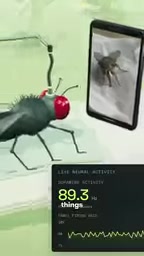
A connectome is a complete "wiring diagram" of all the neurons and their connections in a biological nervous system. The fruit fly is the neuroscience community's go-to subject for achieving a full-brain map, thanks to its small brain volume and relatively manageable neuron count (roughly 140,000). Once researchers have this complete wiring diagram, they can theoretically reconstruct the neural circuitry inside a computer and simulate how it responds to external stimuli.
Google's achievement was carried out by its research teams in collaboration with academic institutions and was officially published in 2024. The technical process for fully mapping the fruit fly brain is extraordinarily complex: researchers first sliced the brain into thousands of nanometer-thin sections, photographed each slice with an electron microscope, and then used machine learning algorithms to automatically stitch together the enormous volume of images while identifying and annotating neurons and their synaptic connections. The resulting dataset is massive — the raw image data alone reached petabyte (PB) scale. This is the most detailed connectome map ever produced at the scale of a complete animal brain, and it lays the data foundation for future whole-brain computational simulation.
From "Wiring Diagram" to "Behavioral Simulation"
Mapping the neurons is only the first step. The truly fascinating part is what comes next — using this map to simulate the fruit fly's behavior. As the video notes, "Now we can create realistic simulations of what it will do." This means the simulation system is no longer a static display of neural connections, but an attempt to reconstruct a dynamically operating "digital brain" that generates responses approximating real behavior in a virtual environment.

The scientific value of this kind of work lies in the following: if a simulation model can accurately predict how a real fruit fly behaves in response to specific stimuli, researchers can run experiments repeatedly inside a computer without depending on large numbers of live specimens. It provides a controllable, reproducible experimental platform for understanding how the brain converts neural signals into concrete behavior.

Of course, the "smoking hookah" and "cutting kebabs" imagery in the video is artistic exaggeration. Real simulations are more likely to focus on fundamental behaviors like motor control, sensory response, and foraging decisions. But this exaggeration amplifies the intuitive impact on the public: when a simulation is sufficiently realistic, it becomes hard to dismiss it with a simple "it's just a program."
How Realistic Does Something Need to Be to Count as "Real"?
The sharpest part of the video isn't the technology — it's the philosophy. It follows the technical logic to its conclusion: if we can fully simulate a fruit fly, could we use the same approach to gradually work our way up to cats, dogs, monkeys, and ultimately humans? If these simulations are made complete and realistic enough, would they count as "real" entities?

This touches on the fundamental problem of consciousness and experience. Does a model that perfectly replicates all of a fruit fly's neural activity also replicate the fruit fly's "feelings"? If neural activity is the physical basis of experience, then a sufficiently precise simulation should theoretically carry that experience as well. But if experience also depends on some physical substrate we don't yet understand, then no matter how realistic a simulation becomes, it may be nothing more than hollow computation.
The scientific community has reached no consensus on this, which is precisely why the video's questions feel so pointed — there are no answers, yet it forces every viewer to consider their own position.
These questions speak directly to the philosophical "Hard Problem of Consciousness," articulated by philosopher David Chalmers in the 1990s. He drew a distinction between the "easy problems" of consciousness — explaining how the brain processes information, integrates perception, and controls behavior — and the "hard problem": why these physical processes are accompanied by subjective qualia, that is, "what it is like" to feel something. Even if we fully replicate every neural firing pattern in a fruit fly, the hard problem remains unresolved: does the simulation system possess any inner subjective experience, or is it merely mimicking outward behavior with nothing "inside"? This philosophical chasm currently has no scientific method to bridge it, and it represents the deepest crack between simulation and "real existence."
"Are We Torturing This Fruit Fly?"
The video ends with an unsettling question: if these simulations are real, are we torturing the fruit fly?
This question directly binds technological progress to ethical responsibility. Traditionally, we bear no moral obligations toward computer programs, because programs have no subjective experience. But once a simulation system is thought to potentially possess some form of sentience, running it, pausing it, and repeatedly applying "painful" stimuli in experiments could constitute genuine moral harm.
For a simple organism like a fruit fly, most people can probably maintain a rational distance. But the video deliberately extends the reasoning to humans, precisely to shatter that comfort: as the subject of simulation advances from insects to mammals to humans, at what point should our ethical stance toward "digital life" begin to shift?
In the context of rapidly advancing AI, this kind of discussion is far from alarmist. As brain connectome research, neuromorphic computing, and large-scale neural simulation continue to progress, society will eventually need to draw a line around "what kinds of computational systems deserve moral consideration." This short video uses a fruit fly playing video games as a hook to bring this grand question down to a scale ordinary viewers can relate to.
Around the moral status of digital life, several cutting-edge frameworks have emerged in academic discourse. The functionalist position holds that if a system is functionally equivalent to a sentient being — that is, if its input-output behavior is the same — it should receive corresponding moral consideration, regardless of its physical substrate. In direct opposition stands biological naturalism, championed by philosopher John Searle, who argues that consciousness depends on specific biochemical foundations; pure computational simulation cannot produce genuine experience, and therefore lacks moral standing. On a more pragmatic level, some neuroethicists propose using "pain possibility" as a precautionary principle: once a simulation reaches a certain threshold of fidelity, even if sentience cannot be confirmed, experimental designs should proactively avoid operations that might induce negative states. These discussions currently remain within academic circles, but as simulation fidelity improves, they will inevitably enter the realm of regulation and policy.
Conclusion
Google's completion of the fruit fly whole-brain connectome is a solid achievement in neuroscience. Building behavioral simulations from that map, however, opens a door into philosophy and ethics. The video wraps a serious question in exaggerated humor: when a simulation is complete enough, the boundary between real and virtual becomes blurry — and the responsibility we bear toward "digital life" becomes an issue impossible to avoid.
(Note: This article is based on the content of a YouTube short. The scenes depicting the fruit fly playing games, smoking hookah, and so on are artistic interpretations, not actual simulation outputs.)
Related articles

Chain of Thought Isn't Just for AI: How Humans Can Use CoT to Improve Thinking Quality
Chain of Thought isn't just a prompt trick for large models. Starting from a Hacker News discussion, this article analyzes why CoT works for human thinking too, breaks down actionable ways to transfer it, and highlights the key differences between human CoT and machine CoT.
Cloudflare Teams Up with OpenAI: Closi…
Cloudflare Teams Up with OpenAI: Closing the Loop from Vulnerability Discovery to Defense with AI
Cloudflare uses OpenAI Daybreak to investigate security vulnerabilities and generate reviewable remediation plans, while developers use Codex to boost coding efficiency and quality.

Orca Multi-Agent Orchestration in Practice: A Guide to Parallel Collaboration with Claude and Codex
Orca is Stable AI's free open-source agent workbench supporting 34 agents like Claude Code and Codex in parallel. Learn its Git worktree isolation, multi-model orchestration, and mobile management.