Google May Remove Gemini Model Selector: Intelligent Routing to Replace Manual Switching
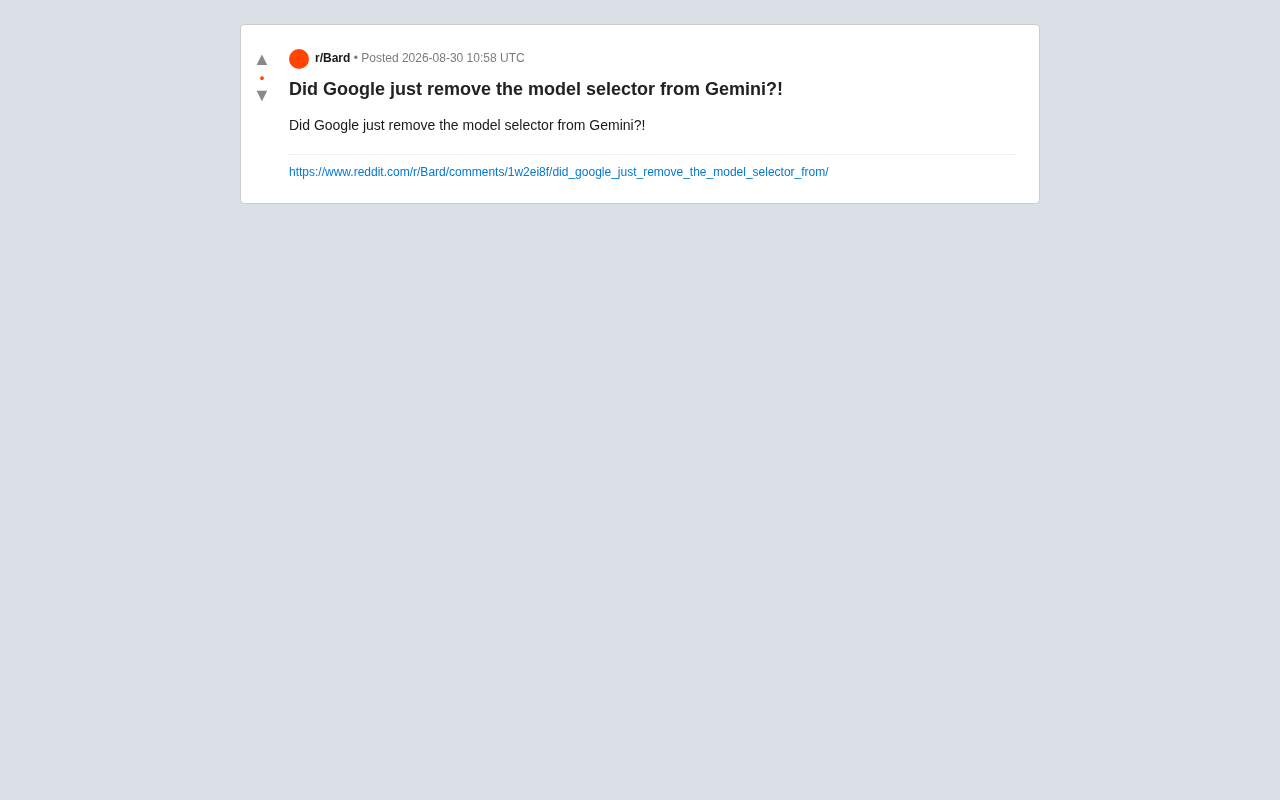
Google may replace Gemini's manual model selector with intelligent routing, sparking debate over user control.
Reports from Reddit suggest Google is removing Gemini's model selector, shifting from manual model switching to automatic intelligent routing. This reflects a broader industry trend toward de-technicalization in AI products. While the change could simplify the experience for mainstream users and optimize Google's compute costs, power users worry about losing control and transparency over which model handles their requests.
The Trigger: Gemini's Model Selector Quietly Disappears?
Recently, a brief yet hotly debated post climbed the discussion charts on Reddit — a user discovered that the "Model Selector," previously used to manually switch between different model versions in the Google Gemini interface, appeared to have been removed. While this change might seem like a minor UI tweak on the surface, for users who have long relied on Gemini for work, research, and creative tasks, it touches on a fundamental question: Can users still choose which model they want to use?
Previously, Gemini gave users the ability to switch between different model versions — for example, choosing between a lightweight model optimized for speed and a high-performance model designed for deep reasoning (such as Gemini Pro, Gemini Flash, etc.). Gemini is the multimodal large language model family officially launched by Google DeepMind in late 2023, positioned as Google's flagship competitor to OpenAI's GPT-4. Based on parameter scale and capabilities, Gemini is divided into multiple tiers: Ultra is the most powerful flagship version, designed for highly complex tasks; Pro is the general-purpose version for a wide range of tasks; Flash is specifically optimized for low-latency, high-throughput scenarios, offering faster response times at the cost of some reasoning depth; and Nano is a compact version designed for on-device use on smartphones and similar edge devices. This multi-tier product matrix gave users fine-grained control over cost, response speed, and output quality. If the selector is removed, it means model scheduling authority would be entirely handed over to Google's backend systems to decide automatically.
The Logic Behind It: From "Manual" to "Automatic"
Intelligent Routing Is Becoming an Industry Trend
Removing the model selector is not an isolated incident — it reflects a paradigm shift underway across the entire AI industry. An increasing number of AI providers are adopting "Intelligent Routing" mechanisms, where the system automatically assigns the most suitable model to handle a request based on the complexity of user input, task type, and real-time load.
From a technical perspective, intelligent routing is typically implemented through a lightweight classifier or rules engine: after receiving user input, the system quickly evaluates the request across dimensions such as complexity, domain, and expected output length, then forwards the request to the best-matching model. OpenAI's ChatGPT adopted a similar strategy after launching GPT-4o, with the system automatically switching between GPT-4o and GPT-4o-mini based on conversation content; Anthropic's Claude likewise offers routing recommendation capabilities at the API level. The technical foundations of this mechanism encompass intent recognition, complexity scoring, and real-time load-balancing algorithms, all aimed at continuously finding the optimal balance between response quality and computational cost.
The core philosophy behind this approach is: Let users focus on the problem itself, rather than agonizing over which model to choose. For average users, they often don't understand the specific differences between Gemini Flash and Gemini Pro, nor can they easily determine which version should be invoked for a particular task. Delegating this decision to algorithms can theoretically maintain experience quality while optimizing resource utilization.
Google's Business Considerations
From Google's perspective, unifying the entry point and hiding model details serves deeper business logic:
- More flexible compute scheduling: Automatic routing helps Google divert simple requests to lightweight models during peak periods, thereby reducing overall operational costs. Given that the GPU/TPU resources required for large model inference are extremely expensive — industry estimates suggest that a single GPT-4-level complex inference can cost tens of times more than a lightweight model — this kind of fine-grained scheduling is critical for controlling operational expenditure.
- Lowering the barrier to entry: A simplified interface helps reduce decision fatigue for new users, expanding the user base. In Google's strategic push to integrate Gemini into Search, Gmail, Google Docs, and other products, it faces billions of ordinary users — too many technical options would only cause confusion.
- Greater freedom for backend iteration: Hiding specific model versions gives Google greater flexibility when iterating and replacing models — users won't develop negative feelings because "a familiar model disappeared," and Google can continuously optimize the underlying models without users even noticing. This aligns with the "Serverless" philosophy in cloud computing: users only care about results, and the platform absorbs the complexity of the infrastructure.
Community Divide: The Battle Over Control
The Reddit community is clearly split into two camps over this change.
The Opposition: Losing Control Means Losing Trust
Critical users argue that removing the selector essentially strips users of their right to know and their right to control. Power users often have specific needs: when debugging code or performing complex reasoning, they want to force-use the most capable model; when handling simple everyday queries, they prefer the fast, low-latency version.
For these users, automatic routing introduces uncertainty — they can't confirm which model generated their answer, making it difficult to assess the reliability of the output quality. In professional and production environments, this kind of "black box" scheduling may be unacceptable. Especially in scenarios demanding high accuracy, such as code generation, academic research, and medical consultation, the capability differences between models can directly affect the credibility of the output. Some developers also pointed out that this creates challenges for third-party developers building applications on top of Gemini — when the underlying model version is unpredictable, application behavioral consistency and reproducibility are both compromised.
The Supporters: Simplifying the Experience Is the Right Direction
On the other hand, some users welcome this change. They argue that for the vast majority of non-technical users, the model selector itself is a form of "cognitive overhead." Letting AI automatically determine and select the appropriate model delivers a smoother, more worry-free user experience.
This perspective holds that truly excellent product design should "hide complexity" rather than shifting the burden of technical choices onto users. This principle has been repeatedly validated throughout tech product history — from smartphones automatically adjusting screen brightness, to cameras with autofocus and auto-exposure, to the widespread adoption of automatic transmissions in cars. Every instance of "automation" initially drew complaints from power users but ultimately became the mainstream choice by dramatically lowering the barrier to entry.
The Bigger Picture: The "De-Technicalization" of AI Products
Regardless of whether Google's adjustment is a permanent strategy or a temporary test, it reflects an industry trend worth paying attention to: AI products are undergoing a "de-technicalization" evolution.
In the early stages of AI development, exposing technical details like model parameters and version selection to users was the norm, because early adopters were predominantly tech enthusiasts and developers. But as AI moves toward the mass market, the focus of product design is shifting from "giving experts more control" to "giving the public less to worry about." This evolution already has numerous precedents in the industry: early AI art tools like Stable Diffusion required users to manually configure professional parameters such as sampler type, CFG Scale, and denoising steps, while the later Midjourney dramatically simplified these parameters so users only need to type a text description to generate high-quality images; OpenAI's journey from the developer-facing Playground to the mass-market ChatGPT also involved gradually hiding sampling parameters like temperature and top-p. Each round of simplification was accompanied by exponential growth in the user base.
While this shift improves the experience for ordinary users, it also raises a deeper contradiction: As AI systems become increasingly intelligent and automated, users' understanding and control over system behavior is actually diminishing. This is not just a problem Gemini faces — it's a challenge the entire AI industry needs to balance: how to find the right equilibrium between "simple and easy to use" and "transparent and controllable." One possible compromise is "layered design": providing a simplified automatic mode by default while retaining manual selection options in advanced settings, allowing users at different levels to get what they need. In fact, many mature tech products — from professional cameras with auto/manual mode switching to operating systems with standard/advanced settings — have adopted this very strategy.
Conclusion: A Small Change, A Big Signal
As of now, Google has not issued an official statement regarding the removal of the model selector, and it's possible this is a canary release or interface adjustment. It's worth noting that canary releases (also known as gradual rollouts) are a long-standing practice at Google — its search engine and various products conduct thousands of A/B testing experiments daily, pushing new features or interface changes to a small subset of users first and observing behavioral data and feedback to decide whether to roll out broadly. Therefore, the inconsistency where some users see the model selector disappear while others still have access is itself a hallmark of canary testing.
But regardless of the final outcome, this discussion sparked by the Reddit community has already touched on a core issue in AI product design.
For users, it's perhaps worth reflecting on: how much control do we actually need? And for Google and other AI providers, how to preserve necessary transparency and user choice while pursuing product simplicity will be an unavoidable challenge in future product iterations.
Note: This article is based on analysis of user discussions from the Reddit community. The changes mentioned have not been officially confirmed by Google. Please refer to Google's subsequent statements for the definitive situation.
Related articles

Python 3.15 New Feature: Is the sentinel Type Better Than None?
Python 3.15 adds the sentinel type, using named unique sentinel objects to replace None and bare object(), resolving confusion among missing values, explicit emptiness, and invalid input while avoiding type hint failures.

Deep Learning's Three Architectures and the Universal Approximation Theorem: A Complete Guide to MLPs, CNNs, and Transformers
Explaining the inductive bias differences among MLP, CNN, and Transformer, the existence meaning of the Universal Approximation Theorem (UAT), and the role of Taylor expansion in approximation analysis, while clearing up common misconceptions.

GitLab Emergency Patch Release: Analysis of Critical Security Fixes
GitLab releases critical patch 19.5.1, sparking 355 points of discussion on Hacker News. This article analyzes the background, upgrade steps for self-hosted instances, and verification points to help DevOps teams respond quickly to security updates.