Google Open-Sources WeatherNext: A Major Breakthrough in AI Weather Prediction

Google DeepMind open-sources WeatherNext, an AI model that predicts cyclones up to 15 days in advance.
Google DeepMind has open-sourced WeatherNext, an AI weather prediction model capable of forecasting cyclone tracks, intensity, size, structure, and formation up to 15 days ahead. By releasing both code and model weights, DeepMind dramatically lowers the barrier for global researchers and meteorological agencies, particularly in developing countries lacking supercomputing resources, to improve disaster early warning systems.
Google DeepMind recently announced the open-sourcing of its AI weather prediction model WeatherNext, releasing both code and model weights on GitHub. This move represents not only another substantive breakthrough for AI technology in meteorological science but also provides the global research community, meteorological agencies, and the broader scientific world with a powerful, freely available tool. While public attention remains focused on chatbots, AI is quietly transforming scientific domains that are closely tied to public safety.
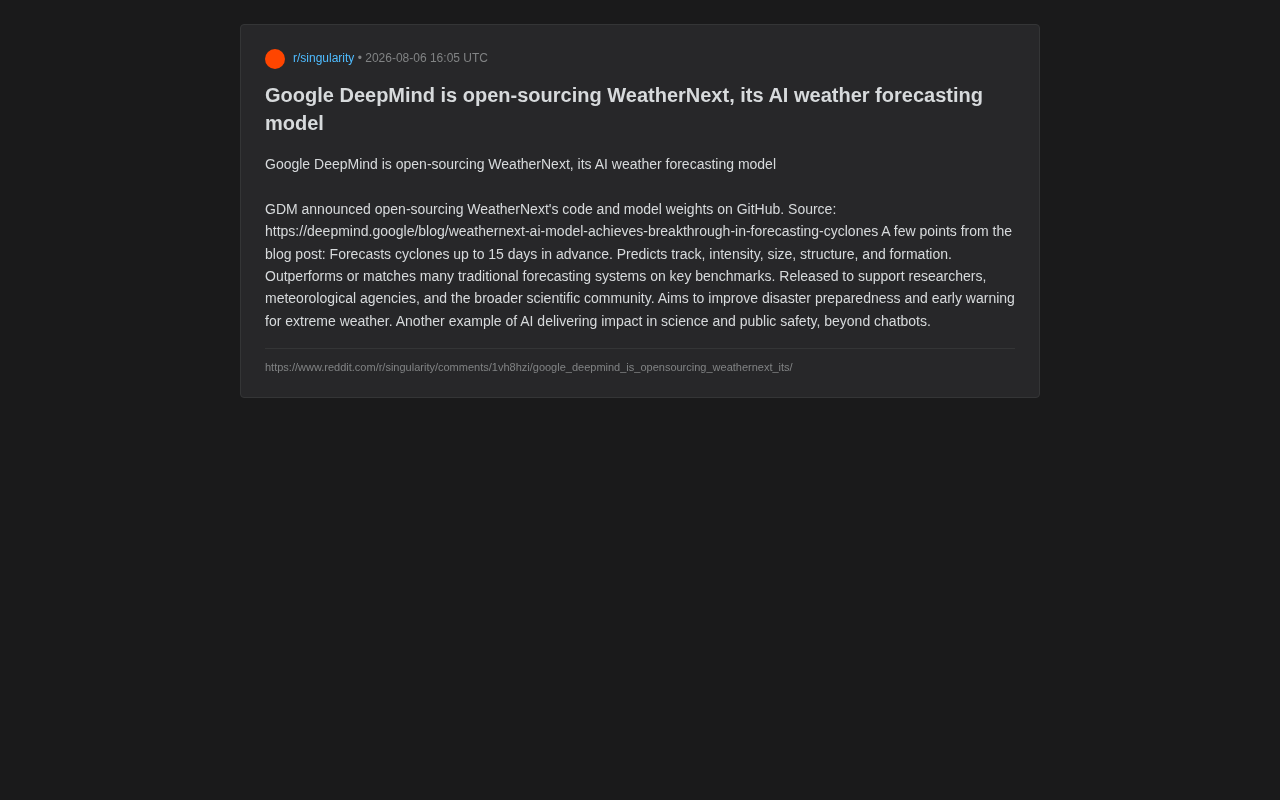
WeatherNext's Core Prediction Capabilities
According to DeepMind's official blog, WeatherNext has achieved significant capability improvements in cyclone prediction. Its core capabilities include:
- 15-day advance cyclone prediction: The model can make predictions within a two-week window before and after cyclone formation, buying precious time for disaster warnings.
- Full-dimensional prediction: It predicts not only the cyclone's track but also its intensity, size, structure, and formation process.
- Performance benchmarked against traditional numerical weather prediction systems: In multiple key benchmark tests, WeatherNext's performance matches or even surpasses many traditional numerical weather prediction systems.
Cyclone prediction has long been one of the most challenging problems in meteorology. Traditional Numerical Weather Prediction (NWP) relies on complex numerical solutions of atmospheric physics equations, which are computationally expensive and have limitations in capturing fine details. Specifically, the core idea of NWP is to treat the atmosphere as a fluid dynamics system, simulating atmospheric evolution by solving partial differential equation systems such as the Navier-Stokes equations. Current mainstream NWP systems, such as the European Centre for Medium-Range Weather Forecasts (ECMWF) IFS model and the U.S. National Weather Service GFS model, need to divide the Earth's atmosphere into millions or even billions of grid points, solving for temperature, pressure, wind speed, humidity, and other variables at each point. A single global 10-day forecast typically requires thousands of CPU cores running for hours, with extremely high operational costs. Additionally, NWP is highly sensitive to initial conditions—the so-called "butterfly effect"—where small observational errors are amplified during the forecasting process, limiting the accuracy ceiling of traditional methods for medium- to long-range forecasting. Machine learning-based approaches, by learning patterns from massive historical meteorological data, can produce high-quality predictions in much shorter timeframes.
Notably, WeatherNext is not the only player in the AI weather prediction space. In recent years, several important models have emerged in this field: Huawei's Pangu-Weather was the first to demonstrate that AI models could rival traditional NWP systems in medium-range weather forecasting; NVIDIA's FourCastNet achieved high-resolution global forecasting based on adaptive Fourier neural operators; Microsoft's ClimaX explored the application of foundation models in climate science; and ECMWF itself launched AIFS (Artificial Intelligence Forecasting System), actively integrating machine learning methods into operational forecasting workflows. A common feature of these models is inference speeds far exceeding traditional NWP—typically reduced from hours to minutes or even seconds. WeatherNext's full-dimensional capabilities in cyclone prediction—simultaneously covering track, intensity, size, structure, and formation—give it a unique competitive advantage in this specialized domain.
Why Open-Sourcing WeatherNext Is Significant
DeepMind's decision to fully open-source WeatherNext's code and model weights—rather than merely publishing a paper or providing an API—carries special weight in the industry.
Dramatically Lowering the Barrier to AI Meteorological Research
For meteorological research institutions and universities worldwide, training a high-quality large-scale meteorological model from scratch requires enormous computational and data resources. Open-sourcing model weights means researchers can directly fine-tune, validate, and develop on top of WeatherNext, dramatically lowering the barrier to entry in this field.
From a technical perspective, "model weights" refer to the specific numerical values of parameters across all layers of a neural network after training is complete. The process of training a large AI meteorological model is essentially the repeated adjustment of these weights through massive amounts of data, enabling the model to extract meaningful atmospheric evolution patterns from input data. Training data typically comes from reanalysis datasets like ERA5—global atmospheric reanalysis data provided by ECMWF covering 1950 to the present—and the training process may require hundreds to thousands of GPU hours. Open-sourcing model weights means other researchers don't need to repeat this expensive training process; they can directly load pre-trained parameters for inference predictions, or perform "fine-tuning" on this foundation—small-scale retraining with region-specific or task-specific data to adapt to localized needs. This is fundamentally different from open-sourcing only the code: code provides only the blueprint of the model architecture, while weights are the core asset that embodies the accumulated training knowledge.
Helping Developing Countries Improve Disaster Prevention and Mitigation
Extreme weather events such as tropical cyclones and typhoons often cause the most severe damage to developing countries—precisely the regions that lack expensive supercomputing resources to run traditional numerical forecasting systems. A freely available AI model with lower computational costs could help resource-limited meteorological agencies improve their early warning capabilities, potentially saving more lives and property before disasters strike.
The urgency of this issue is intensifying. According to multiple reports from the World Meteorological Organization (WMO) and the Intergovernmental Panel on Climate Change (IPCC), global warming is significantly altering the frequency and intensity of extreme weather events. Rising ocean surface temperatures provide more energy for tropical cyclones, increasing the proportion of strong typhoons and hurricanes; increased atmospheric water vapor content (according to the Clausius-Clapeyron equation, atmospheric water-holding capacity increases by approximately 7% for every 1°C temperature rise) exacerbates the risk of heavy rainfall and flooding. 2023 was the hottest year on record, with global average temperatures approximately 1.45°C above pre-industrial levels. The UN Secretary-General launched the "Early Warnings for All" initiative, aiming to ensure every person on Earth has access to extreme weather early warning services by 2027, and the open-sourcing of AI meteorological models is one of the key technological pathways to achieving this goal.
Promoting Collaboration Across the Global Meteorological Science Community
DeepMind explicitly stated that this open-source release aims to support researchers, meteorological agencies, and the broader scientific community. The open model will inspire more comparative studies, improvement proposals, and innovative applications, creating a virtuous cycle of technological iteration.
The Deeper Value of AI in Scientific Domains
WeatherNext is yet another example of AI creating substantive impact in science and public safety—an impact that far exceeds our daily interactions with chatbots.
In recent years, DeepMind has continued pushing forward in multiple scientific directions: from AlphaFold, which solved the protein folding problem, to GNoME for materials discovery, to now weather prediction models. Together, these achievements outline a clear path: AI is not merely a tool for generating text and images but a powerful engine for accelerating scientific discovery and solving humanity's greatest challenges.
Among these, AlphaFold solved the "protein folding problem" that had puzzled biologists for over 50 years—how to accurately predict the three-dimensional structure of a protein from its amino acid sequence. AlphaFold2 achieved near-experimental accuracy at the CASP14 (Critical Assessment of protein Structure Prediction) competition, and its subsequent version AlphaFold3 further expanded to predict complex structures of proteins with DNA, RNA, and small molecules. The model has predicted structures for over 200 million proteins, dramatically accelerating drug development and fundamental biological research. GNoME (Graph Networks for Materials Exploration), released in 2023, used graph neural networks to discover over 2.2 million new stable crystal materials, nearly expanding the number of known stable materials by an order of magnitude—many of which may find applications in batteries, solar cells, and superconductors. Together with WeatherNext, these projects embody the core logic of DeepMind's "AI for Science" strategy—directing frontier AI capabilities toward science's most challenging and socially valuable problems.
Improvements in weather prediction have direct social value. More accurate and earlier extreme weather warnings can optimize the allocation of emergency response resources, guide evacuation decisions, and reduce economic losses and casualties from disasters. Against the backdrop of increasingly frequent extreme weather events driven by climate change, the importance of such technology will only continue to grow.
Conclusion
The open-sourcing of WeatherNext marks an important step in moving AI weather prediction from the laboratory to an open ecosystem. For developers and researchers, it is a high-quality open-source resource worth following and experimenting with; for society as a whole, it represents AI technology serving the public interest in an increasingly inclusive manner.
As more institutions explore and optimize on this foundation, we have good reason to expect that future weather prediction will become more precise, timely, and accessible. This also reminds us once again: AI's most exciting applications often happen at the scientific frontier, far from the spotlight.
Related articles

OpenAI's Ohio Data Center: A Complete Breakdown of Grid Upgrades, Water Use, and Community Commitments
OpenAI partners with SB Energy and NVIDIA to build a massive AI data center in Pike County, Ohio, pledging grid costs won't burden residents, using closed-loop air cooling, creating 35,000 jobs, and investing $80M in the community.

Hollywood Creatives Forced to Train AI to Replace Themselves: The Cruel Reality of Digging One's Own Grave
Hollywood writers, voice actors, and illustrators are being hired to train AI systems, accelerating the automation of their own careers. A deep analysis of the ethical dilemmas and labor challenges.

How AI Video Generation Works: Diffusion Models, Motion Transfer, and Optical Flow Explained
Deep dive into three core AI video generation technologies: diffusion models, motion transfer, and optical flow — the tech behind Sora, Runway, and more.