OpenAI's Ohio Data Center: A Complete Breakdown of Grid Upgrades, Water Use, and Community Commitments

OpenAI's Ohio data center project combines compute expansion with a comprehensive social contract for the local community.
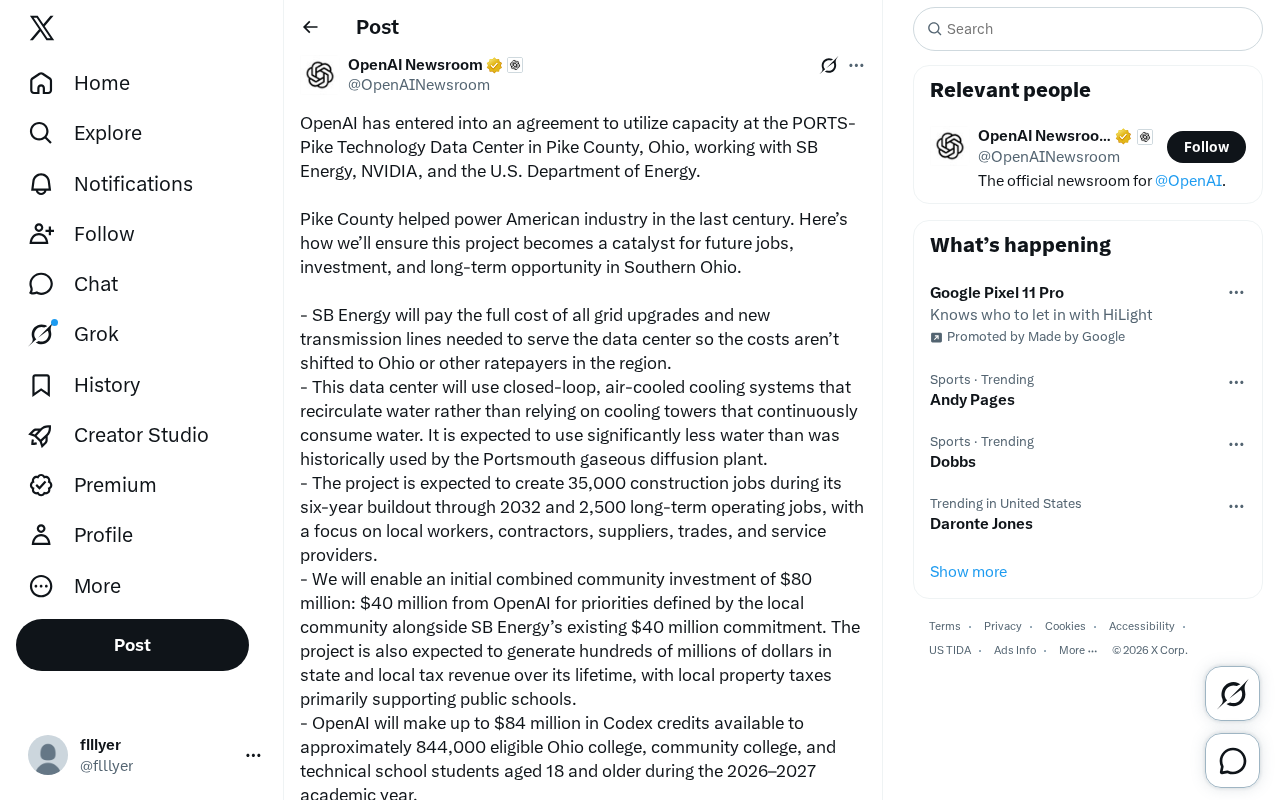
OpenAI has partnered with SB Energy, NVIDIA, and the U.S. Department of Energy to build a major AI data center at the former Portsmouth uranium enrichment site in Pike County, Ohio. The project includes commitments that grid upgrade costs won't be passed to residents, a closed-loop air-cooled system to minimize water use, 35,000 construction jobs, 2,500 permanent positions, $80 million in community investment, and $84 million in Codex credits for Ohio students — forming a comprehensive social contract for the compute expansion era.
OpenAI Expands Its Compute Footprint: Landing in Pike County, Ohio
OpenAI recently announced that it has reached an agreement to use compute capacity at the PORTS-Pike Technology Data Center located in Pike County, Ohio. This isn't a solo effort by OpenAI — it's a joint initiative with energy developer SB Energy, chip giant NVIDIA, and the U.S. Department of Energy. SB Energy is SoftBank Group's renewable energy development platform focused on large-scale solar and energy storage projects in the U.S. market, and has been actively expanding into data center energy supply in recent years. Its involvement in this project suggests that the data center's power supply may include a significant proportion of renewable energy, adding a clean energy narrative to the project.
The choice of Pike County carries historical symbolism — this is the former site of the Portsmouth gaseous diffusion plant, which powered American industry throughout the last century. Built in 1952, the plant was a critical component of the U.S. Cold War nuclear weapons program, primarily using the gaseous diffusion method to separate uranium-235 isotopes for nuclear weapons and reactor fuel production. The facility covered over 3,700 acres and employed thousands of workers at its peak, serving as the absolute economic backbone of the local area. After uranium enrichment operations ceased in 2001, the region experienced the classic pattern of deindustrialization decline, with population loss and economic contraction continuing to this day. Now, OpenAI is attempting to transform this former industrial heartland into a hub powering the next generation of AI compute. This succession from "traditional industry" to "AI infrastructure" forms the core of the project's public narrative.
As demand for large model training and inference explodes, compute has become the scarcest strategic resource for AI companies. OpenAI's move in Ohio is the latest step in its nationwide data center expansion blueprint, reflecting the entire industry's fierce competition for power, land, and cooling resources.
Who Pays for Grid Upgrades? OpenAI Provides a Clear Answer
Data center deployments typically come with enormous power demands, and whether the added load will drive up local electricity prices is the issue most likely to trigger resident concerns.
On this point, OpenAI made an explicit statement in its announcement: SB Energy will bear the full cost of all grid upgrades and new transmission lines needed to power the data center, and these costs will not be passed on to Ohio or other electricity users in the region.
This commitment is critical. In many parts of the U.S., electricity price increases triggered by large data centers have become a flashpoint between residents and tech companies. Take Northern Virginia as an example — as home to the world's largest data center cluster, the local utility Dominion Energy has repeatedly applied for rate increases to cover grid expansion costs, sparking strong resident backlash. Similar conflicts have played out frequently in data center-dense regions like Georgia, making this one of the most prominent social issues in AI infrastructure expansion. By having the developer absorb infrastructure costs, OpenAI is attempting to defuse the PR risk of "AI giants hogging electricity while ordinary residents foot the bill" at its source.
This also reflects how the construction of hyperscale compute infrastructure increasingly requires proactively managing complex relationships with communities and grid regulators, beyond pure business logic.
The Data Center Water Controversy: Closed-Loop Air Cooling Replaces Traditional Cooling Towers
Beyond electricity, water resources are another major environmental sensitivity point for AI data centers. Traditional data centers often rely on cooling towers that continuously consume water to dissipate heat, which frequently draws fierce opposition in water-scarce areas. Specifically, in traditional open-loop evaporative cooling systems, water carries away heat generated by servers through evaporation, but continuously consumes large amounts of fresh water — a single large data center can consume millions of liters per day, equivalent to the daily water usage of a small town.
OpenAI states that this data center will use a closed-loop, air-cooled cooling system — meaning water is recirculated rather than continuously consumed. This system keeps the cooling medium sealed within a piping loop, using fans to drive external air across the pipes for heat exchange. Since water doesn't come into direct contact with the outside environment, there is virtually no evaporative water loss. The trade-off is slightly lower cooling efficiency compared to evaporative cooling — in high-temperature environments, it may require larger cooling surface areas and higher fan energy consumption, with correspondingly higher initial construction costs. The announcement specifically emphasizes that expected water usage will be significantly lower than the historical water consumption of the Portsmouth uranium enrichment plant.
Why Closed-Loop Air Cooling Matters
As public scrutiny of AI energy and water consumption intensifies, cooling technology choices are becoming an important metric for measuring a data center's "green credentials." While closed-loop air-cooled systems may cost more in initial construction and energy efficiency, they can dramatically reduce long-term pressure on local water resources.
OpenAI's proactive disclosure of this technology choice is both an environmental gesture and a direct response to local community concerns. Comparing the new project's water usage with the old industrial facility is a clever narrative strategy — on the same piece of land, the "new economy" is more resource-efficient than the "old industry."
Jobs and Tax Revenue: Boosting Southern Ohio's Local Economy
For southern Ohio, the direct economic returns of this project are the most compelling argument.
According to data disclosed by OpenAI:
- The project is expected to create 35,000 construction jobs during a six-year build period (extending through 2032)
- Once operational, it will provide approximately 2,500 long-term operations positions
- Hiring will prioritize local workers, contractors, suppliers, skilled tradespeople, and service providers
Additionally, the project is expected to generate hundreds of millions of dollars in state and local tax revenue over its lifetime, with local property taxes primarily supporting public schools. The data center is positioned not merely as a power-hungry server farm, but as an economic engine driving local employment and reinvesting in public education.
For America's "Rust Belt" heartland that has experienced traditional industrial decline, such commitments are undeniably attractive. The "Rust Belt" refers to the economically depressed regions of the American Midwest and Great Lakes area that experienced deindustrialization in the latter half of the 20th century. Southern Ohio is a textbook example of this belt, having long faced a shortage of job opportunities and an outflow of young people.
$80 Million Community Investment and Education Reinvestment Plan
To ensure the project truly becomes a "catalyst for future opportunity," OpenAI and SB Energy have also designed a comprehensive community reinvestment plan.
The two parties will launch an initial community investment totaling $80 million:
- OpenAI is contributing $40 million for priorities determined by the local community itself
- SB Energy is continuing its previously committed $40 million
This mechanism of "letting the community define where the money goes" grants local residents a degree of say in how the funds are used.
The education-focused investment is even more noteworthy. OpenAI has committed to providing up to $84 million in Codex credits to approximately 844,000 eligible Ohio university, community college, and technical school students (aged 18 and older) during the 2026–2027 academic year. Codex is OpenAI's AI-powered coding assistant that can automatically generate code from natural language descriptions, supporting multiple programming languages including Python and JavaScript. Fine-tuned from the GPT series of large models, it helps developers quickly complete code writing, debugging, and documentation tasks, and is seen as an important tool for lowering the barrier to programming and enabling people without technical backgrounds to quickly get started with software development. This means hundreds of thousands of young Ohioans will have the opportunity to use OpenAI's AI coding tools for free, gaining early exposure to cutting-edge development capabilities.
This move directly links infrastructure investment to talent development — the students learning with AI tools today could very well be tomorrow's data center and AI industry workforce.
Transparency Commitments and the "Ohio Community Compact"
OpenAI has committed to publishing an annual project progress report and stated that local residents' input will help shape what it calls the "Ohio Community Compact."
This kind of ongoing transparency mechanism has become increasingly common when large tech projects are deployed. It attempts to transform the relationship between companies and communities from a one-time "business attraction" transaction into a long-term, accountable partnership.
The Social Contract of the Compute Expansion Era: Industry Trends Through the Ohio Lens
OpenAI's Ohio deployment is, on the surface, a compute capacity procurement agreement. In substance, it's a carefully designed "social contract." From grid upgrade costs and closed-loop air-cooled water solutions to job creation, tax contributions, education reinvestment, and transparency commitments, OpenAI has addressed virtually every potential point of controversy.
This reflects a larger industry trend: as AI data centers continue to scale up, compute expansion is no longer a purely technical or commercial matter — it's a complex negotiation deeply embedded in energy, environmental, and local livelihood concerns. Those who can secure compute while properly managing community relationships will be the ones who advance most steadily in this infrastructure race.
This data center in Ohio may well be a defining case study for observing this trend.
Related articles

Free Unlimited Claude Code Solution: Agnes AI + CC Switch Setup Guide
No paid subscription needed — pair the free AI platform Agnes AI with the open-source tool CC Switch to provide a backend for Claude Code, enabling unlimited free calls to text, image, and video models. This guide covers the full setup, test results, and usage boundaries.

A Complete Zero-Cost Guide to Getting Started with Claude Code for Beginners in China
A beginner's guide to Claude Code for users in China: two installation methods (command line and IDE plugin), full configuration steps for replacing the official API with the free domestic LongCat model, and a hands-on demo of building a small tool with natural language, plus tips.

When the NSA Gets Involved: The AI Supply Chain Crisis Behind Open-Source CVEs and API Key Hijacking
Multiple open-source projects disclosed severe CVEs in one day, PHP flaws alarmed the FBI, and Railway and OpenCode were breached with API keys stolen. This article breaks down the vulnerability window, AI-accelerated exploitation, and the AI supply chain crisis behind the API key black market, with a developer defense checklist.