Google Opens Google Home MCP Server: AI Agents Can Now Control Smart Home Devices
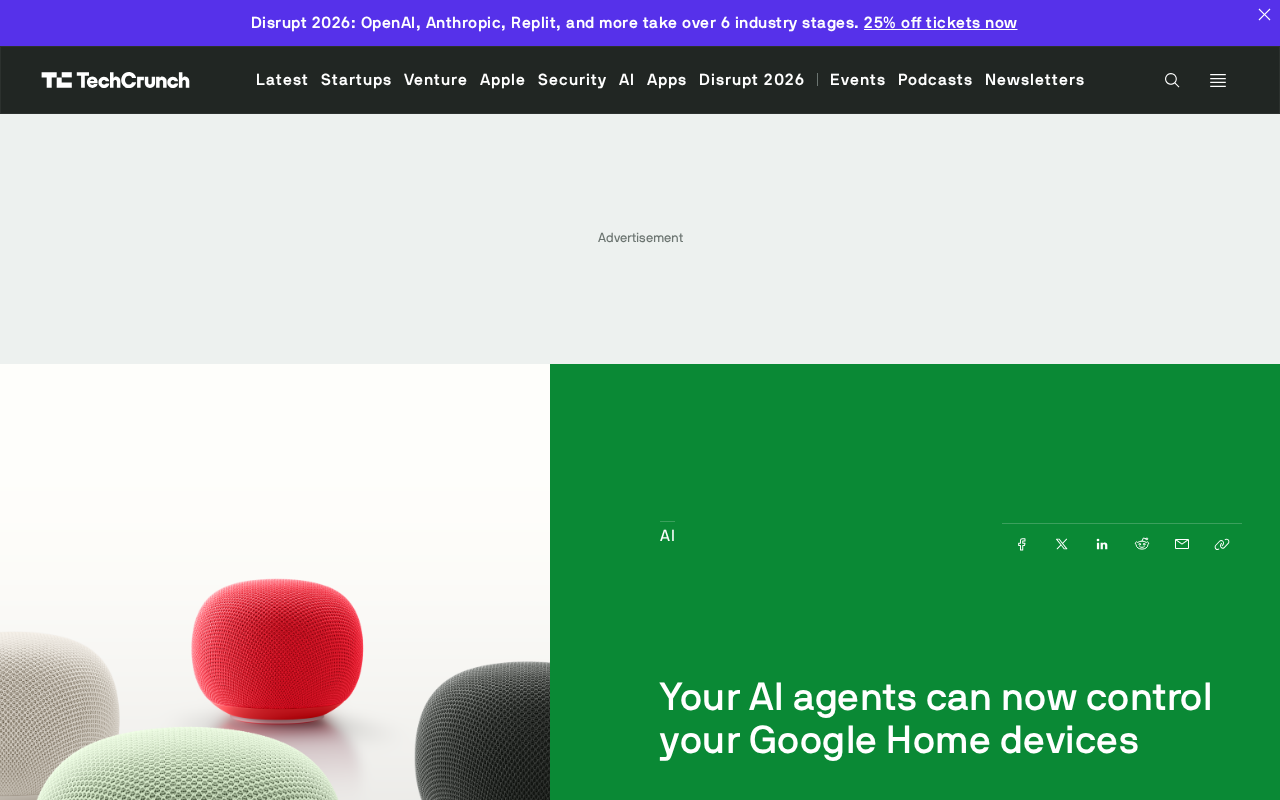
Google launches a Google Home MCP server, enabling AI agents like Claude and ChatGPT to control smart home devices via natural language.
Google has announced an MCP (Model Context Protocol) server for Google Home, now in early access, allowing mainstream AI agents like Claude and ChatGPT to control connected devices, access camera summaries, and view home activity logs through a standardized interface using natural language. MCP as an open standard removes the need for custom integrations between AI and smart home platforms, enabling any compatible AI agent to connect to Google's smart home ecosystem. The service is currently in early access, with access management, data privacy, and protection against unintended actions being the key challenges to validate. Long-term, this signals AI agents are becoming a unified gateway connecting digital and physical services, potentially reshaping the smart home landscape.
Google is rolling out a new MCP (Model Context Protocol) server for Google Home, now available in early access. This means popular AI agents like Claude and ChatGPT can directly control users' connected devices through natural language, view camera summaries, and access smart home activity logs. The move takes the integration between AI assistants and smart home ecosystems to a new level.
Why MCP Is the Key
MCP (Model Context Protocol) is an open standard that has been gaining rapid traction in the AI space. It provides a standardized communication bridge between large language models and external tools and data sources. In the past, getting an AI assistant to control a smart home required custom integrations for each specific platform — costly to build and difficult to scale.
By opening up Google Home through an MCP server, Google is essentially providing a standard interface for the entire smart home ecosystem. Any MCP-compatible AI agent — whether it's Anthropic's Claude, OpenAI's ChatGPT, or other third-party tools — can theoretically connect and call upon these capabilities without needing to integrate with Google's proprietary APIs one by one. This approach lowers the barrier to entry and reflects the industry's broader shift toward interoperability.
MCP was proposed and open-sourced by Anthropic in late 2024. Its design philosophy resembles a "USB port" for AI — a unified protocol enabling plug-and-play connectivity between different AI models and different external services. Technically, MCP defines a client-server architecture: the AI model acts as the client, while external tools or data sources (such as Google Home) act as the server. Both sides communicate via a standardized JSON-RPC message format. Servers can expose three types of capabilities to AI: callable Tools, readable Resources, and reusable Prompt templates. This design means AI models don't need to understand the underlying API details — they only need to know "what tools are available" to initiate a call. By wrapping Google Home as an MCP server, Google has abstracted capabilities like device control, camera summaries, and activity logs into standardized tool interfaces that any MCP-compatible AI client can discover and use directly.
What AI Agents Can Do
According to information published by Google, connected AI agents will primarily have three categories of capabilities:
- Control connected devices: Users can instruct an AI assistant through natural language to turn lights on or off, adjust thermostats, and manage various smart devices — without opening a dedicated app or memorizing specific voice command formats.
- View camera summaries: AI agents can access and summarize camera footage, for example generating a text summary of activity at the front door. This is powered by Google's existing visual understanding capabilities.
- Access smart home activity logs: AI can retrieve historical activity data from home devices, helping users understand what has happened in their home.
This natural language-centric interaction model is far more flexible than traditional fixed voice commands. Users no longer need to remember specific wake words or command structures — instead, they can describe their intent in everyday conversational language, and the AI will interpret it and translate it into the appropriate device action.
The Significance of the Early Access Phase
The service is currently in early access, meaning features are still being refined and coverage and stability may be limited. Google's choice of a gradual rollout allows it to collect real-world usage feedback while also assessing security and privacy risks before a full-scale launch.
Smart home devices include sensitive equipment like cameras and door locks. Once AI agents gain control permissions, access management, data authorization, and protection against unintended actions become unavoidable concerns. Allowing third-party AI to access camera summaries and home activity logs raises core questions that need to be validated during early access: how to ensure user data isn't misused, and how to define the operational boundaries of AI agents.
From a technical architecture perspective, third-party AI agents accessing smart home devices must go through authorization flows such as OAuth, requiring users to explicitly grant the AI agent's scope of access. However, unlike traditional app permissions, AI agent operations are often driven by natural language reasoning, which introduces the risk of "intent ambiguity" — when a user says "turn off the lights at home," the AI needs to correctly understand whether that means all lights or a specific room. Additionally, camera summaries involve AI interpretation of video content; which nodes the data passes through during transmission and processing, and whether it is handled locally or uploaded to the cloud, directly affects users' privacy boundaries. There is currently no unified security standard in the industry for AI agent access to home devices, and the early access phase is effectively Google's process of exploring what that standard should look like.
Impact on the Smart Home Landscape
For a long time, the smart home space has been fragmented by the closed ecosystems of giants like Google, Amazon, and Apple, making cross-platform collaboration difficult. By opening an MCP interface, Google is embracing a more open connectivity paradigm — turning the smart home into a callable capability for AI agents rather than an isolated app feature.
For everyday users, the most immediate change is an upgrade in how they interact — from memorizing commands to natural conversation. For developers and the broader industry, this may signal a new phase: AI agents gradually becoming the unified entry point connecting all kinds of digital and physical services, with the smart home being just one piece of that puzzle. As more platforms adopt similar MCP integrations, those who can offer richer and more secure access capabilities will be best positioned to gain a competitive edge in the next wave of the race.
Related articles
The Siberian Ice Maiden and the Archaeological Mysteries of the Scythian World
The Siberian Ice Maiden is a Scythian female mummy from the Ukok Plateau. Her tattoos, silk garments, and grave goods reveal ancient nomadic art, social hierarchy, and cross-regional trade — alongside ongoing repatriation controversies.
SQL Row Pattern Matching: Implementing "Row-Level Regex" with MATCH_RECOGNIZE
MATCH_RECOGNIZE gives SQL regex-like power over row sequences. Detect brute-force attacks, fraud patterns, and user behavior flows with clean, declarative syntax — no more messy self-joins.
Hackers Break Into Flock Surveillance Cameras, Exposing the Inner Workings of License Plate Recognition Systems
Hackers breached Flock Safety's ALPR cameras, exposing how license plate recognition systems collect data and the privacy and security risks they pose.