Google Play Now Supports Private 'Vibe-Coded' Apps: AI-Generated Personal Apps Without Public Release

Google Play allows AI-generated private apps without public listing, lowering the barrier to personal software development.
Google Play is adjusting its rules for personal app publishing, allowing users to build and use AI-generated private Android apps without publicly releasing them to the Play Store. These vibe-coded apps let users describe functionality in natural language, with LLMs generating runnable code or APKs for use cases like personal expense trackers, habit trackers, or recipe managers. The shift pushes AI programming from "can generate code" to "can generate and actually use it," while giving Google a path to reduce low-quality app pollution. Distribution mechanisms, code security, and the boundary between private use and review circumvention remain open questions.
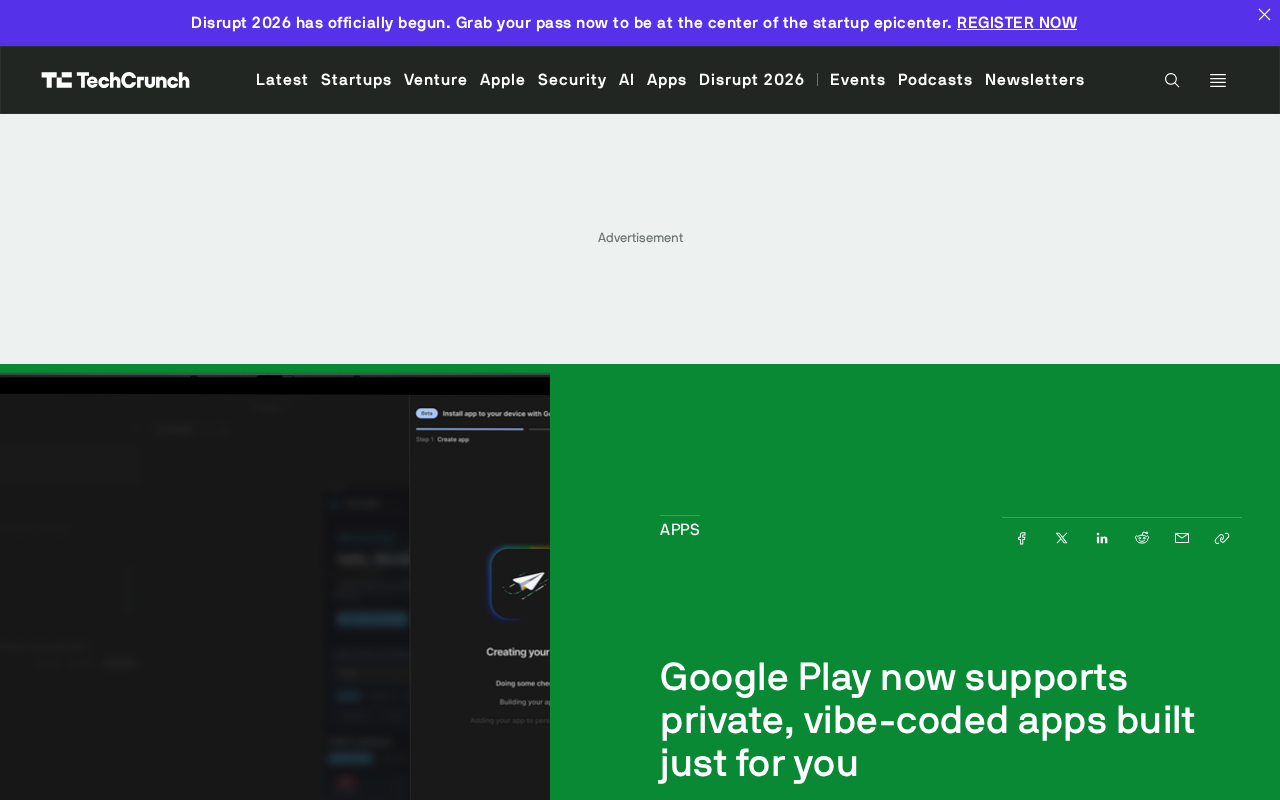
Google Play is quietly changing the rules for personal app publishing. According to recent reports, Google is making it easier for users to build and use AI-generated personal Android apps without having to publish them publicly to everyone on the Play Store. This shift is being called "vibe-coded apps" — lightweight applications generated through natural language descriptions with AI assistance, built to serve a specific individual or a narrow use case.
From "Public Release" to "Private Use"
Traditionally, the path to publishing an Android app has been: developers build, test, and then upload to Google Play for a global audience. Even the simplest utility app has to go through review, listing, and version management. For ordinary users who just want to build a personal expense tracker, a habit tracker, or a family recipe manager, this process is clearly too heavy.
The core logic behind Google's adjustment is this: when an app is AI-generated and serves only its creator, it shouldn't be forced through public distribution channels. Users can build, install, and use these apps locally without worrying about them being indexed, rated, or downloaded by strangers. This lowers both the psychological barrier and the operational cost of personal software creation.
What Exactly Is "Vibe Coding"
"Vibe coding" is a programming approach that emerged alongside the proliferation of large language models. Users don't need to know Kotlin or Java — they simply describe the desired functionality in natural language, and AI generates runnable code or directly produces an APK.
Apps produced this way tend to be single-purpose with plain interfaces, but they precisely meet the need of "it works conveniently for me." Think of a home screen widget that only shows how many glasses of water you've had today, or a simple tool that recommends recipes based on leftover ingredients in your fridge. Their value isn't in commercialization — it's in solving specific small problems in personal life.
Google Play's support for these private apps means the barrier to AI programming is being pushed even lower — from "can generate code" to "can generate and actually use it."
How vibe coding differs from low-code/no-code platforms: Low-code platforms (like MIT App Inventor or Glide) require users to assemble functionality from preset components and logic blocks — it's essentially visual programming with clear capability boundaries. Vibe coding, by contrast, relies on large language models' code generation capabilities. Users describe intent rather than structure — a natural language request like "help me make a widget that tracks how many glasses of water I drink each day" gets translated by the model into complete Kotlin or Dart code. This means it isn't constrained by platform-provided components and can theoretically generate any functionality, but the trade-off is greater variability in output quality: the model may produce logic errors, security vulnerabilities, or unmaintainable code. For individuals who just want personal use, these risks are tolerable — but once distribution is involved, it's a completely different story.
APK and Android app distribution mechanisms: APK (Android Package Kit) is the installation package format for Android apps, containing compiled code, resources, and manifest files. Traditionally, users obtain APKs through two channels: downloading from app stores like Google Play, or sideloading from third-party sources. Google Play's review mechanism is built on the premise that "listing equals public" — submitted APKs undergo static scanning, dynamic analysis, and content policy review. When Google allows AI-generated private apps to bypass the public listing process, it's essentially opening a "creator-install-only" channel within Play's distribution system. Technically, this could be implemented through existing mechanisms like Play's private testing tracks or Internal App Sharing, though the scope of review standards and security checks would differ.
What This Means for the Developer Ecosystem
This change won't replace traditional app development, but it could reshape how individual developers and small teams get started. In the past, someone with an idea but no programming skills needed to find a collaborator or learn a tech stack. Now, they can have AI generate a private version first, validate whether the need is real, and then decide whether to invest more resources into a public release.
For Google, supporting private AI apps also has strategic significance. The Android ecosystem has long faced criticism of having "too many apps with uneven quality." Encouraging private use rather than public flooding helps reduce the pollution of low-quality apps in the Play Store. At the same time, it gives Google another real-world use case in the competition over AI-assisted development tools.
However, questions remain about the distribution and installation mechanisms for private apps, the security of AI-generated code, and how to draw the line between "private use" and "circumventing review."
Security risks of AI-generated code: Code generated by large language models can introduce multiple security concerns. First, dependency risk — models may reference non-existent or compromised third-party libraries. Second, logic vulnerabilities, such as insecure local data storage or missing input validation. Third, permission abuse — generated Android apps may declare system permissions in their manifest files that exceed actual needs. For personal-use apps, these risks are borne by the creator. But once vulnerabilities emerge in the installation and execution mechanisms for private apps (for example, if a third party intercepts the APK), they could become an attack surface. Google needs to find a balance between "not interfering with private use" and "preventing malicious code from spreading through this channel" — which is one of the key reasons current policy details remain unclear.
The review economics of the Play Store: Google Play's listing review isn't purely a compliance process — it also serves to filter out low-quality content and malware. Every year, a large number of duplicate, hastily-made "zombie apps" flood the store, consuming review resources, diluting search quality, and eroding user trust. If AI-generated private apps don't need public listing, this potential supply of low-quality content gets diverted outside the store. For Google, this is a low-cost quality control strategy — rather than raising the review bar (which would hurt legitimate developers), it provides an exit for apps that "don't deserve to be public" without entering the store.
A New Phase in Personal Software Creation
From a broader perspective, Google's move echoes a trend: software is returning from "product" to "tool." When AI drives the cost of creation toward zero, a vast number of applications may no longer need user growth, monetization, or app store rankings — they serve just one person at one specific moment.
Google Play's support for private vibe-coded apps is a platform-level confirmation of this trend. It may not spawn the next blockbuster app, but it could give more people their first taste of the joy that comes from "building an app for yourself."
One-line Summary
Google Play now allows AI-generated private apps without public listing, lowering the barrier to personal software development.
Paragraph Summary
Google Play is adjusting its rules for personal app publishing, allowing users to build and use AI-generated private Android apps without publicly releasing them to the Play Store. These are called vibe-coded apps — users describe functionality in natural language, and large language models generate runnable code or APKs. Typical use cases include personal expense trackers, habit trackers, or family recipe managers. This shift pushes the barrier to AI programming from "can generate code" to "can generate and actually use it," while giving Google a strategic path to reduce low-quality app pollution in the Play Store. However, questions about distribution and installation mechanisms for private apps, the security of AI-generated code, and the boundary between private use and circumventing review remain open.
Related articles

Chain of Thought Isn't Just for AI: How Humans Can Use CoT to Improve Thinking Quality
Chain of Thought isn't just a prompt trick for large models. Starting from a Hacker News discussion, this article analyzes why CoT works for human thinking too, breaks down actionable ways to transfer it, and highlights the key differences between human CoT and machine CoT.
Cloudflare Teams Up with OpenAI: Closi…
Cloudflare Teams Up with OpenAI: Closing the Loop from Vulnerability Discovery to Defense with AI
Cloudflare uses OpenAI Daybreak to investigate security vulnerabilities and generate reviewable remediation plans, while developers use Codex to boost coding efficiency and quality.

Orca Multi-Agent Orchestration in Practice: A Guide to Parallel Collaboration with Claude and Codex
Orca is Stable AI's free open-source agent workbench supporting 34 agents like Claude Code and Codex in parallel. Learn its Git worktree isolation, multi-model orchestration, and mobile management.