Google Releases Cogentic Cryptography Papers: New Approaches to Integer Factorization and Discrete Logarithms
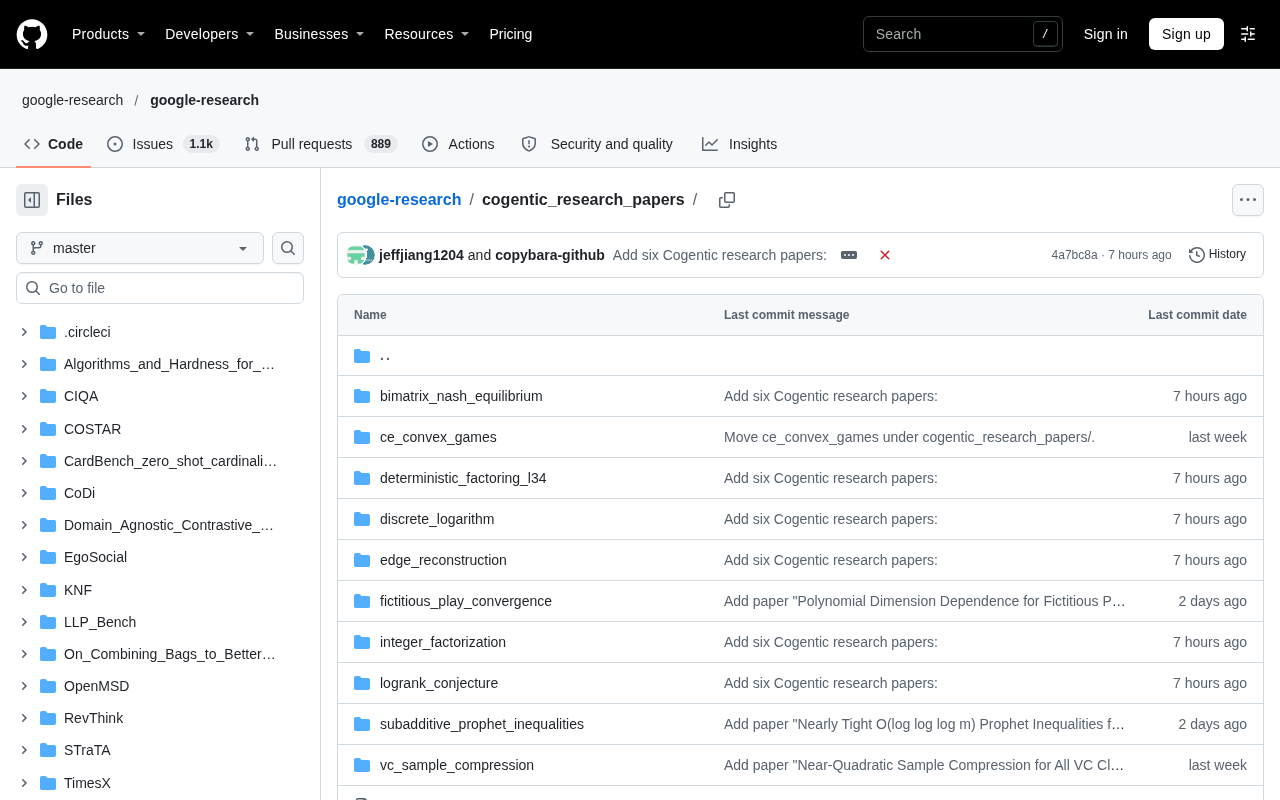
Google publishes Cogentic cryptography papers on GitHub, focusing on integer factorization and discrete logarithms and sparking community buzz.
Google Research has publicly released a series of research papers called Cogentic on GitHub, covering integer factorization and discrete logarithms, two cornerstones of public-key cryptography. The release gained nearly 300 points and over 200 comments on Hacker News, reflecting sustained community interest in hardcore math topics. The papers are released as a collection, suggesting an attempt at a unified methodological framework rather than a single-point algorithmic breakthrough. The article analyzes why this research still matters under the classical computing model and the trade-offs of the GitHub preprint release model. Core takeaway: until theorems are independently verified, Cogentic should be treated as a research lead, not a security conclusion.
Google Releases Cogentic Cryptography Papers: New Approaches to Integer Factorization and Discrete Logarithms
Google Research has publicly released a set of research papers on GitHub under the name Cogentic, covering classic cryptography hard problems such as integer factorization and discrete logarithms. The move sparked nearly 300 points of attention and over 200 comments on Hacker News, showing that hardcore math and cryptography topics still hold strong appeal for the community.
What the Papers Focus On: A Fresh Look at Classic Problems
Integer factorization and discrete logarithms are two cornerstones of public-key cryptography. RSA's security relies on the difficulty of factoring large integers, while Diffie-Hellman and elliptic curve systems are built on the discrete logarithm problem. Cogentic presents these two directions side by side, suggesting the research may attempt to approach them from a unified mathematical perspective rather than discussing a single algorithm in isolation.
Judging from the public repository structure, these papers are released as a collection, indicating that Google intends to present a methodology or research framework rather than a single-point breakthrough. For researchers focused on post-quantum cryptography migration and computational complexity theory, this kind of foundational work is worth tracking.
The Discrete Logarithm Problem (DLP) refers to the difficulty of finding the integer $x$ given group elements $g$ and $h = g^x$, where $g$ is a generator of a cyclic group. The security of Diffie-Hellman key exchange depends on the difficulty of solving this problem in the multiplicative group of a finite field or in an elliptic curve group. The Elliptic Curve Discrete Logarithm Problem (ECDLP) is considered harder than discrete logarithms over finite fields, allowing shorter keys for the same security strength. The key to understanding DLP lies in the choice of group structure: different groups have different known attack algorithms (such as index calculus and Pollard rho), and their complexity upper bounds directly determine parameter selection standards.
Post-quantum cryptography migration refers to replacing existing public-key cryptography that relies on the hardness of integer factorization and discrete logarithms (such as RSA, ECDH, and ECDSA) with algorithms resistant to quantum computer attacks. Shor's algorithm can solve integer factorization and discrete logarithms in polynomial time under the quantum computing model, meaning that once large-scale fault-tolerant quantum computers become practical, existing mainstream public-key systems will be broken. NIST launched its post-quantum cryptography standardization process in 2016 and has selected lattice-based algorithms such as Kyber (key encapsulation) and Dilithium (signatures). However, migration involves engineering challenges including protocol compatibility, performance overhead, and side-channel protection, so algorithmic progress under the classical model still affects security assessments during the transition period.
Focus of Community Discussion: Excitement and Caution Coexist
The 237 comments on Hacker News show a typical technical community reaction. Some discussions revolve around whether the papers propose new algorithmic complexity upper bounds, while others are more concerned about the potential real-world impact of such research on existing encryption standards.
Since the original material only provides repository links and discussion entry points without disclosing the papers' specific theorems and experimental data, outside interpretations inevitably contain speculation. This information incompleteness is itself part of the community buzz—people tend to make judgments at the headline level first, then wait for peer review and reproduction results.
Why Integer Factorization Is Still Worth Studying
Even though quantum computing is seen as a long-term threat, optimizing integer factorization algorithms under the classical computing model still has practical significance. Faster factorization algorithms would directly compress RSA's security margin, driving updates to key lengths and standards; at the same time, new tools in algorithmic number theory often spill over into related fields such as coding theory and lattice cryptanalysis.
The same applies to the discrete logarithm direction. Any theoretical progress on elliptic curve discrete logarithms would affect security assessments of blockchain signature schemes and the TLS ecosystem. If the Cogentic papers can provide verifiable improvements in these directions, their impact will extend beyond pure theory.
Algorithmic number theory is a research field at the intersection of number theory and computational complexity, focusing on algorithm design and complexity analysis for problems such as integer factorization, primality testing, and discrete logarithms. Classic results in this field include the quadratic sieve, the number field sieve (NFS), and the Pollard rho algorithm, which remain benchmark tools for assessing RSA security to this day. New tools in algorithmic number theory often have cross-disciplinary spillover effects: for example, lattice basis reduction techniques (the LLL algorithm) were originally used to factor polynomials and later became a core tool in lattice cryptanalysis; index calculus ideas have also influenced the solving of discrete logarithms over finite fields. Therefore, even if a particular algorithm does not directly threaten existing standards, its methodological value may still manifest in other cryptanalysis scenarios.
How to View the Release of These Papers
Google Research chose to release them in a GitHub repository rather than a journal collection, consistent with the current practice of rapid preprint disclosure by industrial research institutions. This approach shortens the cycle from results to discussion, but it also means the papers have not yet undergone full peer review.
For readers, the rational approach is to distinguish between "published papers" and "established conclusions." Until specific theorems are independently verified, Cogentic is better treated as a research lead rather than a security conclusion.
A preprint is a version of research results shared publicly before formal peer review, commonly on platforms such as arXiv, the Cryptology ePrint Archive, and GitHub repositories. The preprint model significantly shortens the dissemination cycle, enabling the community to discuss and reproduce results quickly, but it also means the papers have not undergone methodological review by independent referees. In cryptography, IACR's ePrint is the most mainstream preprint channel, while GitHub releases tend to focus more on synchronized disclosure of code and documentation. Readers citing preprint conclusions should note their non-peer-reviewed status and pay attention to subsequent reproduction experiments and formally published versions.
Summary
The release of the Cogentic papers reminds us that cryptography's foundational problems have not lost their research value amid the prosperity of the application layer. Every theoretical advance in integer factorization and discrete logarithms leaves an echo somewhere in security engineering. For developers and security practitioners, staying attentive to this kind of foundational research has more long-term value than chasing short-term tool trends.
One-line Summary
Google has publicly released the Cogentic cryptography papers on GitHub, focusing on integer factorization and discrete logarithm problems and sparking heated community discussion.
Paragraph Summary
Google Research has publicly released a series of research papers called Cogentic on GitHub, covering integer factorization and discrete logarithms, two cornerstones of public-key cryptography. The release gained nearly 300 points and over 200 comments on Hacker News, reflecting the technical community's continued interest in hardcore math topics. The papers are released as a collection, suggesting an attempt to approach the problem from a unified methodological framework rather than a single-point algorithmic breakthrough. The article analyzes why integer factorization and discrete logarithm research still has practical significance under the classical computing model, as well as the dissemination advantages and the risk of missing peer review associated with the GitHub preprint release model. The core conclusion: until the theorems are independently verified, Cogentic should be treated as a research lead rather than a security conclusion.
Related articles

GPT-6 Designs Proteins, Claude Creations Become Apps with One Click, DeepMind Releases New Benchmark
OpenAI says GPT-6 can design protein 3D structures, Anthropic lets Claude creations install as desktop apps, DeepMind's HIP benchmark tests stability on simple questions, Google Workspace opens agent MCP interfaces.
OpenAI Weekly Roundup: GPT-6.2 Rolls Out to ChatGPT, GPT-6 Designs Proteins
OpenAI's week: GPT-6.2 rolls out to ChatGPT, GPT-6 claims independent protein design, agent research share surges, perplexity proposed as a shared metric, and internal safety concerns surface.

Is the Crypto Industry About to "Turn Blue"? The Truth Behind Tech and Politics' Shifting Allegiances
Vergecast discusses whether the crypto industry will shift from the right to the Democrats, revealing the pragmatic nature of tech's politics and the costs of a crypto pivot.