Google Releases Gemini 4 Argon: Next-Generation AI Model Sparks Widespread Discussion

Google launches Gemini 4 Argon, drawing intense developer attention on Hacker News as the AI arms race continues.
Google has released Gemini 4 Argon, the newest entry in its Gemini large language model family, continuing its tradition of using chemical element codenames. The announcement quickly earned 453 points and 232 comments on Hacker News, reflecting how closely developers track top-tier AI model updates. While publicly available details remain limited, the Gemini series competes directly with OpenAI GPT and Anthropic Claude — and each update directly shapes developer decisions around API pricing, context windows, function calling, and reasoning performance. If Gemini 4 Argon delivers meaningful advances, it could further strengthen Google's position in enterprise AI via Vertex AI. The article cautions that official announcements tend to emphasize best-case metrics, and that true capability boundaries should be validated through independent testing.
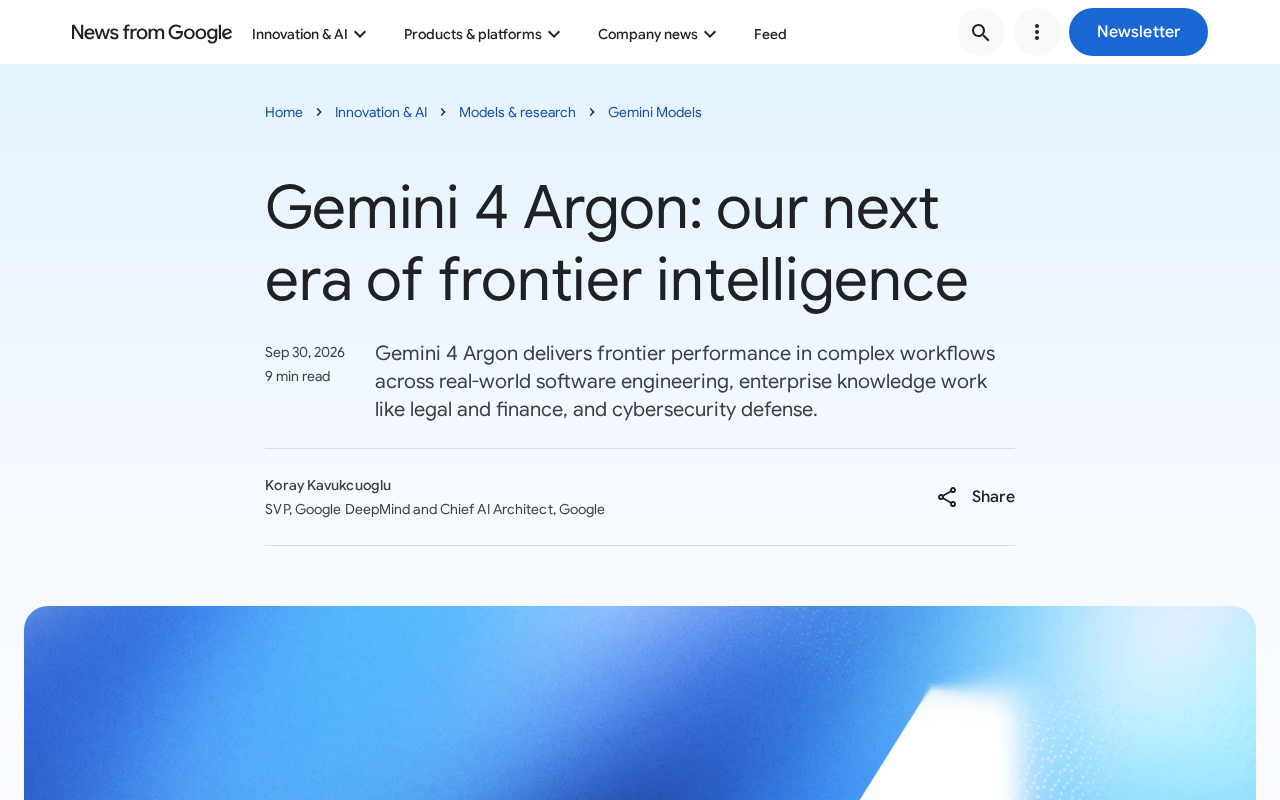
Google has officially published a new addition to the Gemini family — Gemini 4 Argon — on its official blog. The announcement quickly climbed to the top of Hacker News, racking up 453 points and over 230 comments in a short period, making it a focal point for the tech community.
It's worth noting that publicly available information remains fairly limited at this stage, primarily drawn from Google's official blog post and the accompanying Hacker News discussion thread. This article aims to highlight the key aspects of this release based on what is currently known, while offering an objective look at how the community has responded.
What Is Gemini 4 Argon
The naming itself tells us something: Gemini 4 Argon is a continuation of Google's Gemini large language model family. Google has maintained its convention of using chemical element names as internal model version codenames, with "Argon" (atomic number 18) suggesting this is a specific model branch or configuration within the Gemini 4 generation.
Since its launch, the Gemini series has been Google's flagship product line competing head-to-head with OpenAI's GPT series and Anthropic's Claude series. Each major version update typically signals improvements across dimensions such as multimodal understanding, reasoning capability, context length, or inference efficiency. With Gemini 4 as a new generation, the market holds high expectations for progress along these axes.
Google's convention of naming model versions after chemical elements has a long history. Within the Gemini series, functional names like Flash (lightweight and fast), Pro (general-purpose flagship), and Ultra (top-tier flagship) have appeared alongside element-based codenames such as Argon and Nano — the latter typically corresponding to specific capability tiers or deployment scenarios. For instance, Nano targets on-device lightweight inference, while Argon — a chemically inert noble gas known for its stability — as a codename may suggest a finalized model at a particular capability tier. This layered naming system is similar to OpenAI's GPT-4o mini / GPT-4 Turbo structure, designed to help developers make clear trade-offs between performance and cost. That said, specific parameter scales and capability boundaries should always be verified against official technical reports.
Why the Community Is Paying Close Attention
The fact that this announcement earned 453 points and 232 comments on Hacker News speaks volumes about how sensitive developers and technical practitioners are to iterations in Google's large model lineup.
For many developers, each model update directly influences real-world product decisions: API pricing, response latency, context window size, function calling capabilities, and actual performance on code generation and complex reasoning tasks are all recurring topics of discussion in the community.
The competitive pace in the large model space is relentless, with Google, OpenAI, and Anthropic engaged in a near-constant version arms race. Whether a new model delivers tangible capability improvements beyond benchmark scores is the central criterion by which the technical community judges its value — and the main thread running through comment sections.
Potential Impact on Developers and the Industry
If Gemini 4 Argon achieves meaningful breakthroughs in reasoning and multimodal processing, it could further shift the landscape of model selection for enterprises and developers alike.
For teams building products on top of AI capabilities, deep integration with the Google ecosystem — including Google Cloud, Vertex AI, and Workspace — is a significant consideration. The tight coupling between the Gemini series and Google's own services gives it a distinctive advantage in certain enterprise scenarios.
From an industry perspective, leading vendors continuously releasing next-generation flagship models raises the capability baseline across the board. This "arms race" style of iteration is, in the long run, a net positive for users and developers — delivering stronger capabilities, lower marginal costs, and a richer set of feature options.
Vertex AI is Google Cloud's unified platform for delivering machine learning and AI services to enterprises. Developers can call Gemini series models directly through its API, with deep integration across Google Cloud services like BigQuery, Cloud Storage, and Pub/Sub. For enterprises that have already hosted their data and business workflows on Google Cloud, the switching cost of using Gemini models is far lower than calling third-party models — data doesn't need to move across clouds, permission management can reuse existing IAM frameworks, and billing is consolidated in a single invoice. This ecosystem lock-in effect is a key structural advantage Google holds in competing with OpenAI (backed by Azure) and Anthropic (running a dual-track strategy across AWS and GCP) in the enterprise market. It's also a practical factor developers must factor into model selection decisions, beyond pure capability benchmarking.
Keeping a Rational Perspective on New Releases
When evaluating any new model release, maintaining a healthy skepticism is equally important. Vendor blog posts tend to highlight the most impressive gains, while the true capability boundaries, hallucination rates, and edge-case performance typically only become clear after large-scale community testing.
This is precisely where Hacker News comment sections add value: real-world feedback from frontline developers, pushback against marketing claims, and cross-model comparisons together form a far more nuanced picture than official press releases alone. Readers interested in this model are advised to verify its performance through independent evaluations and their own use cases before committing to adoption.
As more technical details and third-party benchmarks emerge, Gemini 4 Argon's true positioning will come into sharper focus. Whether this represents a routine iteration or a genuine capability leap is something worth following closely.
Related articles

Workbuddy for Absolute Beginners: How a Desktop AI Agent Fits Into Real Workflows
A beginner's guide to the Workbuddy desktop AI agent: installation, claiming credits, file management, and building automated workflows—compared with CodeX for fit and cost, helping professionals shift from AI question-askers to AI managers.

OpenAI's New Agent Stack: Computer Use, Decisions API, and Ultra-Fast Workflows
OpenAI Dev Day unveiled a new agent stack: Computer Use outperforms humans, Decisions API delivers ultra-low-latency classification via Luna, Agents API opens the same Computer Use capabilities, and GPT-6.1 Sol costs only one-seventh of Astra. Core updates, benchmark data, and developer insights.

Liang Wenfeng Open-Sources DeepInfo Inference Framework, Takes On U.S. Ban
DeepSeek open-sources its DeepInfo inference framework after its models, featuring GPU/CPU cross-pipelining, small-model prediction with large-model verification, and full Huawei Ascend and NVIDIA chip support—facing the U.S. federal ban head-on. This article analyzes its significance for AI deployment and open-source strategy.