Google Releases Gemini Omni 1.2 Flash Video Model; Fei-Fei Li's Spatial Intelligence Comes to a Handheld

Google releases a batch-capable video model, while World Labs and Muse push spatial interaction into reality.
The article rounds up three AI developments of the day. Google releases the Gemini Omni 1.2 Flash video model, cutting costs 30% versus its predecessor; it generates educational videos from a single style reference image, supports natural multi-character dialogue, reference-timbre dubbing, and cross-species motion transfer, and allows background, subject, and lighting edits on videos up to 15 seconds, with Flow used to extend duration and select quality. World Labs, founded by Fei-Fei Li, unveils Frame Boy in handheld form, powered by an optimized Atlas world model on cloud GPUs, letting users explore an AI-generated 3D world at 15 frames per second from a single uploaded image. AI assistant Muse adds real-time voice and a virtual avatar with synchronized expressions and movements. The author sees two main threads: video toolization and spatial interaction moving onto consumer hardware.
Google Launches Gemini Omni 1.2 Flash: Video Generation Enters the "Batch" Era
Google today released its next-generation video model Gemini Omni 1.2 Flash, positioning it officially as a video tool "with a Gemini brain." According to an analysis by Bilibili creator "Baihu," the model cuts costs by 30% versus its predecessor, but more notable is that it starts to resemble a "batch video tool"—meaning video generation is shifting from single experimental outputs toward a productivity tool capable of batch processing.
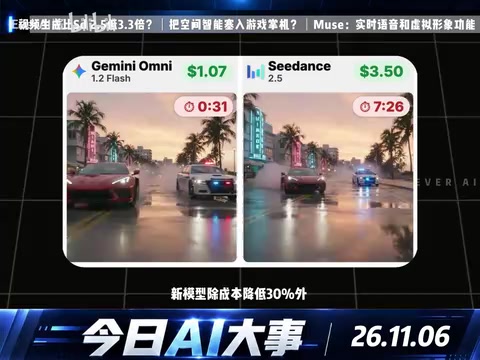
Gemini Omni 1.2 Flash's core capabilities include: generating educational videos from just a single style reference image, and creating fluid multi-character dialogue scenes. In the demo, the model produced a bee educational video with natural character dialogue, and it could follow a reference voice timbre for anthropomorphic dubbing. Cross-species motion transfer is another highlight—a human character can dance like an octopus, with transitions that look quite natural.
What the Gemini Omni Series and the Flash Suffix Mean
Gemini is Google's multimodal large model family released since late 2023, tiered by capability and cost into Ultra, Pro, Flash, Nano, and others, with Flash positioned as a lightweight, high-speed version for large-scale calls. "Omni" generally means the model natively supports multiple input and output modalities (text, image, audio, video) rather than being pieced together from several specialized models. Combining Omni with Flash for video generation means Google is trying to keep multimodal understanding capabilities while driving down inference costs. The so-called "Gemini brain" means the video generation process has a large model responsible for understanding prompts and reference materials, planning shots and lines, and then handing off to a generation module for rendering—which is also why it can handle tasks requiring semantic planning, such as multi-character dialogue and educational narration.
Multi-Character Dialogue and Editing: An All-in-One from Generation to Post-Production
The new model performs well in multi-character dialogue scenes. In the demo clip, two characters have a humorous exchange about "an orchid imitating a color palette": "Excuse me, that orchid is copying my color palette. I demand royalties." Another character responds: "I think it just wants to match your tail, Cosmo." This kind of interaction with personalized lines shows the model has improved in character consistency and contextual understanding.

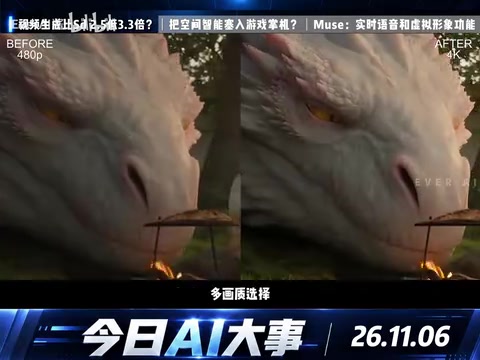
On the editing side, Gemini Omni 1.2 Flash supports changing backgrounds, replacing subjects, or adjusting lighting, and can currently edit videos up to 15 seconds long. Combined with Google's Flow tool, users can also naturally extend video length and choose from multiple output qualities. This combination moves video creation from "generating a clip" toward "editing a whole piece," a clear practical boost for content creators.
Technical Background on Character Consistency and Motion Transfer
"Character consistency" in video generation refers to keeping the same person's face, clothing, and body shape stable across multiple shots and rounds of dialogue—a long-standing challenge for diffusion video models. A common approach is to introduce reference images as identity anchors and constrain features along the timeline. Cross-species motion transfer typically relies on human pose estimation to extract skeletal keypoint sequences, then maps them onto the target body's motion structure, so effects like "a human dancing like an octopus" are essentially skeleton retargeting rather than frame-by-frame imitation. In addition, Flow mentioned in the article is Google's workflow tool for AI filmmaking, used to organize shots, extend duration, and unify output specifications; "editable 15 seconds" reflects the current model's context window limit in the time dimension, beyond which extrapolation or segment stitching is needed.
Fei-Fei Li Puts Spatial Intelligence into a Handheld Game Console: World Labs Launches Frame Boy
Another notable development comes from World Labs, founded by Fei-Fei Li. The company launched a device called Frame Boy, which takes the form of a handheld game console but runs on an optimized Atlas world model at its core. According to the creator, Frame Boy runs on cloud GPUs, and users only need to upload an image to explore an AI-generated three-dimensional world at "15 frames per second."
The "15 frames per second streaming transmission" here describes a streaming experience—frames are generated in real time as the user interacts, rather than pre-rendered. Putting spatial intelligence into a handheld form factor means world models are moving from cloud demos toward interactive consumer hardware. Although details are limited for now, the direction is clear: letting ordinary people "step inside" through a single image.

Spatial Intelligence and World Models
Spatial intelligence has been repeatedly advocated by Fei-Fei Li in recent years, referring to an agent's ability to understand three-dimensional spatial structure, object position relationships, and physical common sense, and is seen as the next-stage goal beyond language intelligence. A world model is a generative model that can predict the next state of a scene (including viewpoint changes and object motion) based on current observations; World Labs' Atlas belongs to this category: inferring a roamable 3D scene from a single image. Unlike earlier approaches that required pre-reconstructing 3D assets, streaming generation computes frames in real time as the user interacts, at the cost of limited resolution and frame rate—which is why "15 frames per second" becomes a key metric: it determines whether interaction feels responsive enough.
AI Assistant Muse Launches Real-Time Voice and Virtual Avatar
On the same day, real-time voice and virtual avatar features went live for AI assistant Muse. Users can "call" the AI assistant at any time and see the virtual character make synchronized expressions and movements during the conversation. This breaks the boundary of pure text or pure voice interaction, combining voice dialogue with visual feedback to make the AI assistant feel more like a conversation partner who is "present."
Summary: Video Tooling and Spatial Interaction Advance in Parallel
From Gemini Omni 1.2 Flash's batch video capabilities, to Frame Boy putting a world model into a handheld, to Muse's real-time virtual avatar, today's AI developments show two clear threads: first, video generation is becoming toolized and process-oriented, with lower costs and better editing capabilities enhancing its practicality; second, spatial intelligence and real-time interaction are seeking lighter hardware carriers. For content creators and AI application developers, both threads are worth following closely.
Related articles
 Tech Frontiers
MuJoCo: An Analysis of DeepMind's Open-Source General-Purpose Physics Simulator
An in-depth analysis of Google DeepMind's open-source physics simulator MuJoCo: high-performance C++ kernel, MJCF modeling format, contact solving principles, MJX GPU acceleration, and robot reinforcement learning use cases.
 Tech Frontiers
Claude API Quick Start: The Official Quickstarts Project Collection
Anthropic's official claude-quickstarts project collection helps developers quickly build deployable apps with the Claude API. Nearly 20k stars, Python-based, great for beginners and prototyping.
 Tech Frontiers
AI Agents Connecting Directly to APIs: Which Calls Can Be Safely Allowed?
AI agents can call any API, but the real challenge is deciding which calls can be safely allowed. This article analyzes allowance decisions from three dimensions—intent matching, least privilege, and controllable impact—and argues that the control layer should sit outside the agent, combined with audit traceability to build a trustworthy API call governance mechanism.