Google Reviews Reveal Hidden Barriers to Food Access Beyond Geographic Proximity
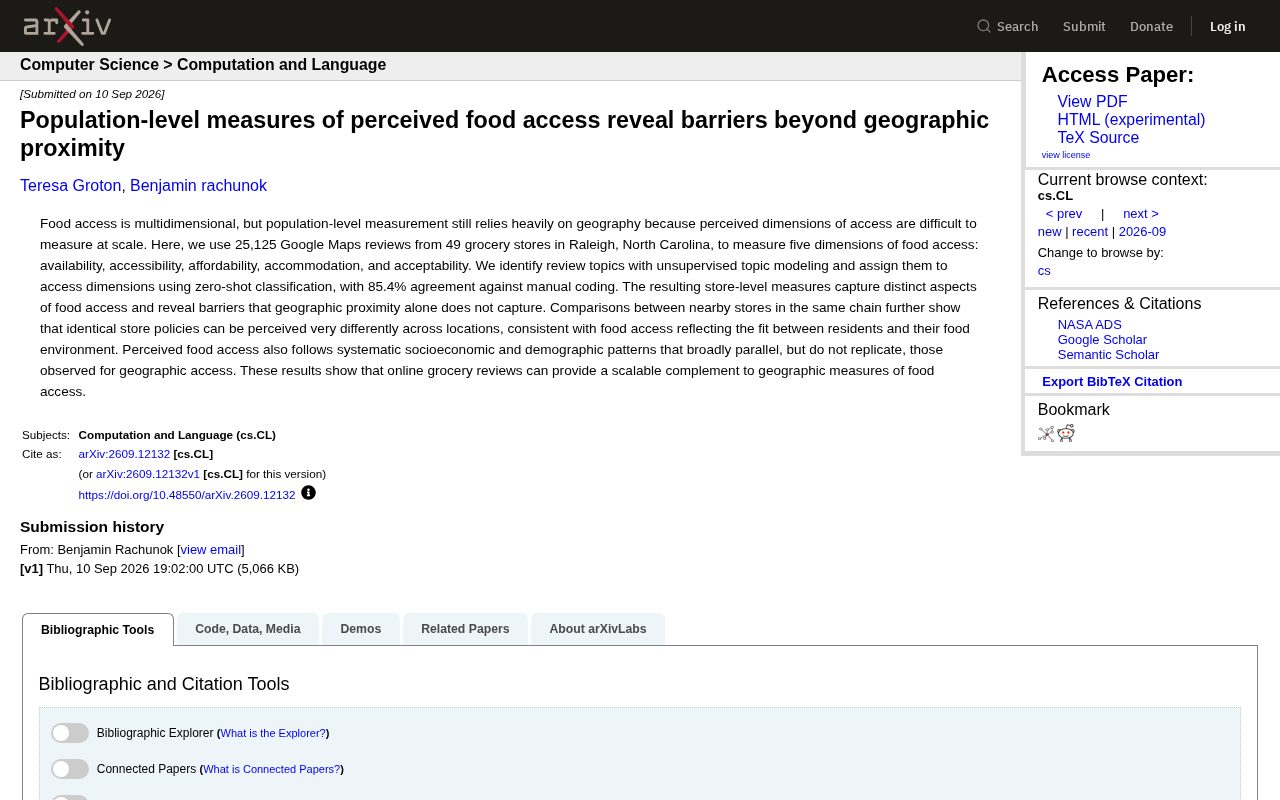
25,000 Google reviews reveal hidden food access barriers that geographic distance alone cannot capture.
This arXiv study analyzes 25,125 Google Maps reviews from 49 grocery stores in Raleigh, NC, using unsupervised topic modeling and zero-shot classification to measure five food access dimensions: availability, accessibility, affordability, accommodation, and acceptability. Even same-brand chain stores showed dramatically different resident perceptions, confirming that food access is a relational fit between people and environment. Perceived access patterns parallel but don't replicate traditional geographic measures, offering incremental insights for public health intervention.
Food Access Is Far More Than Just "Being Close"
For a long time, measuring a community's "food access" has relied almost entirely on geographic indicators — how far away the nearest supermarket is, whether it's walkable. This approach has persisted not because it's accurate enough, but because other dimensions have been too difficult to measure at scale across large populations. A paper published on arXiv (ID 2609.12132) proposes a new approach: using large volumes of online reviews to capture the barriers that geographic data simply cannot see.
The research team collected 25,125 Google Maps reviews from 49 grocery stores in Raleigh, North Carolina, attempting to extract five dimensions of food access: availability, accessibility, affordability, accommodation, and acceptability. Together, these five dimensions form a complete picture of "food access" — whereas traditional methods typically cover only the most surface-level one or two.
Methodology: Unsupervised Topic Modeling + Zero-Shot Classification
The technical approach in this study deserves attention. Researchers first used unsupervised topic modeling to automatically identify discussion themes from review text, then applied zero-shot classification to assign those themes to the five food access dimensions.
The value of zero-shot classification lies in this: without needing to pre-label large training samples for each dimension, the model can directly determine which dimension a given review belongs to based on semantic meaning. To validate reliability, the team compared machine classifications against human coding, achieving an 85.4% agreement rate. This figure demonstrates that the automated pipeline maintains near-human judgment quality while retaining its scale advantage.
The significance of this combined approach is scalability. Manually reading and coding over 20,000 reviews is prohibitively expensive, but zero-shot methods built on large language model capabilities make population-level perception measurement practically feasible for the first time.
Unsupervised topic modeling typically refers to algorithms such as LDA (Latent Dirichlet Allocation) or variants like BERTopic. These methods don't require humans to predefine categories — instead, the algorithm automatically discovers recurring word co-occurrence patterns across large volumes of text, inferring a set of "topics." For example, reviews frequently containing words like "price," "expensive," and "discount" together would be grouped into one topic, which a human or model then assigns a semantic label. The core advantage is the ability to uncover hidden discussion patterns from unstructured text at low cost, making it especially well-suited for large, topically diverse corpora like reviews.
Zero-shot classification relies on the semantic understanding capabilities of pretrained large language models (such as BART or NLI variants of RoBERTa). "Zero-shot" means researchers only need to provide a text description of the target category (e.g., "this review concerns food prices and economic burden") — no labeled training data for that task is needed — and the model can assess how well a piece of text matches that description. This stands in sharp contrast to traditional supervised classification, which typically requires hundreds to thousands of manually annotated samples to train a usable classifier.
Key Finding: Same Chain, Vastly Different Experiences
One of the most illuminating conclusions from this research concerns differences between chain store locations. When researchers compared branches of the same chain brand in different neighborhoods, they found that even when exactly the same store policies were in place, residents' perceptions could be dramatically different.
This finding gets to the heart of food access — it reflects the "fit between residents and their food environment," not the absolute attributes of any given store. The same product layout and pricing strategy might be perceived as convenient in one community and as a barrier in another. Geographic indicators or standardized store ratings are entirely unable to capture this gap.
In other words, food access is a relational concept: it depends on the match between people and their environment, not just physical distance or the hardware conditions of the store itself.
Systematic Links Between Perceived Access and Socioeconomic Factors
The study also found that residents' perceived levels of food access exhibit systematic socioeconomic and demographic patterns. These patterns move in broadly the same direction as those observed through geographic access measures, but do not fully overlap.
This is particularly important. If perceived access were simply a mirror of geographic access, the method would offer no additional value. But the research shows the two are "parallel, but do not replicate" — meaning the perception dimension provides incremental information beyond what geographic data offers. Some communities may appear to have "good access" geographically, yet residents' actual experiences are full of friction; the reverse is also true.
For policymakers, this means that allocating resources based solely on the geographic definition of "food deserts" may overlook the communities that most need intervention.
"Food Desert" is a policy concept introduced by the USDA, typically defined as a low-income community where residents live more than a set distance from the nearest large supermarket or grocery store (1 mile in urban areas, 10 miles in rural areas). This concept has driven substantial infrastructure investment, but has also faced growing criticism — physical distance alone cannot explain why, even after a supermarket opens in a community, residents' diet quality and health indicators often fail to improve. Subsequent research introduced the concept of the "Food Swamp," emphasizing the density of fast food and convenience stores and their impact on dietary choices. Together with the food desert concept, these form a more three-dimensional framework for analyzing food environments. The perception-dimension measurement in this study can be seen as a further refinement of this lineage — incorporating residents' subjective experiences into the assessment system, rather than focusing solely on the objective distribution of physical infrastructure.
The Potential of Online Reviews as a Public Health Measurement Tool
The core contribution of this research is demonstrating that online grocery store reviews can serve as a scalable complement to geographic measurement. The goal is not to replace traditional geographic analysis, but to fill in its blind spots.
- Scale advantage: Covers large numbers of stores and populations without on-the-ground surveys
- Multi-dimensional: Captures availability, affordability, accommodation, and other hard-to-quantify dimensions in a single pass
- Perception perspective: Reflects residents' real experiences rather than stores' nominal attributes on paper
Of course, this approach has limitations. Authors of Google Maps reviews may not be representative of the full community population, and those who write reviews may exhibit systematic biases. Whether results from a single city (Raleigh) can generalize to other regions also awaits further validation. The study itself acknowledges that perceived access patterns are "parallel to, but do not replicate" geographic patterns, suggesting the two approaches each have their strengths and neither can fully replace the other.
Nevertheless, this work charts a clear path forward: by leveraging text mining and language models, public health and urban planning fields can understand social problems — ones that previously required expensive surveys to reach — at lower cost and with finer granularity.
Related articles
CCPS Sampling: Preserving Reasoning Diversity to Boost LLM Performance Without Fine-Tuning
A new arXiv paper proposes CCPS, which boosts LLM reasoning accuracy without any training by preserving reasoning diversity via Chopthin resampling and semantic majority selection — achieving up to 10.6pp absolute gains.

MIT Spinout Transforms Plastic Waste into High-Resilience Building Materials
MIT spinout Atlas Building Composites converts plastic waste into resilient structural components for buildings and infrastructure, pioneering a high-value recycling pathway.
Repair Before Reinforce: Context-Augmented Knowledge Graph Reasoning Tackles Multi-Hop QA
New arXiv paper proposes a context-augmented KG reasoning framework using a "Repair Before Reinforce" strategy to improve LLM multi-hop QA. Validated on Gastroparesis and Diabetes KGs with Qwen3-14B, achieving 100% single-hop accuracy after repair.