Google's Argon Matches Astra on ARC-AGI-3: A Return to the Frontier

Google's Argon model matches Astra on ARC-AGI-3, seen as a signal of returning to the AI frontier.
According to X, Google's internal model Argon shows a similar performance profile to Astra on the ARC-AGI-3 benchmark, prompting interpretations of Google's return to the AI frontier. ARC-AGI-3, maintained by the Arc Prize Foundation, is designed to evaluate abstract reasoning and generalization, deliberately preventing models from memorizing answers through pre-training. The convergence of the two models suggests Google may have developed a reusable reasoning optimization methodology and is employing a multi-model parallel strategy. For developers, this means improved usability in few-shot learning and complex planning; for researchers, it offers a window into general reasoning paradigms. However, technical details remain undisclosed, and whether Google has truly returned to the frontier requires independent verification.
Google's Signal of Return in the Frontier AI Race
According to a post on social media platform X (formerly Twitter), Google's internal model Argon shows a similar performance profile on the ARC-AGI-3 benchmark as Astra. This brief message conveys a clear signal: Google is back at the frontier.
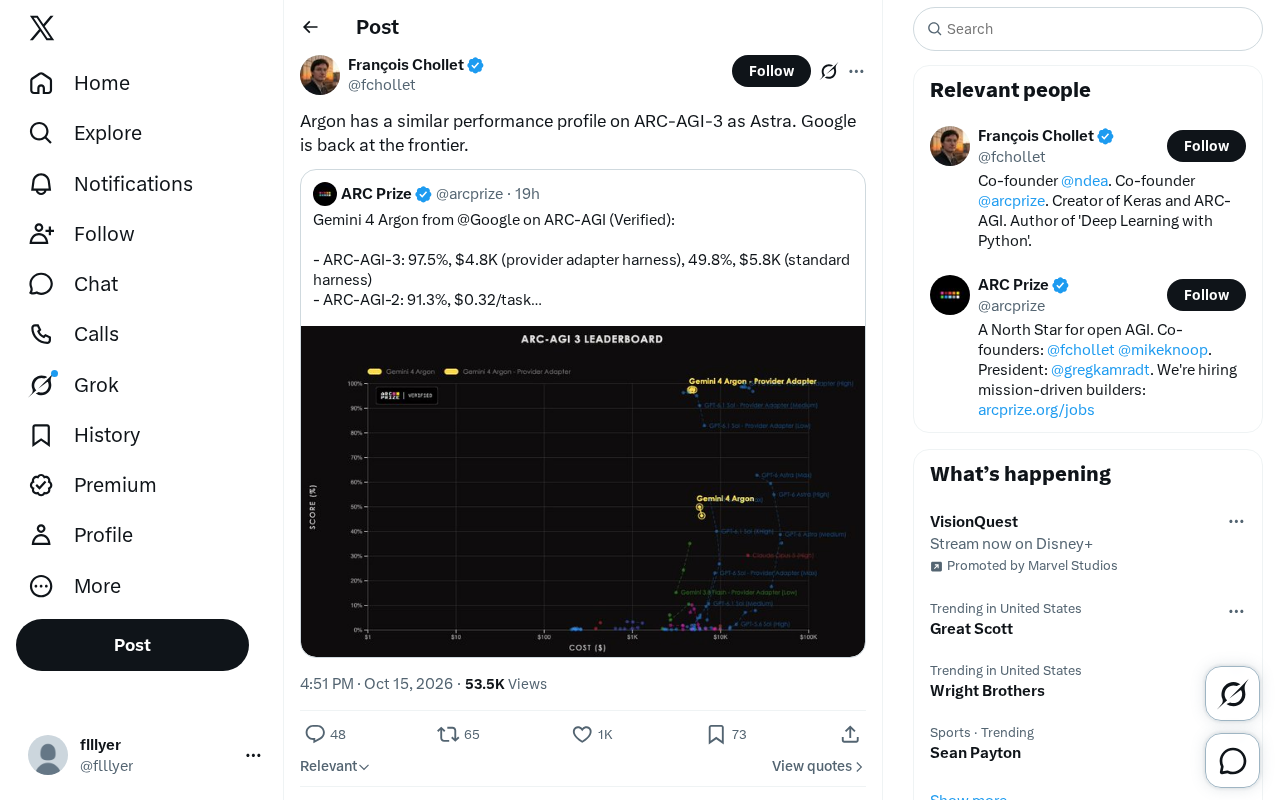
For developers and researchers who closely track AI reasoning capability evaluations, this development is worth noting. The ARC-AGI series of benchmarks, maintained by the Arc Prize Foundation, is specifically designed to measure AI systems' abstract reasoning and generalization abilities, rather than relying on massive data memorization or pattern matching. As the latest iteration in the series, ARC-AGI-3 further increases task complexity, requiring models to complete reasoning under few-shot or even zero-shot conditions.
Argon and Astra showing similar performance profiles on ARC-AGI-3 suggests the two models may share similar architectural approaches or training strategies. Considering that Astra was previously seen as an important exploration by Google in the reasoning direction, Argon's follow-up indicates that Google is systematically advancing its frontier model matrix rather than relying on a single breakthrough.
Why ARC-AGI-3 Has Become a Key Touchstone
The unique aspect of the ARC-AGI benchmark is that it is deliberately designed as a task set that is relatively easy for humans but extremely challenging for AI. Each task requires inducing abstract rules from a small number of examples and applying them to entirely new test scenarios. This setup effectively eliminates the possibility of models "remembering" answers through large-scale pre-training.
ARC-AGI-3 further increases task diversity and compositional complexity on this basis. A model that can achieve consistent performance on ARC-AGI-3 typically demonstrates stronger generalized reasoning ability, rather than performance gains from mere scale expansion.
The similar performance of Google's two models on this benchmark suggests that its reasoning optimization approach may have formed a reusable methodology. This is quite important for Google in re-establishing its position in the frontier AI competition—for some time previously, the general consensus was that Google had fallen behind OpenAI and Anthropic in the large model race.
ARC-AGI (Abstraction and Reasoning Corpus for Artificial General Intelligence) was proposed by former Google engineer François Chollet in 2019, with the original intent of providing a general reasoning evaluation set unaffected by training data distribution. Each task consists of several colored grid pairs, and the model needs to infer transformation rules from input-output demonstrations and apply them to new input grids. Since each task provides only a few demonstrations and rules are not shared between tasks, models cannot pass through pre-training memorization and must perform genuine "on-the-spot reasoning." ARC-AGI-1 and ARC-AGI-2 progressively increased task count and difficulty, while ARC-AGI-3 further introduces more complex compositional rules and interactive elements, making it one of the most rigorous public benchmarks for measuring large models' abstract reasoning capabilities.
The Competitive Logic Behind a Multi-Model Strategy
The parallel advancement of Argon and Astra reflects Google's multi-line approach to frontier model development. This approach contrasts with the strategies of other major industry players: while a single flagship model facilitates resource concentration, multiple models in parallel can cover different capability dimensions and application scenarios.
From a competitive landscape perspective, performance on ARC-AGI-3 is gradually becoming a hard indicator for measuring AI labs' frontier research capabilities. Unlike traditional language understanding or code generation benchmarks, ARC-AGI focuses more on evaluating whether models possess human-like abstract reasoning abilities. Breakthroughs in this dimension often signal a model's potential in complex real-world tasks.
As an additional note, the specific technical details of Argon and Astra have not yet been made public. Whether the similar performance of the two on ARC-AGI-3 is the result of architectural convergence or shared training data and methods remains undetermined.
Among frontier AI labs, multi-model parallel development is not unique to Google. OpenAI once simultaneously advanced the GPT series and o-series reasoning models, while Anthropic differentiates different scales and capability tiers within the Claude series. The core advantage of a multi-model strategy lies in risk diversification and capability complementarity: different architectures or training objectives may perform better on different tasks, and failure in one direction will not block the entire roadmap. Additionally, multi-model parallelism can provide controlled experimental conditions for internal research, accelerating understanding of reasoning mechanisms. However, this strategy also brings challenges in compute allocation, team coordination, and product line integration. How to balance multi-line advancement with resource concentration is key to whether Google can translate research results into competitiveness.
Practical Implications for Developers and Researchers
For AI application developers, Google's progress in frontier reasoning capabilities is worth continuous tracking. Improvements in abstract reasoning ability directly relate to model usability in scenarios such as few-shot learning, complex planning, and multi-step problem solving. If the technical approaches of Argon or Astra can be partially open-sourced or made available through APIs, it would help developers build more reliable AI applications.
For AI researchers, the performance profile on ARC-AGI-3 is itself a valuable research subject. The fact that two models show similar profiles suggests there may exist some general reasoning optimization paradigm. Deep analysis of the source of this similarity may reveal the capability boundaries and breakthrough paths of current large models in abstract reasoning.
Whether Google has truly returned to the frontier ultimately still requires more independent evaluations and real-world application performance to verify. But the current information at least indicates that its continued investment in the reasoning direction is producing measurable results.
One-line Summary
Google's Argon model performs similarly to Astra on ARC-AGI-3, seen as a signal of returning to the AI frontier.
Paragraph Summary
According to a post on X, Google's internal model Argon shows a similar performance profile to Astra on the ARC-AGI-3 benchmark, prompting interpretations of Google's return to the AI frontier. ARC-AGI-3, maintained by the Arc Prize Foundation, is designed to evaluate abstract reasoning and generalization, deliberately preventing models from memorizing answers through pre-training. The convergence of the two models suggests Google may have developed a reusable reasoning optimization methodology and is employing a multi-model parallel strategy for frontier R&D. For developers, this means improved usability in few-shot learning and complex planning scenarios; for researchers, it offers a window into analyzing general reasoning paradigms. However, specific technical details remain undisclosed, and whether Google has truly returned to the frontier still requires independent verification.
Related articles

JobRunner MCP Server: AI Agents Can Now Fix Failed Java Jobs
JobRunner launches an open-source MCP server enabling AI agents to view cluster status, diagnose failures, and recover Java jobs—incident response from any cloud coding environment or existing agent.

MLAI Digital Launches 9 Security Agents: MCP Server Safeguards the Full Lifecycle of Agentic AI
MLAI Digital launches Security MCP Server with nine built-in specialized security agents covering vulnerability discovery, attack simulation, prompt injection detection, API and infrastructure assessment, and accelerated remediation—embedding security validation across the full Agentic AI lifecycle from development to production.

Running Isaac Lab on H100 GPUs: Exploring Better Approaches
Exploring optimization methods for running Isaac Lab on NVIDIA H100 GPUs, including MIG configuration, mixed precision, TensorRT acceleration, and community experience to improve robotics simulation and reinforcement learning efficiency.