Google's Frontier Models and Sketchy Benchmarks? The Community Speaks Up

A Reddit jab at Google's opaque benchmarks highlights the AI community's growing demand for transparent, reproducible model evaluation.
A Reddit post mocking Google's "trust me bro" benchmarking style resonated widely across the AI community. The piece argues that major AI labs routinely release model scores without disclosing testing methodology, dataset versions, or comparison conditions — making independent verification nearly impossible. Since these numbers directly influence media coverage, developer adoption, and investor confidence, the stakes are high. Inconsistent baselines, data contamination, and selective disclosure are identified as the three main sources of distortion. The author calls for the industry to embrace third-party evaluation platforms like LMSYS Chatbot Arena, and advises users to cross-reference multiple independent sources rather than trusting any single official leaderboard.
A Reddit Rant That Sparked a Conversation
In the AI community, every time a major lab releases a new frontier model, a familiar debate follows: how trustworthy are the benchmarks? A recent Reddit post captured this frustration perfectly: "Google loves using 'trust me bro' benchmarks when releasing frontier models. Feels great."
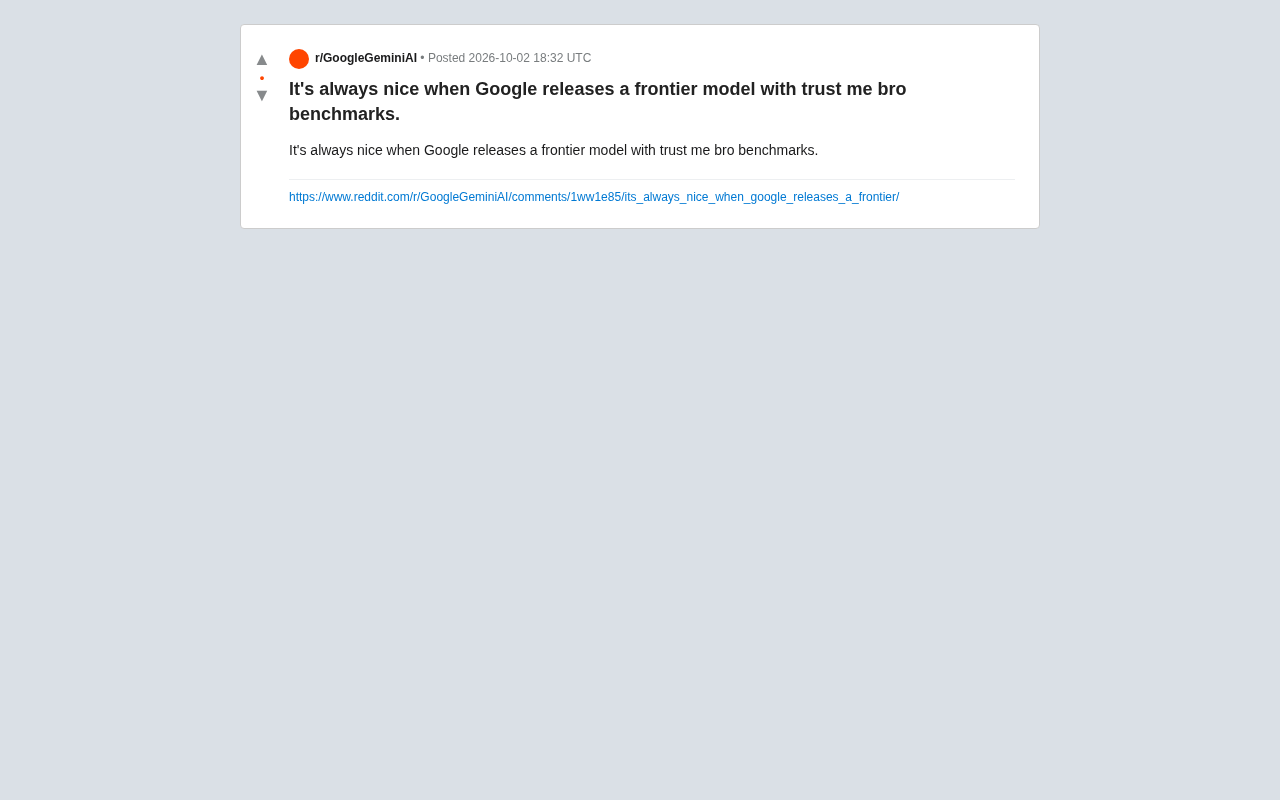
The sarcasm cuts straight to a recurring complaint about how major model releases work — the benchmark numbers shown in official announcements often lack reproducible details, leaving the community with little choice but to take the vendor's word for it.
What Does "Trust Me Bro" Benchmarking Actually Mean?
"Trust me bro" is an internet slang phrase used to mock claims made without supporting evidence — essentially asking someone to believe something just because you said so. In the context of AI model releases, it refers to the practice of presenting impressive benchmark scores without disclosing the full methodology: which dataset version was used, how prompts were configured, what comparison conditions were applied, or whether third parties can independently verify the results.
This isn't unique to Google. Nearly every major AI lab selects the most favorable evaluation dimensions and comparison targets when launching a new model — that's standard marketing. But because frontier model capability assessments directly shape industry decisions and user expectations, the community's demands for transparency have only grown louder.
Why Benchmark Credibility Matters
Benchmarks are the most direct yardstick the outside world has for measuring model capability. When a model claims to reach a new high on some reasoning, coding, or multimodal task, those numbers are quickly cited by media, used by developers to make adoption decisions, and cited by investors as proof of technical leadership.
If those numbers can't be independently reproduced, several real problems emerge:
- Inconsistent comparison baselines: Vendors may test their own model under optimal configurations while comparing against a competitor's default setup, skewing results.
- Data contamination risk: If benchmark datasets were included in training data, inflated scores can go undetected.
- Selective disclosure: Only showcasing strong-performing tasks while quietly avoiding weaker areas.
Taken together, these factors make it genuinely difficult to assess a model's true capabilities from official leaderboard numbers alone.
Data contamination is one of the hardest problems to detect in large model evaluation. Since widely used benchmarks — such as MMLU, HumanEval, and GSM8K — have long been publicly available on the internet, models may have encountered these questions, and even their correct answers, during pretraining or fine-tuning, leading to artificially inflated scores. What makes this particularly insidious is that vendors may not be doing this intentionally: large-scale web crawls naturally capture benchmark content, and it's extremely difficult to audit which data made it into a training set after the fact. Some researchers have tried to address this by building "future datasets" (questions made public only after the model's training cutoff) or by dynamically generating new problems, but neither approach has become an industry standard. For this reason, healthy skepticism toward any claim of dramatically outperforming prior models on public benchmarks is entirely justified.
What the Community Wants: A More Transparent Evaluation Ecosystem
Behind this Reddit jab lies a broader call for third-party independent evaluation and reproducibility. In recent years, platforms like LMSYS Chatbot Arena — built on real-user blind testing — and various open-source evaluation frameworks have gained traction precisely because they offer a more neutral reference point than vendor self-reporting.
For labs, publicly disclosing evaluation methodology, providing reproducible scripts, and clearly stating comparison conditions would not only quiet the critics — it would build long-term technical credibility. For users and developers, maintaining healthy skepticism toward any single-source benchmark score and cross-referencing multiple independent evaluations is the more prudent approach when choosing a model.
LMSYS Chatbot Arena is an open model evaluation platform maintained by a UC Berkeley team. Its core mechanism asks real users to chat simultaneously with two anonymous models — without knowing which is which — and vote for the one they prefer after the interaction. This "blind test + real users" design avoids the conflicts of interest inherent in vendor self-testing and sidesteps the problem of benchmark questions being specifically optimized for. The platform uses an Elo rating system to aggregate votes into a continuously updated leaderboard. Because user queries reflect genuine, everyday use cases rather than standardized academic test items, many developers consider Chatbot Arena results a better proxy for real-world usability than isolated benchmark scores. That said, it has limitations: result quality depends on the composition of the user base, and deep capabilities in specialized professional domains are difficult to distinguish through general-audience voting.
Closing Thoughts
This brief Reddit quip offered no specific model names or data points — it was mostly a concentrated expression of community sentiment. But it serves as a useful reminder: in an era of intensifying AI capability competition, what's more valuable than impressive benchmark numbers is transparent, verifiable, and reproducible data. When any frontier model launches with bold claims, a degree of rational skepticism is always warranted.
Note: This article is based on a Reddit community discussion with limited source material. The views expressed reflect general community sentiment and do not constitute conclusions about the actual performance of any specific product.
Related articles

Chain of Thought Isn't Just for AI: How Humans Can Use CoT to Improve Thinking Quality
Chain of Thought isn't just a prompt trick for large models. Starting from a Hacker News discussion, this article analyzes why CoT works for human thinking too, breaks down actionable ways to transfer it, and highlights the key differences between human CoT and machine CoT.
Cloudflare Teams Up with OpenAI: Closi…
Cloudflare Teams Up with OpenAI: Closing the Loop from Vulnerability Discovery to Defense with AI
Cloudflare uses OpenAI Daybreak to investigate security vulnerabilities and generate reviewable remediation plans, while developers use Codex to boost coding efficiency and quality.

Orca Multi-Agent Orchestration in Practice: A Guide to Parallel Collaboration with Claude and Codex
Orca is Stable AI's free open-source agent workbench supporting 34 agents like Claude Code and Codex in parallel. Learn its Git worktree isolation, multi-model orchestration, and mobile management.