Google's Gemini 4 Carbon Targets Cybersecurity as OpenAI Reportedly Buys TPUs

Google's Gemini 4 Carbon pivots to cybersecurity as LLM competition enters the workflow-embedding phase.
The article rounds up a batch of AI and tech news, with the core thread being LLMs shifting from general capability demonstrations to embedding in specific workflows. Google released Gemini 4 Carbon, positioned for cybersecurity and long-horizon tasks, focusing on vulnerability discovery, exploit verification, and patch generation, opened first to defenders; Chrome autofill integrates Gemini personal intelligence to extract info from Gmail and generate form suggestions, responding to privacy concerns with an optional toggle. Microsoft opened its hosted agent runtime and sandbox via Foundry Agent Service, with Azure quarterly revenue ~$33.2B, up ~48% YoY. Reports also indicate OpenAI plans to purchase Google TPUs to reduce reliance on Nvidia, though unconfirmed. Hardware and consumer apps advance in parallel, with Meta launching a non-chatbot AI pet app.
Google Releases Gemini 4 Carbon: Cybersecurity Becomes the New Battleground for LLMs
According to a roundup by Bilibili creator CaseyAI Global Tech Frontier Express, Google has launched its frontier model Gemini 4 Carbon, positioned not for general conversation but for cybersecurity and long-horizon tasks. The official capability list centers on three things: vulnerability discovery, exploit verification, and patch generation. The model leads on multiple benchmarks and has already been made available to select cyber defenders first.
This directional choice is worth noting. Over the past year, LLM competition has focused on reasoning and multimodality, but Gemini 4 Carbon makes "defenders" its first batch of users, signaling Google's attempt to embed model capabilities into real security operations workflows rather than stopping at demos. Vulnerability hunting and patch generation are classic long-chain, multi-step, low-tolerance scenarios—exactly matching the "long-horizon tasks" description. They require the model to maintain context consistency across dozens of steps and make verifiable judgments at key decision points.
A Shift from "Can Talk" to "Can Do"
Security scenarios impose very different requirements on models than chat scenarios: conclusions must be reproducible, patches must compile, and the verification process must leave an audit trail. Gemini 4 Carbon lists "exploit verification" as a separate capability, indicating Google recognizes that the real bottleneck in vulnerability discovery isn't identification but confirming whether a vulnerability can actually be triggered. If this step is automated by the model, security teams' processing queues would shorten noticeably.
Long-horizon tasks refer to complex tasks requiring a model to make continuous decisions across dozens to hundreds of steps, maintain state, and ultimately achieve a goal. Unlike single-turn Q&A, long-horizon tasks impose three key requirements on models: context consistency (not forgetting information obtained in earlier steps), error recovery capability (being able to backtrack or switch strategies when a step fails), and process auditability (every step leaves a trace for human review). Vulnerability hunting in cybersecurity is a typical long-horizon task: from reconnaissance, fingerprinting, and input construction to trigger verification, the chain is long and tolerance is extremely low—any hallucination at any step can lead to false positives.
Patch generation differs fundamentally from general code generation. Security patches must satisfy three constraints: fix the target vulnerability, introduce no new triggerable defects, and pass the project's compilation and testing pipeline. This requires the model to understand not only the root cause of the vulnerability but also the target codebase's build system and existing test coverage. Industry practice typically places model-generated patches into isolated environments for automatic compilation and regression testing, then has humans or higher-order models review them, forming a "generate-verify-filter" pipeline. Patch generation is therefore regarded as one of the hardest-to-implement yet most commercially valuable scenarios for LLMs in software engineering.
Chrome Autofill Integrates Personal Intelligence, Privacy Toggle Becomes Key
In the same batch of news, Google enhanced Chrome's autofill capability: leveraging Gemini's personal intelligence to extract flight numbers, order details, and addresses from Gmail and generate form-filling suggestions. Desktop and mobile users in the US can choose to enable or disable it.

Using email content as a data source for form filling is highly practical—addresses and order numbers are already scattered across emails, and manually transferring them is costly. But this also puts the boundary question of "personal intelligence reading personal data" on the table. Google's answer is an explicit optional toggle that puts the decision in users' hands. Whether this design is sufficient depends on the default state and clarity of prompts, and the source material only mentions an "optional toggle" without disclosing whether it's on by default.
Microsoft Opens Copilot Hosted Agents, Azure Growth Shines
Microsoft has opened its enterprise-grade Copilot runtime through Foundry Agent Service in public beta, providing a hosted agent loop and sandbox with support for multiple models, skills, and MCP tools. For developers, this means handing agent orchestration, execution, and isolation to the platform while focusing on business logic.

Financial data was disclosed alongside: Alphabet's Q3 revenue grew about 25% year-over-year, with Google Cloud revenue at approximately $30.7 billion, doubling year-over-year, driven by strong AI infrastructure and TPU demand. Microsoft disclosed Azure quarterly revenue of approximately $33.2 billion for the first time in dollar terms, up about 48% year-over-year, and revealed approximately $10 billion from its OpenAI commercial arrangement. Both cloud providers' growth rates point to the same thing—AI compute spending remains in an expansion phase.
The Significance of Hosted Agents
The main friction point in agent deployment has never been model capability but the runtime: how loops terminate, how failed tool calls are retried, how sandboxes are isolated. Foundry Agent Service turns these into platform capabilities, lowering the barrier for enterprises to push agents from prototype to production.
MCP (Model Context Protocol) is an open protocol proposed by Anthropic and increasingly adopted across the industry, used to standardize how LLMs connect to external tools and data sources. Think of it as a "USB interface for AI tool calling": the model side only needs to describe available tools per the protocol, the tool side exposes capabilities per the protocol, and the two can be composed without writing a separate adapter layer for each model. Microsoft Foundry Agent Service's declared support for MCP tools means enterprises' existing internal systems or third-party services only need to implement an MCP server to be directly callable by hosted agents—a key factor in how platform-based agent runtimes reduce integration costs.
OpenAI Reportedly Purchasing Google TPUs, Compute Supply Chain Shifts
According to related reports, OpenAI plans to purchase Google TPUs to reduce dependence on Nvidia. Details are undisclosed and neither party has officially confirmed. This is news to treat with caution: single-sourced and lacking official endorsement, though the direction echoes the strong TPU demand mentioned earlier.
If true, it reflects LLM companies' long-term desire to diversify their compute supply chains. Structural cost pressures in training and inference give any frontier lab an incentive to bring in a second supplier. However, without official confirmation, this should still be treated as rumor rather than established fact.
Hardware and New Apps: From Smart Glasses to Pixel Pets
On the hardware side, Acreo released the Aura wired smart glasses, featuring Android XR and Gemini, using an external compute box design, starting at about $1,099, shipping in mid-November. Amazon released the Alexa smart picture frame and the EchoTime smart alarm clock—the frame starting at about $200, and the clock with optional sleep sensing and sunrise wake-up.

On the software side, Meta launched the AI pet app Wild World in the Philippines, where users can raise pixel pets, write diaries, and play mini-games, targeting users 18 and older.
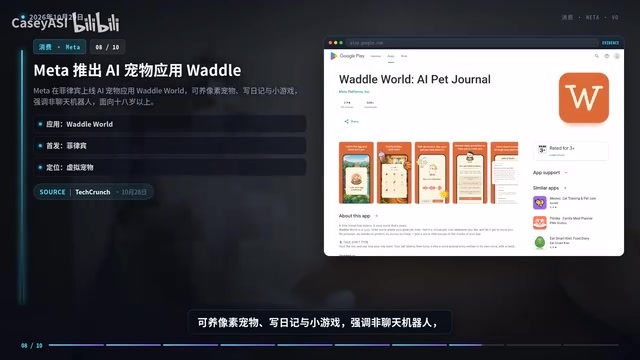
Meta specifically emphasizes it's "not a chatbot," and this positioning is quite interesting: in an era flooded with conversational AI, shifting the interaction form from "Q&A" to "companionship and nurturing" is testing another product path. The retention logic of nurturing-style interactions differs from chat—it relies on daily rituals rather than information acquisition efficiency.
Open-Source Additions
Nvidia open-sourced Nemotron 3.5 Transcribe, supporting transcription in about 40 languages with multi-speaker diarization, targeting meeting and medical scenarios, and runnable on a single GPU. Single-GPU runnability is friendly to small and mid-sized teams—deployment cost is a key consideration for high-frequency tasks like transcription.
Summary
The common thread across this batch of news is that LLMs are shifting from general capability demonstrations to embedding in specific workflows—security defense, form filling, agent hosting, voice transcription, each corresponding to clear use cases and deployment constraints. Meanwhile, rumors of compute supply chain diversification and cloud providers' rapid growth indicate underlying investment hasn't cooled. For practitioners, what's worth watching isn't just model leaderboards but the form in which these capabilities are delivered and the conditions under which they're opened up.
Related articles

VERS: Editing Activation Explanations to Halve Reasoning Model Tokens
VERS guides reasoning models by editing activation explanations, cutting 45.8% of tokens on GSM8K with only a 0.82 pp accuracy drop and transferring to larger models, but losing accuracy on competition problems.

Finding Errors Is Not Enough: Selective Model Escalation for Entity-Targeted Sentiment Analysis
This study explores selective model escalation for entity-targeted sentiment analysis, comparing data collection ordering, uncertainty-driven re-examination, and model routing—finding that minority-class priority only helps at very small data volumes, the oracle upper bound far exceeds actual gains, and escalation must be tailored to each dataset.

WAS-PO: Using Whitened Advantages to Solve the Correlation Trap in Multi-Reward Reinforcement Learning
WAS-PO paper proposes whitening advantages to correct correlation bias in multi-reward RL: when rewards are correlated, naive weighted summation effectively applies Σ^{1/2}w instead of w. Experiments show training reward improves steadily, but held-out accuracy does not improve in sync, and under two rewards it actually falls behind.