Google's Project Suncatcher Prototype Satellite Reaches Orbit: A First Step Toward Space-Based AI Data Centers

Google's Project Suncatcher prototype orbits Earth, testing AI data centers powered by space-based solar energy.
Google's Project Suncatcher has successfully placed a prototype satellite in orbit, moving the concept of orbital AI data centers into active engineering validation. The core logic: satellites in low Earth orbit can access intense, near-continuous solar energy, and rather than beaming that power back to Earth with enormous transmission losses, the project performs AI computation directly in orbit and transmits only results — sidestepping the fundamental efficiency problem of traditional space-based solar power. However, the engineering challenges are severe: heat in a vacuum can only dissipate through radiation, cosmic rays can cause chip bit flips, and on-orbit hardware failures are nearly impossible to repair. The current mission is a validation prototype, far from a cluster capable of real AI workloads, and the technical community remains cautious — though broadly supportive of the engineering groundwork it lays for the future of space computing.
AI Computing Experiment in Space Gets Underway
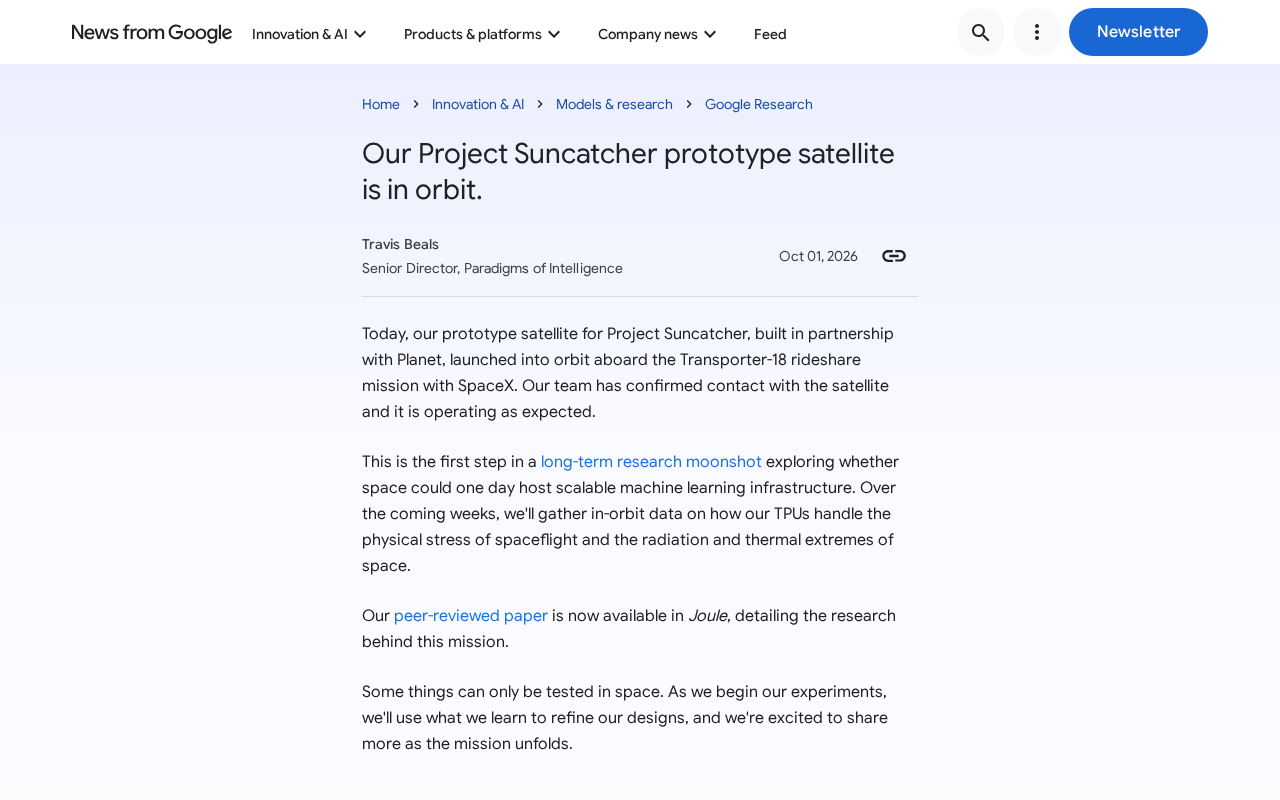
Google's Project Suncatcher has reached a key milestone — its prototype satellite has successfully entered orbit. The news sparked discussion on Hacker News and other tech communities. While public details remain scarce, this marks a significant shift for the ambitious idea of moving AI computing infrastructure into space: from concept to active technical validation.
At its core, Project Suncatcher envisions building a network of AI data centers operating in orbit, powered by solar energy that flows far more freely in space than on the ground. Terrestrial data centers have long been constrained by power supply, cooling costs, and land availability. Satellites in low Earth orbit can access solar energy more continuously and efficiently — offering a fundamentally different energy model for large-scale AI inference and training.
Why Move Data Centers to Space?
As demand for large model training and inference has exploded, energy consumption has become an unavoidable bottleneck for the AI industry. Ground-based solar power is limited by day-night cycles, weather, and latitude. In the right orbit, a satellite can remain in sunlight for the vast majority of the year, achieving power generation efficiency that far exceeds anything possible on the ground.
This idea isn't entirely new — space-based solar power has been discussed for decades. What sets Project Suncatcher apart is that it brings the compute itself to where the energy is. Rather than beaming power generated in space back to Earth, it performs the computation directly in orbit and transmits only the results. This architecture has the potential to sidestep the enormous energy losses inherent in wireless power transmission.
The concept of Space-Based Solar Power (SBSP) was first proposed by scientist Peter Glaser in 1968. The basic idea is to deploy large solar arrays in geostationary orbit and wirelessly transmit electricity back to Earth via microwave or laser. Compared to ground-based solar, orbital solar irradiance is roughly 8 times more intense at peak, unaffected by atmospheric absorption, day-night cycles, or weather — theoretically enabling 24-hour power generation. However, the fatal flaw in traditional SBSP has always been transmission loss: microwave or laser transmission efficiency from orbit to the ground typically doesn't exceed 50%, and combined with conversion losses, overall efficiency drops dramatically. Project Suncatcher's architecture sidesteps this problem entirely — instead of trying to send electricity back to Earth, it completes AI computation in orbit and transmits only data, eliminating the biggest efficiency drain of wireless energy transfer at the source.
What the Prototype Means — and What Remains Unsolved
What launched is a prototype satellite, meaning the project is still in its early technical validation phase. A fully operational space-based AI data center is still a long way off. Prototype missions typically serve to verify fundamental engineering assumptions: whether hardware can function in the orbital environment, whether thermal management approaches are viable, and how data links actually perform in practice.
The challenges of computing in space are far more complex than on the ground:
The Thermal Management Problem
In a vacuum, there is no air convection — heat can only be dissipated through radiation. This places extreme demands on thermal management for high-power compute chips. AI accelerators generate enormous amounts of heat, and figuring out how to effectively cool them in space is one of the core engineering bottlenecks.
Ground-based data centers rely on air convection and liquid cooling, but in the vacuum of space, heat can only escape via infrared radiation, with efficiency constrained by radiator surface area and temperature differential. According to the Stefan-Boltzmann law, radiative heat dissipation scales with the fourth power of temperature — meaning that to shed the same amount of heat, you either need an enormous radiator surface area or you must allow chips to run at higher temperatures. Modern AI accelerators (such as GPUs and TPUs) can have thermal design power (TDP) ratings in the hundreds of watts, making every watt of heat dissipation far more costly in space than on the ground. This is why space compute hardware may need to favor low-power, high-efficiency chip architectures rather than directly repurposing the AI accelerators used in terrestrial data centers.
Radiation and Reliability
Cosmic rays and high-energy particles in orbit can cause bit flips and other chip failures. Consumer-grade or data center-grade AI hardware may not survive the space environment without additional fault-tolerance design.
Orbital radiation threats come primarily from two sources: galactic cosmic rays (GCR), which are extremely high-energy and difficult to shield against, and solar energetic particle (SEP) events, which are especially intense during solar activity peaks. When high-energy particles pass through a chip, they can cause a Single Event Upset (SEU) — a bit in a memory cell is randomly flipped, leading to anything from a calculation error to a full system crash. Radiation-hardened chips typically use Triple Modular Redundancy (TMR) and majority voting to correct errors, but this significantly reduces compute density and increases power consumption. Striking the right balance between the computational demands of AI inference and training and the fault-tolerance requirements of orbital radiation is one of the central engineering challenges in space AI hardware design.
Data Transmission and Maintenance
Communication bandwidth and latency between orbital satellites and the ground, combined with the practical reality that equipment failures are nearly impossible to repair on-site, are problems that must be solved before any scaled deployment becomes feasible.
The Community's Cautious Stance
Judging by the level of discussion on Hacker News, the news is generating interest but the technical community is broadly cautious. Getting a prototype satellite into orbit is only the very first step. Between a single validation satellite and an orbital data center cluster capable of handling real AI workloads lies a gauntlet of cost, scale, and reliability challenges.
What's worth noting is that projects like this reflect the long-term bets major tech companies are placing on solving AI's energy bottleneck. As terrestrial resources and power grids increasingly become a ceiling, looking to space for compute and energy is a direction worth exploring. Even if Project Suncatcher never achieves large-scale deployment, the engineering lessons it generates will be valuable for the broader field of space computing.
Conclusion
The successful orbital insertion of the Project Suncatcher prototype satellite is a technology probe aimed squarely at the future. It illustrates both the imaginative possibilities for AI infrastructure evolution and the many foundational problems that space computing still needs to solve. As data comes back from the mission and gets analyzed, whether this project can deliver on its energy efficiency promises is well worth following.
Note: Given the limited public information currently available, this article is based on the project's publicly stated vision and early reporting. More detailed technical specifications await official disclosure.
Related articles

Chain of Thought Isn't Just for AI: How Humans Can Use CoT to Improve Thinking Quality
Chain of Thought isn't just a prompt trick for large models. Starting from a Hacker News discussion, this article analyzes why CoT works for human thinking too, breaks down actionable ways to transfer it, and highlights the key differences between human CoT and machine CoT.
Cloudflare Teams Up with OpenAI: Closi…
Cloudflare Teams Up with OpenAI: Closing the Loop from Vulnerability Discovery to Defense with AI
Cloudflare uses OpenAI Daybreak to investigate security vulnerabilities and generate reviewable remediation plans, while developers use Codex to boost coding efficiency and quality.

Orca Multi-Agent Orchestration in Practice: A Guide to Parallel Collaboration with Claude and Codex
Orca is Stable AI's free open-source agent workbench supporting 34 agents like Claude Code and Codex in parallel. Learn its Git worktree isolation, multi-model orchestration, and mobile management.