Google Search Launches Five AI Learning Features: A Complete Guide to Test Prep Assistants and Smart Learning Platforms
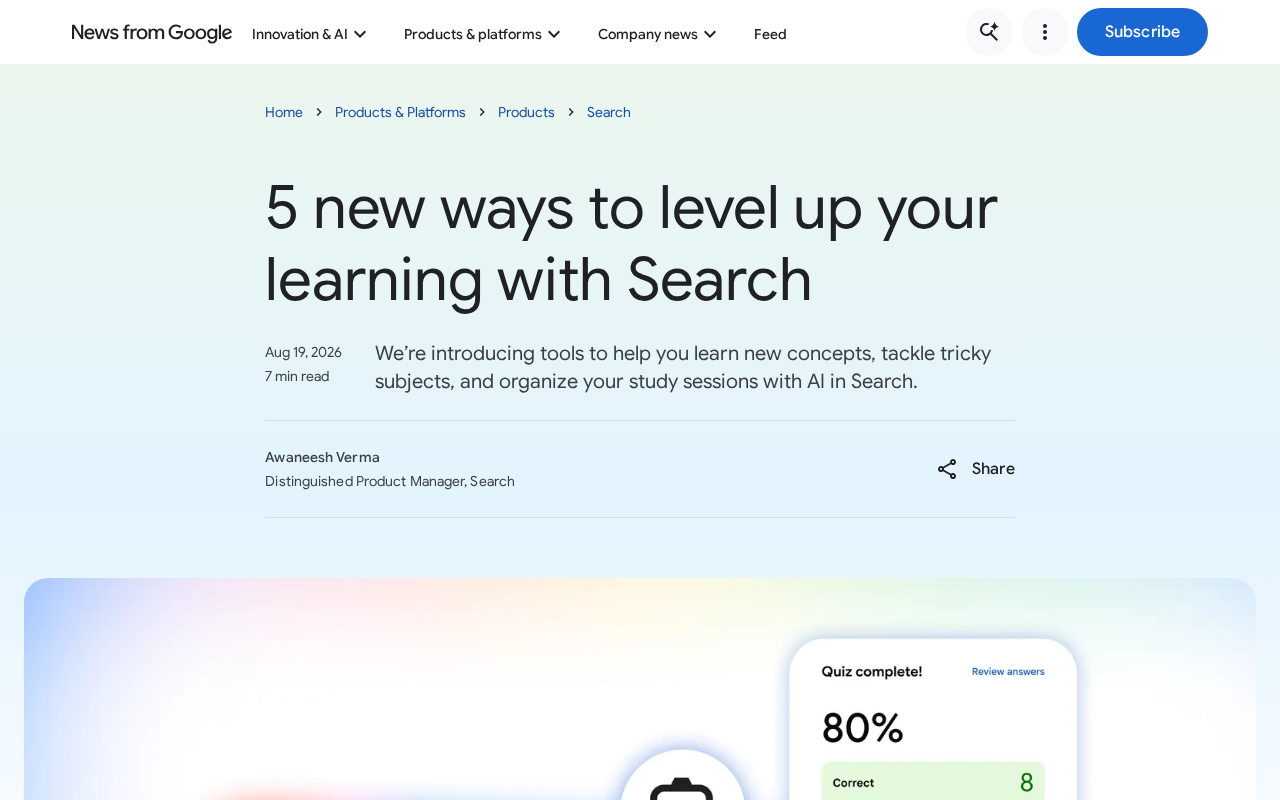
Google Search adds five AI features turning it into a smart learning and test prep platform.
Google has introduced five new AI-powered learning features in its search engine, designed to help students prepare for courses and standardized exams like the SAT and GRE. The updates transform Google Search from a simple information retrieval tool into a structured, interactive learning platform powered by Gemini LLMs. With its unmatched user reach and zero-friction access, Google aims to democratize test prep while competing with EdTech players like Khan Academy and OpenAI's educational products.
Google Search Evolves into a Smart Learning Platform
Google recently announced the launch of five new AI-powered learning features within its search engine, aimed at helping students study more efficiently for courses and standardized exams. This series of updates signals that Google Search is gradually transforming from a traditional information retrieval tool into an intelligent learning platform with integrated AI capabilities.
As generative AI technology continues to mature, Google is accelerating the integration of these capabilities into its core product lineup. Generative AI refers to artificial intelligence technology capable of producing entirely new content based on training data, with its core architecture typically built on Transformer models that learn language patterns and knowledge associations through large-scale pre-training. Google has deep expertise in this field, and its Gemini series of large language models serves as the underlying engine powering these search-based learning features. Unlike traditional discriminative AI, generative AI can understand user intent and produce structured responses, making it naturally suited for educational tutoring scenarios such as concept explanations, question generation, and answer feedback.
For students, the biggest benefit of this shift is clear — there's no longer a need to switch between multiple apps. Instead, they can complete the entire learning workflow, from concept comprehension to practice tests, directly within the familiar search box.
Core Feature Upgrades for Test Prep Scenarios
From Information Retrieval to Structured Deep Learning
The core design philosophy behind this update is to make Google Search truly understand students' learning needs. In the past, when students searched for academic concepts, they often had to sift through and synthesize information from numerous search results — a far from efficient process. The new AI learning features aim to change this by directly providing students with structured, interactive learning content.
Behind this transformation lies Google's deep understanding of educational test prep scenarios. Whether preparing for routine course quizzes or standardized exams like the SAT and GRE, students need systematic knowledge organization, targeted practice, and instant answer feedback. Traditional search fell noticeably short in these areas, and AI technology fills that gap perfectly.
Targeted Support for Standardized Test Preparation
Google placed special emphasis on standardized test prep capabilities in this update. The SAT (Scholastic Assessment Test) is a standardized exam for U.S. college admissions covering reading, writing, and math, taken by over 2 million students annually. The GRE (Graduate Record Examinations) is a general entrance exam for graduate school that tests verbal reasoning, quantitative reasoning, and analytical writing skills. These exams share common characteristics: highly standardized question formats, strictly quantified scoring systems, and clearly structurable study processes — precisely the kind of scenarios where AI technology excels. Traditional test prep has typically relied on expensive tutoring services (such as Kaplan and Princeton Review), with costs ranging from hundreds to thousands of dollars.
By offering relevant practice resources and problem-solving explanations directly through Google Search, students can significantly reduce both the time and financial costs of test preparation. It's particularly worth noting that for students with limited financial means who cannot afford expensive tutoring programs, these free AI learning tools carry significant educational equity value. They help narrow the educational gap caused by unequal resource distribution to a meaningful degree.
AI Reshaping the EdTech Industry
A Fundamental Shift in the Search Engine's Role
Google's move is not an isolated case but rather a microcosm of the broader tech industry's deep integration of AI into education. From OpenAI launching student-focused products to the rapid rise of various AI tutoring apps, educational technology is undergoing a profound AI-driven transformation.
Competition in the AI education space has become increasingly fierce. In 2024, OpenAI launched ChatGPT Edu, a version specifically designed to offer customized AI services for higher education institutions. Khan Academy partnered with OpenAI to develop the AI tutor Khanmigo. Duolingo deeply integrated GPT-4 into its language learning experience. Additionally, traditional EdTech platforms like Chegg and Coursera are accelerating their AI transformations. Google's unique advantage lies in the gateway effect of its search engine — users don't need to download a new app or register a new account; learning behavior can seamlessly occur within the most natural information-seeking context. This "zero-friction" user reach is a competitive moat that other EdTech products find difficult to match.
As the world's most widely used search engine, Google has an unparalleled traffic gateway advantage. Embedding learning features directly into the search product means that hundreds of millions of users can access these AI learning tools at zero cost and with no barriers to entry. This scale effect is something no standalone educational app can replicate.
Opportunities and Challenges Coexist
However, AI-assisted learning also raises some issues that must be honestly addressed.
Content Accuracy Risks: Generative AI is prone to "hallucination" — the phenomenon of including inaccurate information in its responses. The root cause lies in the generation mechanism of large language models, which essentially predict the next most probable word based on probability rather than retrieving facts from a reliable database. This risk is especially pronounced in educational settings: for example, a model might skip critical steps in a mathematical derivation, confuse timelines when discussing historical events, or provide imprecise scientific explanations. Google's typical countermeasures include Retrieval-Augmented Generation (RAG), which has the model retrieve and cross-reference reliable sources before answering, as well as setting confidence thresholds to filter uncertain outputs. Nevertheless, delivering incorrect answers in academic contexts could still mislead students' understanding.
Concerns About Depth of Learning: Will over-reliance on AI-provided instant answers weaken students' ability to think independently and explore subjects deeply? This is an important topic that the education community has been actively discussing. Cognitive science research shows that "desirable difficulty" in the learning process — actively retrieving and processing information under moderate challenge — is crucial for long-term memory formation. If AI is too "helpful" in eliminating all cognitive friction, it could actually undermine deep learning outcomes.
Google needs to find a reasonable balance between providing learning convenience and ensuring learning quality. The ideal AI learning tool should serve as an "intelligent teaching assistant" that guides students' thinking, rather than an "answer generator" that replaces the thinking process entirely.
Far-Reaching Impact on Students and the Education Industry
For students, these new Google Search features offer more convenient and personalized learning pathways, particularly useful for self-directed test preparation. For the education industry as a whole, Google's entry into the AI education space via its search engine will further accelerate the adoption of AI learning tools while potentially reshaping the competitive landscape of online education platforms and tutoring services.
It's foreseeable that as general-purpose tools like search engines and AI assistants continue to enhance their learning support capabilities, traditional EdTech companies will face increasingly intense competitive pressure. How to build differentiated, high-quality learning experiences amid the AI wave will become the key battleground. Education platforms that can provide deep content in vertical domains, possess authoritative certification systems, or offer strong community interaction capabilities may have a better chance of finding their niche in competition with tech giants.
Overall, the five AI learning features launched by Google Search demonstrate both the empowering potential of technological progress for educational scenarios and the strategic ambitions of tech giants toward the massive education market. For the broad student user base, this is undoubtedly a positive signal worth paying attention to and trying out.
Related articles

Hexel Editor: A Native macOS Hex Editor That Actually Understands File Structures
Hexel Editor is a native macOS hex editor for reverse engineers and security researchers, with built-in Mach-O, ELF, PE parsing, instant large file loading, entropy analysis, and real-time byte decoding.

Suno 2.0 Teaser Strengthens Creative Control, Cursor Origin Reimagines Programming Infrastructure
AI roundup: Suno Studio 2.0 teases stronger creator control, Cursor Origin adds code review & repo sync, Tencent launches HY3D World Claw for text-to-3D, Ant Group open-sources Ling 3.0 Tiny, Kimi K3 arrives on Databricks.

Techietribe AI Review: An All-in-One Online Presence Management Platform for Small Businesses
In-depth review of Techietribe AI, an all-in-one online presence platform for small businesses, covering AI website building, business profiles, and integrated directories.