Google Student Plan Is Back: Can Free Year Stack with Existing Discounts? A Redemption Guide

Google's student plan returns with a free year, but stacking and billing display issues confuse users.
Google has relaunched its Student Plan offering a free year of AI Premium subscription. Users are confused about whether the free year stacks with previously claimed $5/month discounts, and why Google Play still shows charges after redemption. This guide explains potential causes including sync delays and offer conflicts, and provides steps to verify offer status through billing pages, confirmation emails, and Google support.
Google AI Student Plan Returns Once Again
Recently, discussions on Reddit about the Google Student Plan reopening have been gaining traction. Users have discovered that Google is once again offering students a free one-year AI subscription. However, confusion and questions have emerged in the community regarding the specific rules and stacking logic of this promotion.
The Google Student Plan is an AI subscription promotion targeting enrolled higher education students, primarily covering the Google One AI Premium plan. This plan typically includes Gemini Advanced (access to Google's most advanced AI models), 2TB of cloud storage, and AI features integrated into Google Workspace apps (such as Docs, Gmail, and Sheets). Students need to verify their enrollment status through third-party identity verification platforms like SheerID to qualify for the offer. Google has launched similar promotions multiple times throughout 2024, though the terms and generosity have varied—ranging from a discounted price of $5 per month to a completely free year.
The core appeal of this latest wave: eligible students can get one full year free of Google's AI premium subscription. For students who already rely on AI tools for studying, writing, and coding, this is undeniably an attractive benefit. But as the original poster noted, the actual redemption experience isn't always smooth.
Core Confusions Users Are Facing
Can You Stack the Free Year on Top of an Existing $5 Discount?
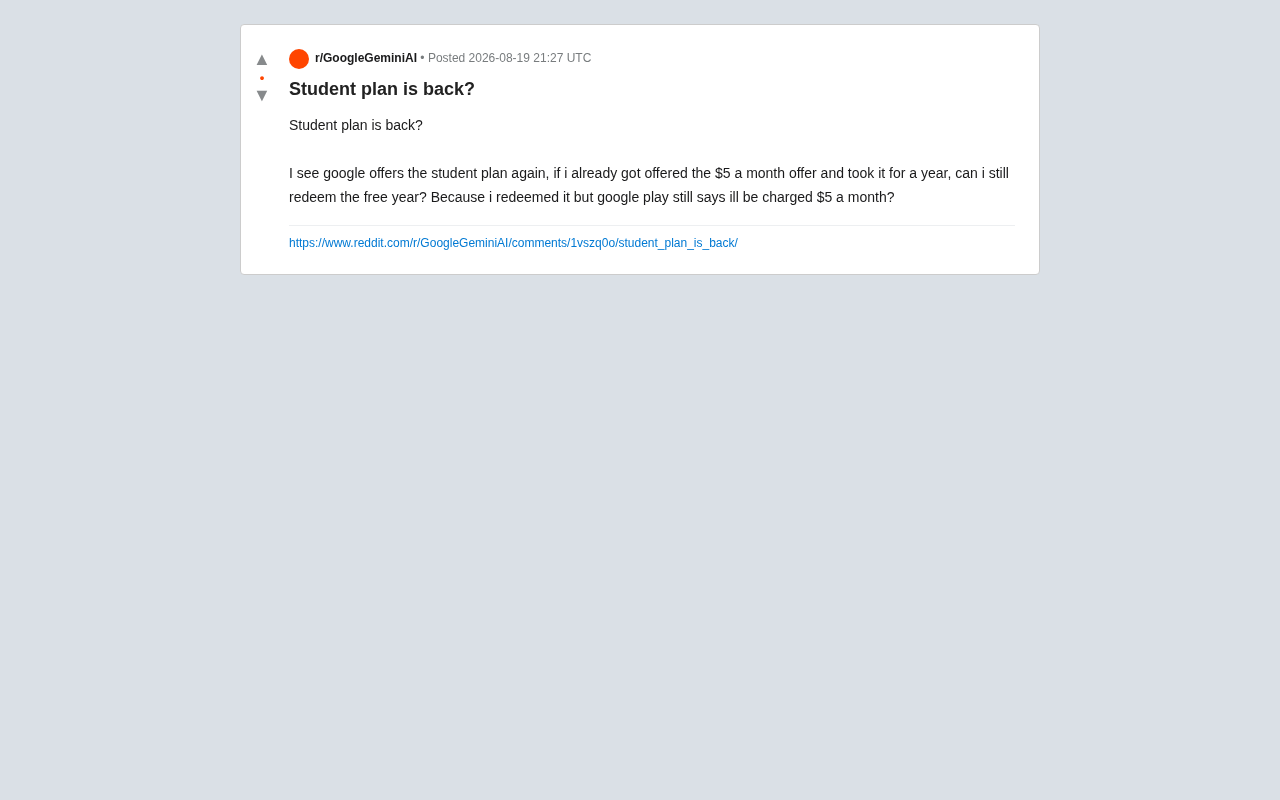
The original poster raised a very common question: they had previously claimed Google's $5/month student discount and had been using it for a year. Now that the free one-year plan is back, they wanted to know if they're still eligible to redeem this new free subscription.
This question touches on one of the most common pain points in subscription promotions—stacking and conflicts between offers. The offer-stacking mechanism in subscription products is a complex technical and business challenge in the SaaS (Software as a Service) industry. Most subscription platforms follow a "mutual exclusivity" principle, meaning a single account can only enjoy one promotional offer at a time, and new offers typically don't take effect until the old one expires. However, some platforms allow "upgrade overrides," where a better deal can directly replace the current plan. Google's promotional system is based on an internal account promotion history database that records every promo code and campaign each account has ever claimed. Whether a user who has already enjoyed a discounted rate can receive an entirely new free benefit depends on Google's backend logic for evaluating account promotion history—and this logic isn't always transparent to users.
Successfully Redeemed but Still Showing Charges
What confused the user even more: they had already completed the free year redemption process, but upon opening Google Play, the system still showed a monthly charge of $5. This inconsistency between "redemption status" and "billing notification" is a fairly common display delay or logic conflict issue in subscription products.
Google Play's subscription management system is the unified subscription billing infrastructure in the Android ecosystem, handling subscription transactions for millions of developers. The system uses a "subscription state machine" model, where a subscription can exist in multiple states: trial period, active paid, grace period, paused, cancellation pending, and more. When a promo code is applied, the system needs to complete state transitions in the backend, including modifying billing cycles, updating next payment amounts, and adjusting subscription validity periods. Because this involves data synchronization across multiple microservices, display delays (typically ranging from a few minutes to 24 hours) are a known technical limitation.
This phenomenon usually has several possible causes:
- System sync delay: The redemption has already taken effect, but Google Play's billing page hasn't refreshed yet and still shows the old subscription billing information. This is a common "eventual consistency" issue in distributed system architectures.
- Offer stacking failure: Because the user previously used the $5 discount, the new free offer may not have correctly overridden the existing paid subscription. The system may treat the two offers as mutually exclusive, resulting in the new promo code being accepted but not actually applied at the billing layer.
- Post-free-period renewal notice: The $5 shown on Google Play might be the normal billing that will automatically resume after the free year ends, rather than an immediate charge. Many subscription platforms display post-promotion pricing during the promotional period to meet transparency requirements under consumer protection regulations.
How to Verify Whether the Google Student Offer Has Actually Taken Effect
Facing this kind of ambiguous subscription status, users can verify on their own through the following steps:
Check Google Play Subscription Details Page
Go to Google Play's "Subscription Management" page and check your current subscription's next payment date and payment amount. If it shows a date one year from now with an amount of $0, the free offer has taken effect; if it shows a $5 charge next month, the free offer may not have been successfully applied. Note that Google Play's subscription page sometimes displays both "current plan" and "upcoming plan change" simultaneously—users need to carefully distinguish between these two information sections.
Check Google's Confirmation Email
Google typically sends a confirmation email after a successful offer redemption. Verifying the offer type, validity period, and post-expiration renewal price stated in the email is the most reliable way to determine offer status. Search for keywords like "Google One" or "subscription confirmation" in Gmail to quickly locate the relevant email.
Contact Google Official Support
If the displayed information remains contradictory, the safest approach is to contact the Google Play support team directly. Since this involves evaluating account promotion history, support agents can check the actual backend status, preventing users from being unexpectedly charged while in a state of uncertainty. Users can initiate an online chat or phone callback request through the "Help & Feedback" option within the Google One app, or by visiting support.google.com.
The Industry Logic Behind Google's Student Offers
Google's repeated launch and adjustment of student promotion plans reflects the fierce competition in the AI subscription market. In 2024-2025, the AI subscription market has entered a phase of intense competition. OpenAI's ChatGPT Plus ($20/month), Anthropic's Claude Pro ($20/month), Microsoft's Copilot Pro ($20/month), and Google's Gemini Advanced (approximately $20/month) have formed a four-way standoff. Students are heavy users of AI tools and the future paying majority—research shows that tool usage habits formed during student years carry over into professional careers, creating strong user stickiness. It's estimated that there are over 230 million enrolled higher education students globally, representing a massive potential user pool. Through high-intensity offers like a free year, Google hopes to capture mindshare during the critical habit-formation period, converting student users into long-term paying customers after graduation.
However, redemption experience issues with these offers also expose the complexity of promotional stacking logic in large subscription systems. When the same user claims multiple offers at different times, the system needs to clearly handle eligibility determination, billing overrides, and status display. Any gap in these processes leads to user confusion and even trust issues. For Google, this is a user experience challenge that requires ongoing optimization—after all, if the redemption process for a free offer is itself full of friction and uncertainty, the goodwill generated by the offer will be significantly diminished.
For users, the most practical advice is: always carefully verify your billing page after redeeming a free offer, and retain proof of redemption (such as confirmation email screenshots, redemption page screenshots, etc.). If you discover an unexpected upcoming charge, promptly dispute it or cancel through official channels to avoid paying for a service that should be free. Additionally, set a calendar reminder one month before the offer expires so you can make a proactive decision about whether to continue subscribing before auto-renewal kicks in.
Conclusion
The return of Google's Student Plan is good news for student users, but the actual redemption process still requires vigilance. This Reddit discussion reminds us that when facing complex subscription promotion rules, proactive verification and timely communication are always the best strategies for protecting your interests. As AI subscriptions become increasingly common, understanding the billing logic behind these offers is a required course for every user in the digital age. Whether you're a student or a working professional, while enjoying the convenience AI tools bring, you also need to maintain a clear understanding of how the subscription economy operates.
Related articles

Chain of Thought Isn't Just for AI: How Humans Can Use CoT to Improve Thinking Quality
Chain of Thought isn't just a prompt trick for large models. Starting from a Hacker News discussion, this article analyzes why CoT works for human thinking too, breaks down actionable ways to transfer it, and highlights the key differences between human CoT and machine CoT.
Cloudflare Teams Up with OpenAI: Closi…
Cloudflare Teams Up with OpenAI: Closing the Loop from Vulnerability Discovery to Defense with AI
Cloudflare uses OpenAI Daybreak to investigate security vulnerabilities and generate reviewable remediation plans, while developers use Codex to boost coding efficiency and quality.

Orca Multi-Agent Orchestration in Practice: A Guide to Parallel Collaboration with Claude and Codex
Orca is Stable AI's free open-source agent workbench supporting 34 agents like Claude Code and Codex in parallel. Learn its Git worktree isolation, multi-model orchestration, and mobile management.