Google Universal Cart Shopping Tool Launches in U.S. Search and Gemini

Google Universal Cart launches in the U.S., bringing the shopping cart into Search and Gemini to turn AI conversations into transactions.
Google's Universal Cart shopping tool has launched in the U.S., covering both Google Search and the Gemini app. It turns the cart into a universal capability within Google's ecosystem, letting users add items directly from search results or AI chats. Search supports comparison-driven conversion, while Gemini supports conversational discovery, but both share one cart. The tool could weaken retailers' role in the decision chain while giving smaller merchants a new acquisition channel. Key details like payment, logistics, and returns remain unclear, and broader replication is still uncertain.
Google is pushing the shopping experience from "search and compare" to "search and buy." According to RSS sources, Google's Universal Cart shopping tool has launched in the United States, covering two major entry points: Google Search and the Gemini app. This means that after users see a product in an AI conversation or search results, they can add it to their cart directly without jumping to a separate shopping page.
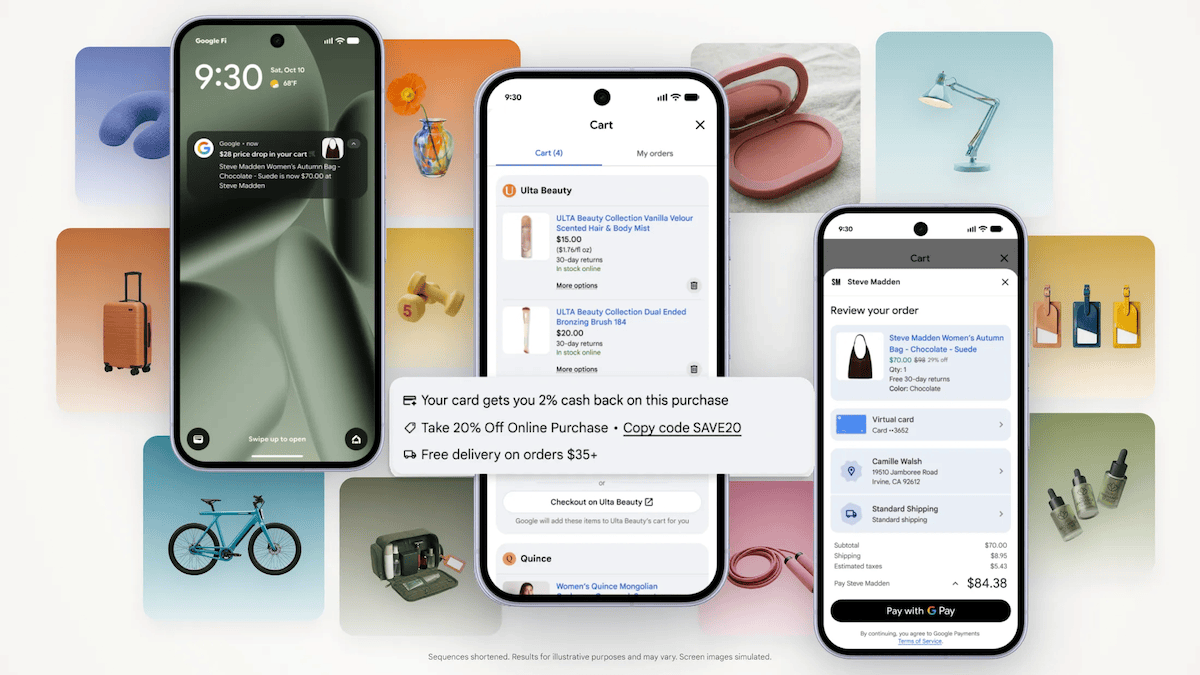
What Is Universal Cart: Moving the Shopping Cart Into the Search Box
The core idea behind Universal Cart is to make the "shopping cart" no longer tied to a single e-commerce website, but instead a universal capability within the Google ecosystem.
In the traditional e-commerce flow, users click on a product in search results, jump to the retailer's website, and complete adding to cart and checkout there. Universal Cart attempts to compress this chain—when users browse products in Google Search or Gemini, they can add items directly to a unified cart without having to leave the current page first.
From a product positioning standpoint, this tool looks more like Google's formal response to the "AI shopping assistant" race. Over the past year, products like OpenAI and Perplexity have been exploring how to use conversation to complete product discovery and recommendation. By building cart capabilities directly into Search and Gemini, Google is essentially using its existing traffic entry points to capture conversions directly.
What is the fundamental difference between Universal Cart and the traditional "add to cart"?
A traditional shopping cart is a state management component inside an e-commerce website. It relies on that website's cookies or account session, and product information, inventory, pricing, and checkout logic are all controlled by a single retailer. Items added to carts on different websites are isolated from one another and cannot be combined for checkout.
Universal Cart, by contrast, is a kind of "cross-platform shopping cart" that attempts to abstract the cart into a service layer independent of retailers. When users add items within the Google ecosystem, Google only records the product identifier, the source merchant, and the user's intent. Actual pricing, inventory, and checkout still need to be traced back to the merchant's system. Technically, this architecture is closer to an "aggregation layer": Google provides the entry point and state synchronization, while merchants provide fulfillment capabilities.
This also explains why it is both attractive and threatening to retailers—attractive because of the traffic entry point, threatening because the user relationship gets intercepted by Google. Understanding this distinction is key to judging whether Universal Cart is truly a "shopping cart" or a "shopping guide layer."
Two Entry Points: The Division of Labor Between Search and Gemini
Universal Cart has launched simultaneously on Google Search and the Gemini app, but the usage logic in the two scenarios is not the same.
In Google Search, users usually arrive with a clear need, such as searching for a certain type of product or a specific model. The value of Universal Cart here is to shorten the distance from decision to purchase and reduce the friction of repeatedly jumping between pages during price comparison.
In the Gemini app, shopping leans more toward conversational discovery. Users might describe a vague need, such as "I want to prepare a lightweight set of gear for camping." After Gemini offers suggestions, Universal Cart allows those suggestions to be turned directly into items in the shopping cart. This "conversation as shopping" format is one of the most natural landing points for monetizing AI assistants.
The two entry points share the same shopping cart, which also means Google is trying to connect shopping data across two paths: "search discovery" and "AI conversational discovery."
Potential Impact on the E-Commerce Landscape
With Universal Cart launching in the U.S. market, the most directly affected players are likely retailers and price comparison platforms.
If the shopping cart is uniformly hosted by Google, retailers' presence in the user decision chain will be weakened—users may only encounter the merchant at the final checkout stage. This puts pressure on e-commerce platforms that rely on on-site recommendations and add-to-cart conversions to increase average order value.
On the other hand, for small and medium-sized merchants, integrating with Google's universal shopping cart could lower the barrier to customer acquisition. If products can be added directly to cart through Search and Gemini, merchants no longer need to rely entirely on self-built traffic or in-platform advertising.
The key points to watch are: how Universal Cart will ultimately connect with retailers' back-end systems, and whether Google will commercialize product ranking or recommendation placements within the cart. These details will determine whether it is a new channel for merchants or a new traffic toll booth.
What is a "traffic toll booth"?
The "traffic toll booth" mentioned in this article refers to a business model in which a platform establishes a mandatory passage between users and merchants and charges fees for exposure, clicks, or transactions passing through that passage. Typical examples include search advertising within e-commerce platforms, affiliate commissions on price comparison websites, and app store commissions.
Once the shopping cart is uniformly hosted by Google, whether a product can appear in a user's Universal Cart, in what order it appears, and whether it comes with recommendation placements may all become monetizable variables. If Google charges for these positions, merchants would need to pay extra to gain add-to-cart opportunities, and Universal Cart would turn from a "new channel" into a "new toll booth." Conversely, if Google maintains neutral ranking, merchants may view it as a low-cost customer acquisition entry point.
This divide is not hypothetical—Google's existing Shopping ads and search advertising system have already proven that product discovery placement itself is a highly valuable commercial asset. Therefore, Universal Cart's ranking and recommendation rules will directly determine whether it is a channel or a tax card.
Key Differences in Competition With AI Shopping Assistants
Competition among AI shopping assistants currently centers on two things: "how accurate the recommendations are" and "whether you can actually buy."
The weakness of most conversational shopping products lies in the latter—AI can recommend products, but the checkout step still requires jumping to an external website. By putting the shopping cart inside the Google ecosystem, Universal Cart theoretically fills in the "whether you can actually buy" part.
Its advantage is the scale of its entry points: Google Search itself is one of the largest product discovery scenarios in the world, while Gemini provides a conversational interface. Combined, Universal Cart's potential user base far exceeds that of standalone AI shopping apps.
The challenges are equally obvious. Once the shopping cart is unified, how payment, logistics, and return/exchange responsibilities are divided, and how user trust is established, are all questions that have not yet been clarified in public information. Launching in the U.S. market is only the first step. Whether this model can be replicated in other regions depends on the progress of Google's negotiations with local retailers and payment service providers.
For practitioners focused on the real-world deployment of AI applications, what is worth tracking about Universal Cart is not the feature itself, but how Google turns AI conversation capabilities into an actual transaction loop.
Why is it difficult for AI shopping assistants to achieve both "accurate recommendations" and "actual purchase capability"?
"Accurate recommendations" belong to information retrieval and generation capabilities, relying on the model's understanding of user intent, the coverage of product data, and access to real-time pricing and inventory. This part is relatively easy to improve through model iteration and API integration.
"Actual purchase capability," however, involves the transaction loop: payment authorization, order generation, inventory locking, logistics fulfillment, returns and after-sales responsibility. These steps rely heavily on retailers' existing systems, payment providers' compliance capabilities, and consumer trust in the platform. Conversational products often lack this infrastructure, so they can only "send users out."
Universal Cart's differentiation lies in the fact that it does not try to build its own fulfillment system, but instead leverages Google's existing accounts, payments (Google Pay), and merchant partnership network to carry transactions. But this also means that whether the loop can ultimately be closed depends on whether retailers are willing to open their inventory and order interfaces to Google—this is both a technical issue and a commercial power struggle.
One-line Summary
Google Universal Cart launches in the U.S., bringing the shopping cart into Search and Gemini in an attempt to turn AI conversations directly into a transaction loop.
Paragraph Summary
Google's Universal Cart shopping tool has launched in the United States, covering both Google Search and the Gemini app. Its core idea is to detach the shopping cart from individual e-commerce websites and make it a universal capability within the Google ecosystem, allowing users to add items directly from search results or AI conversations without jumping away. The two entry points work differently: Search leans toward comparison and conversion under clear demand, while Gemini leans toward conversational product discovery, but they share the same cart. This tool could weaken retailers' presence in the decision chain while offering small and medium-sized merchants a new customer acquisition channel. Key details such as payment, logistics, and responsibility for returns remain undisclosed, and whether the model can be replicated in other regions remains to be seen.
Related articles

Workbuddy for Absolute Beginners: How a Desktop AI Agent Fits Into Real Workflows
A beginner's guide to the Workbuddy desktop AI agent: installation, claiming credits, file management, and building automated workflows—compared with CodeX for fit and cost, helping professionals shift from AI question-askers to AI managers.

OpenAI's New Agent Stack: Computer Use, Decisions API, and Ultra-Fast Workflows
OpenAI Dev Day unveiled a new agent stack: Computer Use outperforms humans, Decisions API delivers ultra-low-latency classification via Luna, Agents API opens the same Computer Use capabilities, and GPT-6.1 Sol costs only one-seventh of Astra. Core updates, benchmark data, and developer insights.

Liang Wenfeng Open-Sources DeepInfo Inference Framework, Takes On U.S. Ban
DeepSeek open-sources its DeepInfo inference framework after its models, featuring GPU/CPU cross-pipelining, small-model prediction with large-model verification, and full Huawei Ascend and NVIDIA chip support—facing the U.S. federal ban head-on. This article analyzes its significance for AI deployment and open-source strategy.