Google vs Codex vs Claude Code: A Deep Comparison of Three AI Coding CLI Approaches

AI coding tool competition evolves from code completion to Agent orchestration across three distinct approaches.
Google, OpenAI, and Anthropic have taken three distinct paths in AI coding tools: a platform-level Agent operating system, a task queue command center, and a UNIX philosophy toolchain. The core divergence lies in where control resides — Google controls the platform, Codex controls the task queue, and Claude Code controls the development workflow. By 2026, evaluation criteria will shift from code completion to four system-level capabilities: division of labor, isolation, auditability, and end-to-end delivery.
Introduction: CLI Is No Longer Just a Command Line
Google recently announced that the personal version of Gemini CLI will transition to Anti-Gravity CLI after June 18th. What appears to be a simple rebrand actually signals something much bigger — the competition among AI coding tools has evolved from "who can autocomplete code better" to "who can orchestrate a fleet of Agents."
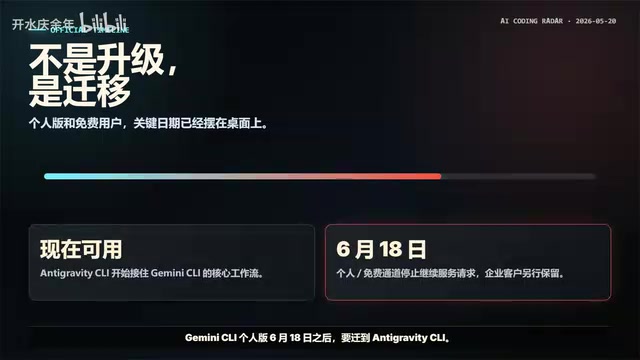
While we're still debating which AI coding assistant has more accurate code completion, Google, OpenAI (Codex), and Anthropic (Claude Code) have quietly diverged onto three fundamentally different technical paths. The dividing line isn't about model capability — it's about where control resides.
The Google Approach: A Platform-Level Agent Operating System
Unified Backend, Multi-Agent Collaboration
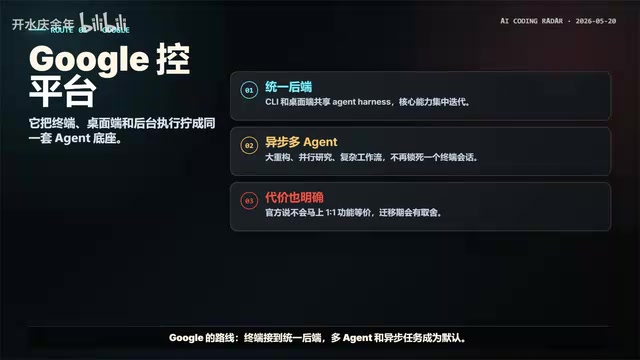
Google's strategy is to "consolidate" the CLI — not simply updating a tool, but integrating it into a unified platform architecture. The core idea is clear: connect the terminal to a unified backend, enabling multi-Agent collaborative task execution in stages. The desktop client and CLI share the same Harness (execution framework). Regardless of which entry point you use to initiate a task, the same Agent orchestration system powers everything behind the scenes.
Agent Orchestration refers to a mechanism in multi-Agent systems where a central scheduler coordinates multiple specialized AI agents to collaboratively complete complex tasks. Unlike a single large model directly generating code, an orchestration system decomposes tasks into subtasks, assigns them to specialized Agents with different capabilities (such as a code generation Agent, testing Agent, or documentation Agent), and manages the dependencies and data flow between them. This concept originates from the microservices architecture philosophy in distributed systems. Its core value lies in the fact that a single Agent's context window and capability boundaries are limited, while an orchestration system can break through these limitations to achieve reliable execution of ultra-long task chains. Google's Harness execution framework is the engineering realization of this philosophy.
The essence of this approach is controlling the platform. Google aims to become the "operating system" layer for AI programming, with all Agents running, coordinating, and interacting on its platform. Developers use Google's unified scheduling capabilities rather than a standalone code generation tool.
The Codex Approach: A Task Queue Command Center
OpenAI's Codex takes an entirely different path — it's more like a command center.

One Task, One Isolated Workspace
Codex's design philosophy is: each task corresponds to an independent workspace, with cloud environments running in parallel. This architecture is particularly well-suited for splitting feature development, bug fixes, and code refactoring into multiple parallel streams.
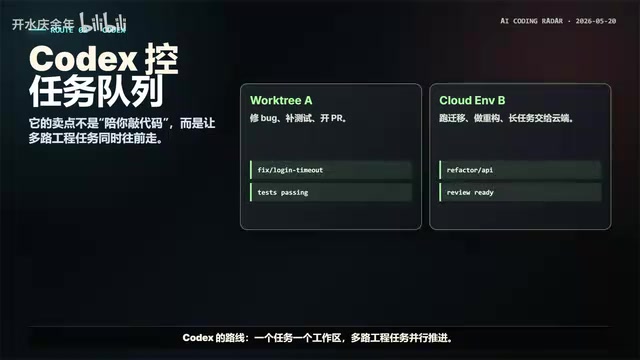
Codex's "one task, one workspace" model relies on containerized sandbox technology (such as Docker or Firecracker micro-VMs) for its technical implementation. Each task runs in an independent filesystem, network namespace, and process space. Tasks cannot access each other's resources, fundamentally eliminating the risk of one Agent's erroneous operation contaminating another task's environment. This design draws from the browser's multi-process architecture (Chrome's independent process per tab) and the stateless execution model of cloud functions (Serverless). For AI coding scenarios, isolation provides an additional layer of value: reproducibility — any task can be re-executed from the same initial state, facilitating debugging and auditing. This is precisely the technical foundation for the 2026 core evaluation criterion of "can it be audited."
Its core is controlling the task queue. Developers act like project managers distributing tasks, with each task executing independently in an isolated environment without interference. This model is naturally suited for team collaboration and large-scale project management, emphasizing task distribution, isolation, and parallel processing capabilities.
The Claude Code Approach: UNIX Philosophy in the Developer's Hands
Anthropic's Claude Code takes the path closest to a developer's daily workflow — it's more like a UNIX tool in the developer's hands.
Terminal-Native, Composable Architecture
The UNIX philosophy was proposed by Ken Thompson and Doug McIlroy at Bell Labs in the 1970s. Its core principle is "Do one thing and do it well," combined with using pipes to compose small tools into powerful workflows. Claude Code's Subagents architecture directly inherits this philosophy: each sub-Agent focuses on a single responsibility (such as file I/O, code execution, or network requests) and can be composed through standardized interfaces, rather than building a monolithic "do-everything" Agent. The advantages of this design lie in testability, replaceability, and fault isolation — if one sub-Agent fails, it won't crash the entire system, and developers can audit and intervene at specific stages.
Claude Code's design follows several core principles:
- Terminal-native: Never leaves the terminal environment developers are familiar with
- Subagents division of labor: Sub-Agents each handle their own responsibilities, composable like UNIX pipes
- Hooks as gatekeepers: Hook mechanisms enable process control and security auditing
- MCP for internal system access: Connects to enterprise internal toolchains via Model Context Protocol
Model Context Protocol (MCP) is a standardized protocol open-sourced by Anthropic in late 2024, designed to solve the fragmentation problem of integrating AI models with external tools and data sources. Before MCP, every AI tool needed to develop separate adapters for different enterprise systems (databases, code repositories, CI/CD platforms), making maintenance costs extremely high. MCP defines a unified client-server communication specification that allows AI models to discover and invoke any external tool through standard interfaces — similar to how the USB interface standardized hardware devices. For enterprise developers, MCP's value lies in securely connecting internal private systems (such as intranet code repositories and private documentation libraries) to AI workflows without uploading data to the cloud. This is particularly critical for industries with strict compliance requirements.
The essence of this approach is controlling your development workflow. It doesn't try to become a platform or a command center. Instead, it deeply embeds itself into the developer's local workflow, becoming the most powerful tool in your terminal.
The Fundamental Divergence of Three Approaches
| Dimension | Codex | Claude Code | |
|---|---|---|---|
| Control | Platform | Task Queue | Development Workflow |
| Architectural Metaphor | Operating System | Command Center | UNIX Toolchain |
| Best For | Full-stack platform users | Multi-task parallel teams | Terminal power users |
| Core Advantage | Unified scheduling | Environment isolation | Local integration |
The real competition isn't about which CLI is "more powerful" — it's about their different bets on the future of AI programming.
Core Evaluation Criteria for AI Coding Tools in 2026
Looking ahead to 2026, the criteria for evaluating AI coding tools will undergo a fundamental shift. It will no longer be about single-point metrics like "code completion accuracy" or "context window size," but rather four system-level capabilities:
- Can it divide labor: Does it support multi-Agent collaboration with automatic task decomposition?
- Can it isolate: Are there clear boundaries and security isolation between different tasks?
- Can it be audited: Is every operation traceable, reversible, and reviewable?
- Can it run autonomously to delivery: Can it achieve end-to-end automation from requirements to deployment?
These four criteria essentially describe an "Agent operating system"
Related articles
 Industry Insights
IRS Fully Embraces Claude AI, Accelerating Federal Government's AI Adoption
The IRS is recruiting staff with 24/7 Claude AI access, marking Anthropic's breakthrough into the federal government. Explore the strategic implications and tax use cases.
 Industry Insights
Nadella Introduces the Loopcraft Framework: Building AI Ecosystems Through Feedback Loops
Microsoft CEO Satya Nadella's Loopcraft framework explains how to build frontier AI ecosystems through nested feedback loops across technology, business, and ecosystem dimensions.
 Industry Insights
OpenAI's Internal Codex Usage Surges 56x — AI Coding Is Eating Everything
OpenAI reveals internal Codex usage data: Research up 56x, Customer Support 32x, Engineering 27x, Legal 13x since Nov 2025. AI coding tools are penetrating every department faster than expected.