GoogleTest Deep Dive: A Practical Guide to C++ Unit Testing and Mock Frameworks

A comprehensive guide to GoogleTest's core features for industrial-grade C++ unit testing and mocking.
This article provides an in-depth analysis of GoogleTest, the de facto standard for C++ unit testing. It covers the dual assertion system (ASSERT/EXPECT), test fixtures for resource management, GoogleMock for object interaction verification, parameterized tests for data-driven testing, and death tests for verifying crash behavior. Practical engineering advice on CI/CD integration and avoiding over-mocking is also included.
Introduction: The De Facto Standard for C++ Testing
In the C++ development ecosystem, unit testing has long lacked a unified and powerful tool. Unlike Java with JUnit or Python with pytest—languages that have built-in or quasi-built-in testing frameworks—C++ developers once struggled to choose among CppUnit, Boost.Test, Catch2, and other frameworks. CppUnit was cumbersome to configure, Boost.Test depended on the massive Boost library ecosystem, and Catch2, while lightweight, fell short on Mock support. GoogleTest, open-sourced by Google in 2008, filled this gap perfectly. With its comprehensive assertion system, built-in Mock support, and the endorsement of large-scale industrial validation within Google, it has gradually become the industry-recognized de facto standard. As of now, the project has accumulated over 39,000 Stars and 10,800 Forks on GitHub, maintaining a steady growth trajectory. Behind these numbers lies the urgent demand from C++ developers worldwide for high-quality testing tools.
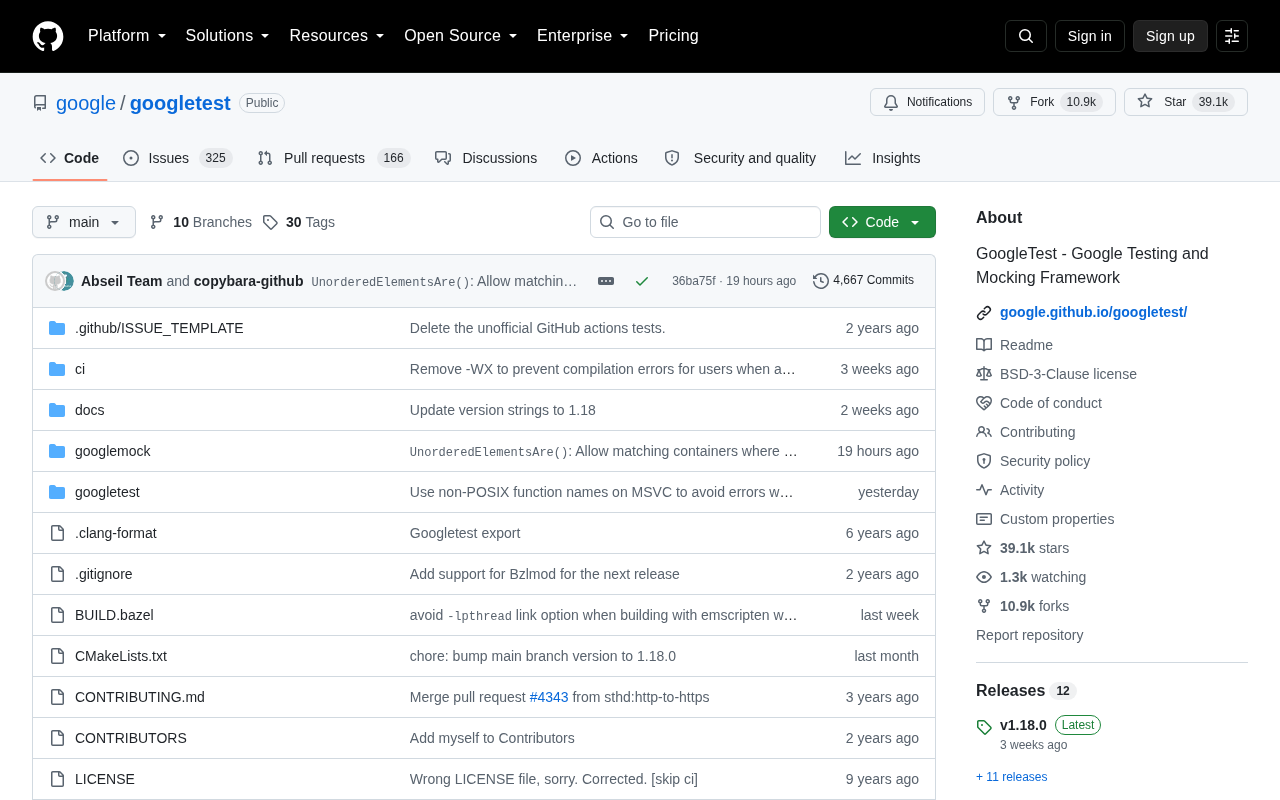
GoogleTest is more than just an assertion library—it's a complete testing and mocking framework that covers everything from simple unit tests to complex interaction verification. This article provides an in-depth analysis of its core features, design philosophy, and practical value in modern C++ engineering.
GoogleTest Core Capabilities in Detail
Powerful Assertion System: ASSERT and EXPECT
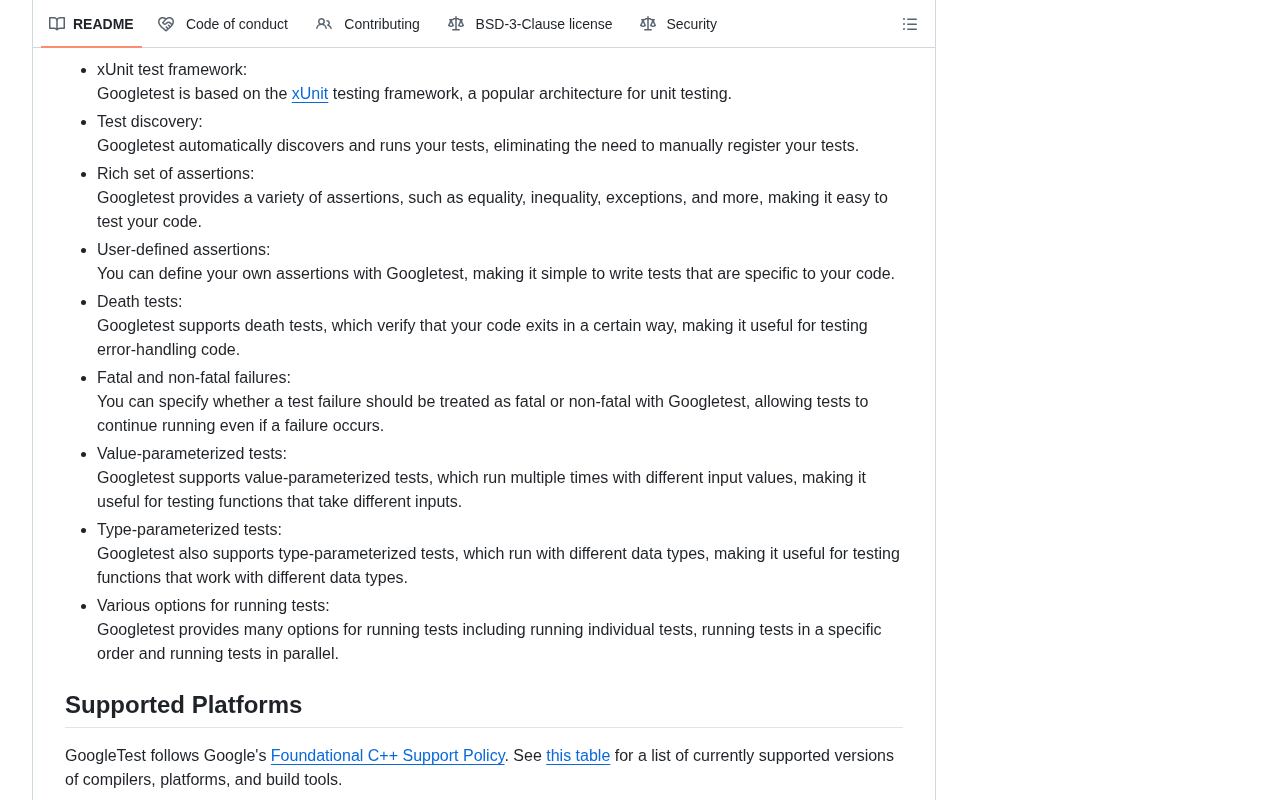
GoogleTest provides two types of core assertions: ASSERT_* and EXPECT_*. The former immediately terminates the current test function upon failure, making it suitable for critical checks; the latter continues execution after failure, allowing you to collect multiple error messages in a single run. This dual-track design stems from a classic trade-off in test engineering: Fail Fast vs. Maximum Information. The fail-fast strategy holds that once a precondition is not met, subsequent assertion results are meaningless, and continuing execution might even trigger cascading issues like segmentation faults. The maximum-information strategy argues that a single test run should expose as many problems as possible, reducing the time cost of developers running tests repeatedly. Similar design thinking appears in other language frameworks—for example, JUnit 5's assertAll() method supports collecting multiple assertion failures. GoogleTest exposes both strategies to developers, letting them choose based on context—a pragmatic engineering design.
The framework also supports a rich set of assertion macros, including:
EXPECT_EQ/ASSERT_EQ: Equality comparisonEXPECT_TRUE/EXPECT_FALSE: Boolean checksEXPECT_NEAR: Approximate floating-point comparisonEXPECT_STREQ: String matching
The existence of EXPECT_NEAR reflects a fundamental issue in floating-point computation: due to the precision limitations of IEEE 754 floating-point representation, floating-point arithmetic results often contain tiny rounding errors. For example, 0.1 + 0.2 does not precisely equal 0.3 in binary floating-point representation, and using EXPECT_EQ for floating-point comparison would almost certainly produce false failures. EXPECT_NEAR allows developers to specify a tolerance—as long as the difference between two floating-point numbers falls within the tolerance range, they are considered equal. Additionally, GoogleTest provides EXPECT_FLOAT_EQ and EXPECT_DOUBLE_EQ, which compare based on ULP (Units in the Last Place), tolerating a default deviation of 4 ULPs—a comparison strategy more aligned with floating-point arithmetic characteristics.
These assertions cover virtually all common C++ unit testing needs.
Test Fixtures for Resource Reuse
For multiple test cases that need to share initialization logic, GoogleTest provides a test fixture mechanism. By inheriting from the ::testing::Test class and overriding the SetUp() and TearDown() methods, developers can automatically prepare and release resources before and after each test run.
This design originates from the classic xUnit test architecture pattern, first proposed by Kent Beck in SUnit (Smalltalk's testing framework) and later popularized across the entire software engineering field by JUnit. The xUnit pattern defines four core phases: Setup (establish the test environment), Exercise (execute the code under test), Verify (check the results), and Teardown (clean up resources). In C++ scenarios, test fixtures are particularly valuable because C++ programs frequently involve heap memory allocation, file handles, database connections, and other resources that require explicit lifecycle management. Through the automatic invocation of SetUp() and TearDown(), developers can ensure that even if a test exits midway due to an assertion failure, resources are properly released—effectively preventing memory leaks and resource leaks.
This pattern effectively reduces duplicate code and improves test maintainability.
GoogleMock: Object Interaction Behavior Verification
GoogleTest bundles the GoogleMock component for creating Mock objects and verifying interaction behavior between objects. In scenarios involving dependency injection, interface segregation, and similar patterns, Mocks can replace real dependencies, allowing unit tests to achieve true "unit"-level isolation.
The core idea behind Mock objects comes from Test Double theory, systematized by Gerard Meszaros in xUnit Test Patterns. Test doubles include five types: Dummy (placeholder objects), Stub (returns fixed values), Spy (records call information), Mock (verifies interaction behavior), and Fake (simplified implementations). GoogleMock primarily focuses on Mock and Stub capabilities. To use Mocks effectively, the code under test typically needs to follow the Dependency Injection principle—declaring dependencies through interfaces (pure virtual classes) rather than concrete classes. This aligns with the Dependency Inversion Principle from SOLID principles. In C++, this means the class being mocked needs a virtual function interface, and GoogleMock uses the MOCK_METHOD macro to automatically generate Mock implementations of virtual functions, greatly reducing the tedium of writing Mock classes by hand.
Through macros like EXPECT_CALL, developers can precisely specify:
- The number of times a method should be called
- Matching rules for input parameters
- Simulated return values
This is crucial for testing complex business logic and multi-component collaboration scenarios.
Key Reasons Developers Choose GoogleTest
Cross-Platform Compatibility and Build System Integration
GoogleTest is written in standard C++ and supports major operating systems including Linux, macOS, and Windows, working seamlessly with compilers like GCC, Clang, and MSVC. It also integrates deeply with mainstream build systems such as CMake and Bazel, lowering the barrier to adopting a testing framework in large projects.
CMake is currently the most widely used cross-platform build system generator in the C++ ecosystem. It describes project structure through CMakeLists.txt files and can generate Makefiles, Ninja build files, Visual Studio project files, and more. GoogleTest integration with CMake is typically achieved through the FetchContent module or the find_package command, combined with enable_testing() and gtest_discover_tests() functions to automatically discover and register all test cases. Bazel is Google's in-house build system, renowned for its incremental builds, remote caching, and hermetic builds (ensuring build results don't depend on the host machine environment), performing exceptionally well in ultra-large-scale monorepos. As a Google internal product, GoogleTest has the most native integration with Bazel—you simply declare a cc_test rule in the BUILD file and add a dependency on @com_google_googletest.
Parameterized Tests Reduce Repetitive Code
Parameterized Tests allow developers to run the same test logic across multiple sets of input data, eliminating mechanical copy-and-paste. The core idea is to separate test logic from test data, implementing data-driven testing.
In GoogleTest, parameterized tests define test logic through the TEST_P macro and supply parameter sets through the INSTANTIATE_TEST_SUITE_P macro. The framework automatically combines each parameter set with the test logic at runtime, generating independent test instances. GoogleTest supports multiple parameter generators: Values() provides discrete value lists, Range() generates arithmetic sequences, Bool() generates boolean combinations, and Combine() performs Cartesian product combinations of multiple parameter sets, covering a vast input space with minimal code. This mechanism is especially efficient when testing mathematical functions, parsers, codecs, and other components with large numbers of input variants.
When you need to verify how a function handles a large number of different inputs, parameterized tests can significantly improve test coverage and code conciseness.
Death Tests Verify Abnormal Exit Behavior
Death Tests are specifically designed to verify whether a program crashes or exits as expected under certain conditions, making them particularly useful for detecting assertion triggers, boundary handling, and other defensive code.
The operating system-level implementation of death tests is technically sophisticated. On POSIX systems (Linux, macOS), GoogleTest uses the fork() system call to create a child process for executing potentially crashing code, while the parent process monitors the child's exit status via waitpid() to determine whether it was terminated by a specific signal (such as SIGABRT or SIGSEGV). On Windows, CreateProcess() is used to achieve similar process isolation. This design ensures that crashes in the code under test don't affect the test process itself.
Through the EXPECT_DEATH family of macros, developers can confirm the correctness of error-handling logic. These macros also support regular expression matching to verify whether the error message output to stderr during a crash matches expectations—for example, verifying that the assert() macro fires correctly on illegal arguments, or that custom error-handling logic calls abort() or exit() as expected.
Google Backing and Active Community Support
As a testing cornerstone for numerous projects within Google, GoogleTest has been validated at industrial scale. Continuous contributions from the open-source community also ensure the framework's stable evolution. For enterprises, choosing a tool with long-term maintenance by a major tech company and a mature ecosystem means lower technical risk.
GoogleTest Engineering Best Practices
Although GoogleTest is feature-rich, there are several important considerations for practical use:
Avoid Over-Mocking: Excessive reliance on Mocks can lead to tight coupling between tests and implementation details, requiring extensive test modifications whenever refactoring occurs. The industry generally recommends testing behavior rather than implementation and drawing reasonable boundaries for Mock usage.
Integrate with CI/CD Pipelines: The value of tests lies in continuous execution. Integrating GoogleTest into CI/CD pipelines so that every code commit automatically triggers tests is the key to truly leveraging its quality-guarding capabilities. GoogleTest natively supports outputting test reports in JUnit XML format (via the --gtest_output=xml:filename.xml parameter), a format supported by virtually all major CI/CD platforms, including Jenkins, GitLab CI, GitHub Actions, and Azure DevOps. JUnit XML is a test result exchange format originally defined by the Apache Ant project and has become the de facto standard for test reporting across languages and platforms. Additionally, GoogleTest can be used in conjunction with code coverage tools (such as gcov/lcov or llvm-cov) to generate coverage reports that visually show which code paths are covered by tests and which have blind spots. Combined with services like Codecov or Coveralls, coverage changes can be automatically displayed in each Pull Request, forming a Quality Gate mechanism.
Organize Test Structure Properly: Use test suites and naming conventions to maintain test code readability and maintainability, facilitating team collaboration.
Conclusion
GoogleTest has become the benchmark in C++ testing because of the excellent balance it strikes among ease of use, feature completeness, and industrial-grade reliability. Whether you're a beginner writing your first unit test or a senior engineer building a complex verification system, it provides intuitive and capable support. For any C++ project that pursues code quality, GoogleTest is a core choice worthy of inclusion in the toolchain.
Key Takeaways
Related articles

Chain of Thought Isn't Just for AI: How Humans Can Use CoT to Improve Thinking Quality
Chain of Thought isn't just a prompt trick for large models. Starting from a Hacker News discussion, this article analyzes why CoT works for human thinking too, breaks down actionable ways to transfer it, and highlights the key differences between human CoT and machine CoT.
Cloudflare Teams Up with OpenAI: Closi…
Cloudflare Teams Up with OpenAI: Closing the Loop from Vulnerability Discovery to Defense with AI
Cloudflare uses OpenAI Daybreak to investigate security vulnerabilities and generate reviewable remediation plans, while developers use Codex to boost coding efficiency and quality.

Orca Multi-Agent Orchestration in Practice: A Guide to Parallel Collaboration with Claude and Codex
Orca is Stable AI's free open-source agent workbench supporting 34 agents like Claude Code and Codex in parallel. Learn its Git worktree isolation, multi-model orchestration, and mobile management.