Goose: The Open-Source AI Agent That Goes Beyond Code Suggestions to Execute, Edit, and Test
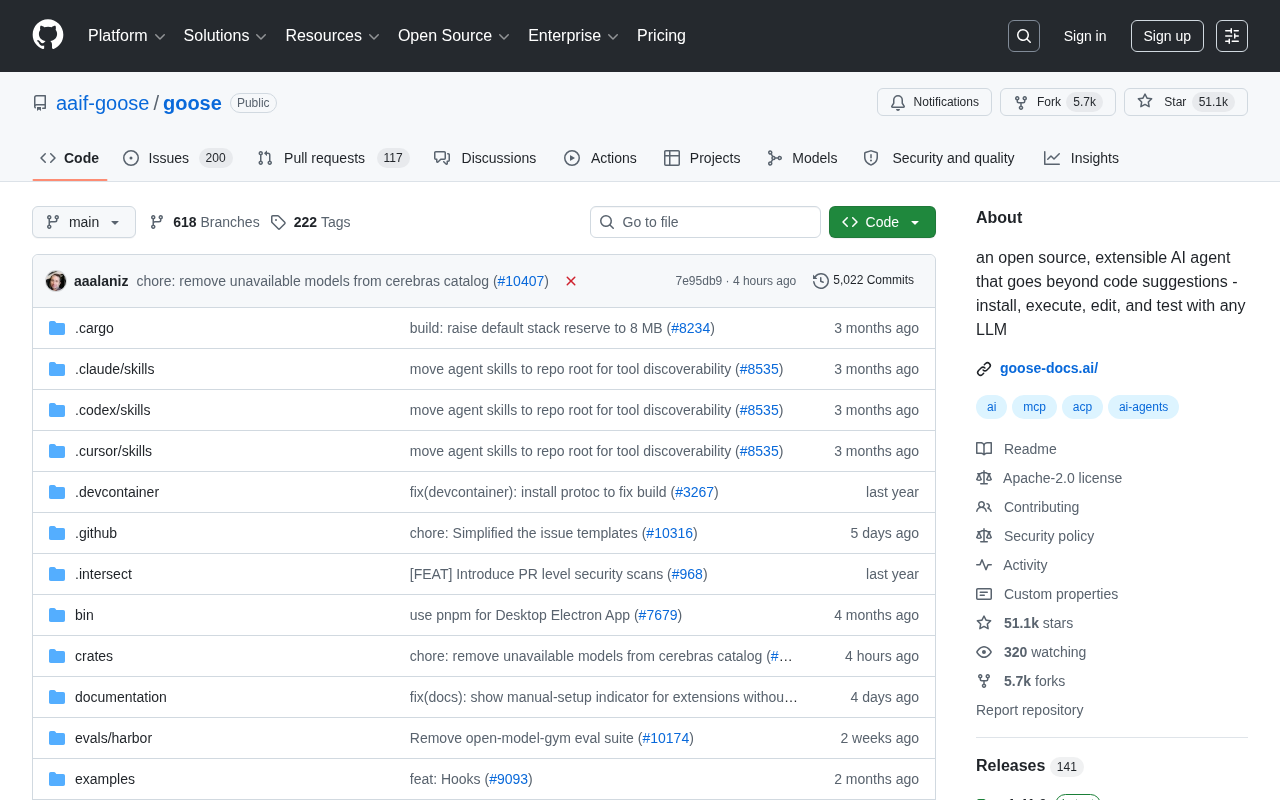
Goose is an open-source Rust-based AI Agent that autonomously installs, executes, edits, and tests code across any LLM.
Goose is an open-source AI Agent developed by the aaif-goose team, written in Rust with over 44,000 GitHub Stars. It goes beyond traditional code completion by autonomously executing real development tasks — installing dependencies, running commands, editing files, and running tests — forming a complete development loop. Its model-agnostic design supports OpenAI, Anthropic, and locally deployed open-source models, avoiding vendor lock-in. Built in Rust for stability and system-level performance, Goose positions itself as a production-grade alternative to commercial closed-source tools.
What Is Goose
Goose is an open-source, extensible AI Agent developed by the aaif-goose team and hosted on GitHub. Its positioning is clear — it's not content with staying at the level of traditional AI coding assistants that merely "offer code suggestions." Instead, it actively participates in every stage of the development workflow: installing dependencies, executing commands, editing files, and running tests. Written in Rust, the project has already earned over 44,000 Stars and more than 4,500 Forks, making it one of the more prominent projects in the open-source AI tools space.
The name "goose" continues the developer tool tradition of animal-based naming, while its core value proposition is hidden in plain sight: goes beyond code suggestions. This phrase marks a clear dividing line in today's AI coding tools — the difference between being a "copilot" that only autocompletes code versus an "autopilot" capable of independently completing tasks.
From Code Suggestions to Autonomous Execution
Over the past two years, AI coding assistants like GitHub Copilot have largely played the role of "autocomplete": you write half, it guesses the rest. These tools improve typing efficiency, but developers still have to manually execute, debug, and verify. Goose aims to break through exactly that boundary.
According to the project description, Goose can install, execute, edit, and test — four verbs that together form a complete development loop. In other words, it doesn't just tell you "this is how it should be written"; it goes ahead and gets it done, then reports back with the results. This shift from "suggestion" to "action" is the defining characteristic of the current AI Agent wave — giving AI the ability to operate in real environments rather than just generating text.
For developers, this means repetitive, procedural tasks — like configuring environments, running tests, and fixing errors — can be handed off to the Agent, freeing up mental bandwidth for architecture design and creative work.
An Open Design Compatible with Any LLM
Another notable feature of Goose is any LLM compatibility — it's not locked to any single large model provider. This model-agnostic design gives users tremendous flexibility: depending on cost, performance, or privacy requirements, you can freely choose to connect with commercial models like OpenAI or Anthropic, or locally deployed open-source models.
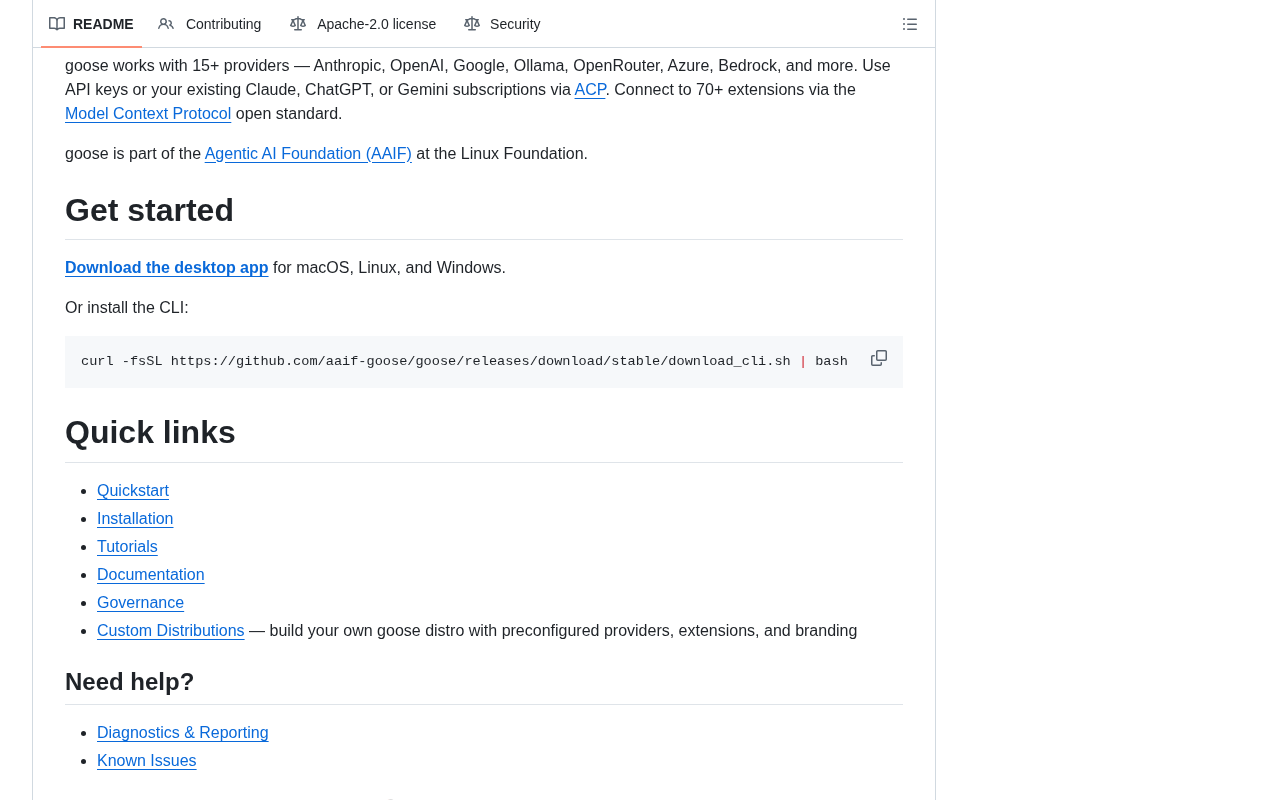
This matters especially today. As the large model landscape shifts rapidly, tying a tool to a single vendor introduces real risk. Goose's open architecture allows it to continuously benefit from improvements in underlying models, and gives enterprise users the option of local deployment in data-compliance scenarios.
Combined with its "extensible" positioning, Goose allows developers to add custom capabilities tailored to their own workflows, laying the groundwork for a thriving community ecosystem.
Why Rust
The project's choice of Rust as its primary language sends a clear signal. Rust is renowned for memory safety and high performance — qualities that are critical for an AI Agent that frequently executes system commands, manipulates files, and interacts with multiple processes simultaneously.
Compared to prototypes hastily assembled in scripting languages, a Rust implementation signals that Goose aspires to be a production-grade tool you can rely on long-term, rather than an experimental toy. This may be one reason it has attracted so much developer attention — the technical community tends to favor projects with solid fundamentals under the hood.
Where Goose Sits in the AI Agent Landscape
Goose's emergence reflects a paradigm shift underway in AI coding tools. From Devin to various open-source coding agents, "autonomously completing development tasks" has become the focal point of industry competition. Goose enters this space with three key differentiators: open-source, model-agnostic, and extensible — offering an alternative for developers and teams who don't want to be locked into commercial, closed-source products.
Over 44,000 Stars signals genuine market demand for this kind of tool. That said, it's worth keeping perspective: popularity on GitHub doesn't always translate directly to maturity in production environments. The reliability of AI Agents when autonomously executing commands, the boundaries of safe operation, and their ability to handle complex tasks all require extended validation in real-world projects.
For developers eager to explore, Goose is an excellent entry point for understanding how "AI Agents go beyond code completion." For team decision-makers, the recommendation is to evaluate its execution safety in a controlled environment before integrating it into critical workflows.
Related articles
Altman: Taking OpenAI Public This Year Would Be 'Ill-Advised'
OpenAI CEO Sam Altman says going public this year would be 'ill-advised,' even as the company has confidentially filed IPO paperwork. Here's what it means for AI.
An Open Letter to Dario: If AI Safety Is Real, Open the Model Weights
Developer Jacob's open letter to Anthropic CEO Dario Amodei went viral on Hacker News, challenging the contradiction between AI safety rhetoric and closed-source models: if safety truly matters, why not open the weights?
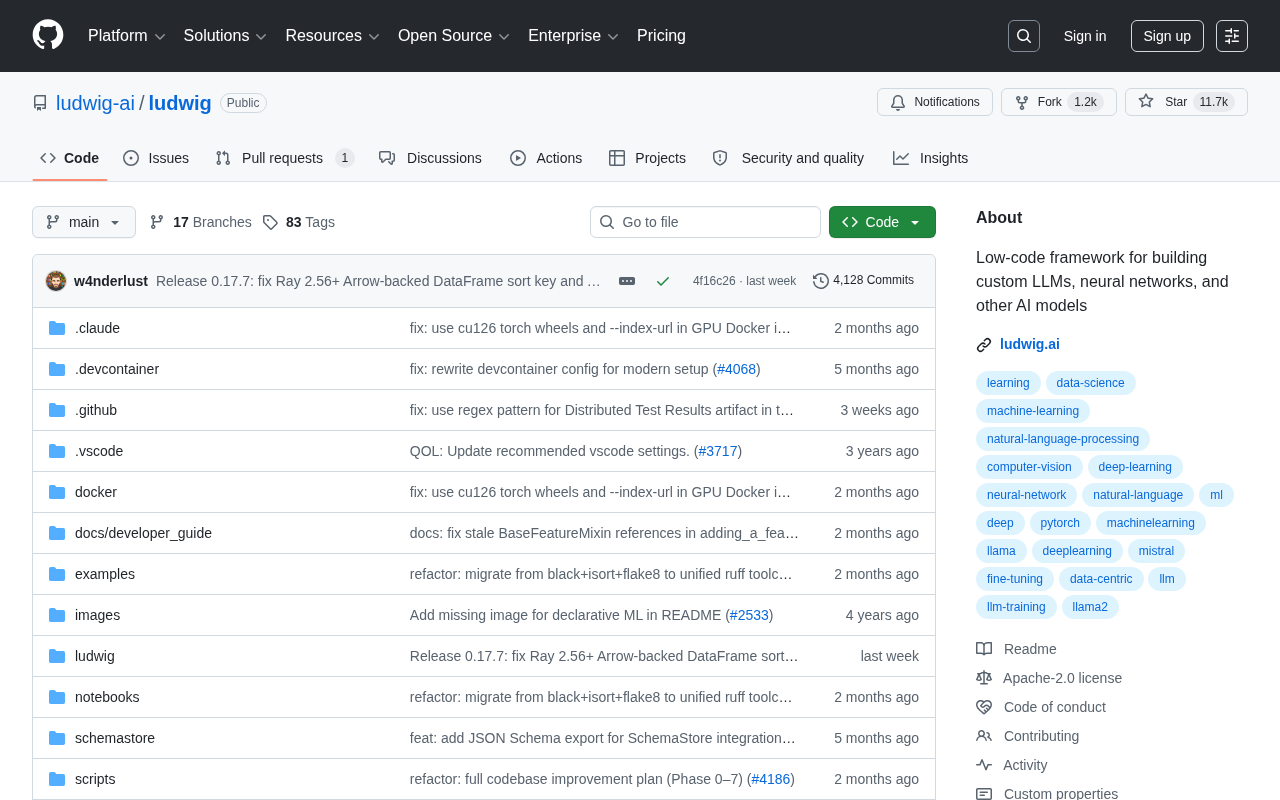
Ludwig: Building Custom LLMs and Neural Networks with Declarative Low-Code Configuration
Ludwig is an open-source low-code ML framework that builds custom LLMs and neural networks via declarative YAML config — no boilerplate training code required.