Gotcha: The World's First Open-Source AI Voice Copilot for Android, Running On-Device for Free

Gotcha is an open-source Android AI voice copilot that runs on-device with 100+ native tools.
Gotcha is the world's first open-source AI voice copilot for Android, designed to execute device operations via natural language commands entirely on-device. Powered by its Samosa AIR engine combining LLM, STT, and TTS capabilities, it offers 100+ native device tools, dual safety modes, and cross-app voice interaction — all while keeping user data local and the project free and open-source.
A New Paradigm for Controlling Your Phone with Voice
With the AI Agent concept gaining massive traction, the industry is laser-focused on making AI actually "do things" rather than just chat. An AI Agent is an AI system capable of autonomously perceiving its environment, formulating plans, and executing actions — it doesn't just understand user intent, but can decompose tasks, invoke tools, monitor execution results, and self-correct. Since 2023, as large models like GPT-4 and Claude have made capability leaps, open-source projects like AutoGPT and BabyAGI first ignited community interest, while commercial products like Microsoft Copilot and Google Project Astra have embedded Agent capabilities into productivity and mobile scenarios.
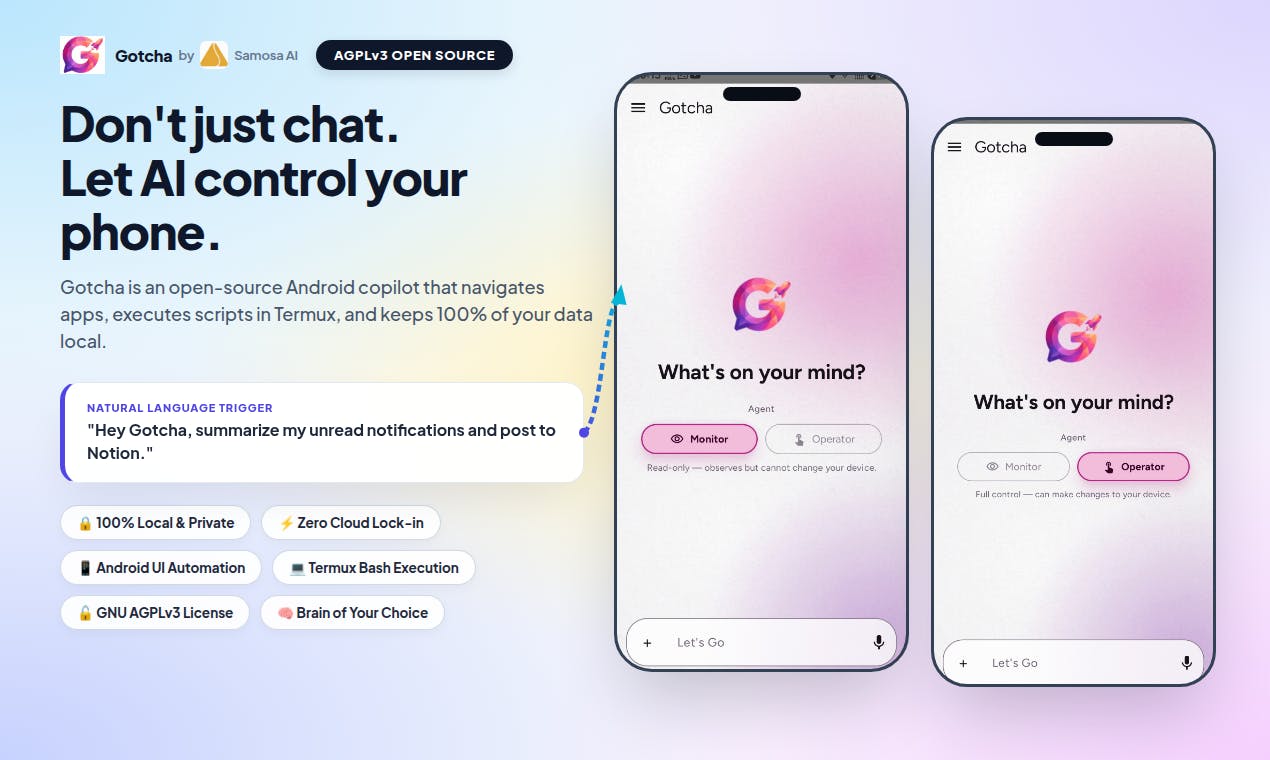
Recently launched on Product Hunt, the open-source project Gotcha offers a rather ambitious answer: it bills itself as the "World's First AI Copilot for Android," with its core philosophy distilled into a single slogan — "You talk. It acts."
On launch day, Gotcha secured 83 upvotes and ranked 14th on that day's leaderboard. While not a viral hit, its technical positioning and open-source nature attracted considerable developer attention.
From "Conversational Assistant" to "Execution Copilot"
Unlike the traditional voice assistants we're familiar with — Siri, Google Assistant — Gotcha emphasizes "acts" (execution) rather than merely "answers." Users issue commands in natural language, and Gotcha invokes system capabilities to carry out actual operations. According to the official introduction, it comes with 100+ native device tools covering all aspects of daily phone usage, theoretically capable of executing complex task chains across applications.
This design philosophy aligns with the mainstream direction of current AI Agent development: making large models not just processors of information, but executors of tasks. By pushing this capability down to the phone's operating system level, Gotcha attempts to close the complete loop from "voice command → intent understanding → device operation."
Deep Dive into Gotcha's Three Core Features
On-Device Execution: Balancing Privacy Protection with Zero-Cost Usage
Gotcha's most noteworthy aspect is its on-device architecture. This means the core AI inference happens locally on the phone, rather than being uploaded to the cloud. For phone operation scenarios involving extensive personal privacy, on-device execution inherently offers privacy protection advantages — your commands, screen content, and operation logs never need to leave the device.
The core challenge of on-device AI inference is that mobile chips have far less compute power, memory, and power budget than data center GPUs. To address this, the industry has developed various model compression techniques: Quantization (compressing FP32 weights to INT4/INT8), Knowledge Distillation (training small models using large models), Pruning (removing redundant parameters), and more. Chipmakers like Qualcomm and MediaTek have also integrated NPUs (Neural Processing Units) into their SoCs to accelerate on-device inference. Typical on-device LLMs like Google Gemini Nano and Microsoft Phi-3 Mini typically keep parameter counts in the 1B-4B range to balance performance and resource consumption. The engineering optimization that enables Gotcha to deliver usable Agent capabilities under such hardware constraints is worth noting.
Additionally, Gotcha adopts a free + open-source strategy, with the project hosted on GitHub. In an era overflowing with commercialized AI assistants, this provides the developer community with an auditable, customizable, and extensible alternative.
Samosa AIR: A Proprietary Three-in-One AI Inference Engine
Powering Gotcha is a technology stack called Samosa AIR, which integrates three key AI capabilities:
- LLM (Large Language Model): Responsible for understanding the user's natural language intent and planning operational steps;
- STT (Speech-to-Text): Converts the user's spoken commands into text;
- TTS (Text-to-Speech): Enables Gotcha to provide voice feedback, achieving true conversational interaction.
This "LLM + STT + TTS" combination forms the technical foundation of the voice copilot. On the technology evolution front, traditional STT relied on pipeline architectures combining acoustic models and language models, while recent end-to-end models (such as OpenAI Whisper and Meta's MMS) have dramatically improved multilingual recognition accuracy. Representative on-device STT solutions include Google's USM and Apple's on-device dictation, which compress models from tens of GBs down to hundreds of MBs through model distillation. For TTS, neural network synthesis (such as VITS and Bark) can now generate near-human-quality speech, with the key challenge being low-latency streaming synthesis — voice feedback needs to begin within 200-500ms after the user finishes speaking to maintain conversational flow.
All three must work in concert to deliver a smooth "speak—listen—do—respond" experience, and packaging them all to run on-device presents significant engineering challenges in model lightweighting and inference optimization.
Dual Safety Modes and Cross-App Voice Calls
Considering the risks that AI-automated operations may pose, Gotcha has designed dual safety modes. While the official team hasn't disclosed the exact mechanisms in detail, such designs are typically used to intercept and confirm sensitive operations (like payments, deletions, or sending messages) to prevent AI misoperations from causing losses.
Security risks from AI Agents directly controlling devices are a universally acknowledged core challenge in the industry. Typical risks include: misinterpreted intent leading to wrong operations (e.g., sending to "Zhang San" instead of "Li Si"), prompt injection attacks (malicious webpage content inducing the Agent to perform unintended operations), and privilege abuse. Common mitigation strategies in the industry include: operation confirmation mechanisms, sandboxed execution (limiting the applications and data the Agent can access), operation log auditing, and progressive authorization (gradually expanding permissions based on user trust level). Designing these mechanisms requires finding the balance between convenience and security — a trust problem that Agent products must solve to become truly practical.
Furthermore, Gotcha supports real-time voice calls over any app. This means that regardless of which app the user is currently using, they can summon Gotcha at any time for voice interaction, creating a "floating" global copilot experience.
Gotcha's Strategic Positioning: Why Android and Open Source
The Natural Advantages of Android's Open Ecosystem
Choosing the Android platform was no accident. Compared to iOS's closed ecosystem, Android's open system permissions and Accessibility Service provide the technical foundation for third-party apps to control the device.
Android Accessibility Service was originally designed as a system-level API for visually impaired users, allowing apps to monitor screen content changes, read UI element properties, and simulate user operations (such as taps, swipes, and text input). Through Accessibility Service, apps can obtain the current screen's View hierarchy tree (AccessibilityNodeInfo), identify controls like buttons and text fields, and execute operations. However, this capability also introduces security risks — malicious apps could exploit it to steal passwords or manipulate payment flows, so Google has been increasingly strict about its usage policies, requiring apps listed on the Play Store to clearly justify their use of accessibility services. This is the fundamental reason why many automation tools land on Android first, and also explains why Gotcha needs to design strict safety modes.
Open Source Strategy Lowers the Trust Barrier
The open-source strategy gives Gotcha the opportunity to leverage community power for rapid iteration — maintaining 100+ device tools, adapting multilingual STT/TTS, and debugging various edge cases would be difficult for a small team alone. Open code not only enhances transparency but also lowers the trust barrier for users regarding the sensitive capability of "AI controlling your phone."
Key Questions Gotcha Still Needs to Answer
As a newly launched product, Gotcha's actual performance remains to be proven. Several key questions deserve ongoing attention:
- Capability ceiling of on-device models: Constrained by phone computing power, can local LLMs reach a usable level for complex intent understanding? Current mainstream on-device models (1B-4B parameters) perform adequately on single-turn simple commands, but face significant gaps compared to cloud-based 70B+ models when dealing with multi-step reasoning, context memory, and ambiguity resolution;
- Reliability of cross-app execution: Cross-app operations depend on interface recognition and simulated clicks, and stability is the biggest challenge given the ever-changing landscape of app UIs. App updates may change UI structures, and different manufacturers' custom ROMs can introduce compatibility issues;
- Effectiveness of safety boundaries: Whether the dual safety modes can truly prevent misoperations, especially in financial and privacy-related scenarios.
Conclusion
Gotcha represents an important exploratory direction for mobile AI Agents: deeply integrating the intelligence of large models with a phone's operational capabilities, making voice a true "conductor's baton" for devices. Its on-device execution and free open-source positioning offer differentiated value in an era where privacy anxiety and commercialization waves coexist.
Although product maturity and actual user experience still need time to validate, the "You talk. It acts." philosophy undeniably points toward the next possible form of human-computer interaction. For developers interested in AI Agent deployment and on-device AI, this open-source project deserves a spot on the watchlist.
Related articles

AI-Powered SRC Vulnerability Hunting: A Hands-On Guide to Building the Hermes Agent Workbench
Based on a hands-on Bilibili video: how to build an AI-powered SRC vulnerability hunting workbench—three-step method, four report elements, Agent mode vs web chat, and tool selection.

CLI-Anything Complete Beginner's Guide: How AI Operates Software — Principles and Practice
A complete beginner's guide to CLI-Anything: how AI Agents operate professional software via the command line, covering the three-layer architecture, CLI Hub installation, DrawIO practice, generator principles, and limits.

Carbon-X: A 14.8B Open-Source Model That Handles DNA and Text Simultaneously
Carbon-X is a 14.8B open-source multimodal model on Hugging Face where DNA and text share a token stream. 6-mer tokenization, 302B token mid-training, deployable on a single 80GB GPU, 66.7% average on five DNA benchmarks, Apache 2.0 license.