GPT-4.1 Mini Document OCR Benchmark: Major Leap in Table Parsing

GPT-4.1 Mini delivers major document OCR improvements in one week, but still costs far more than dedicated parsing tools.
The LlamaIndex team used their ParseBench benchmark to evaluate GPT-4.1 Mini on document OCR, comparing it to GPT-4 Mini released just one week earlier. Results show significant improvements in table parsing and reading order — two core dimensions of structured document understanding — with table parsing performance now approaching the higher-tier GPT-4 Flagship. The team called the gains "pleasantly surprising." However, frontier model costs remain roughly an order of magnitude higher than dedicated parsing solutions, making them best suited for premium, accuracy-critical use cases. The team sees this high-end segment as an area with substantial untapped potential.
Frontier Model OCR Capabilities Get Another Upgrade in Just One Week
The pace of iteration in Document OCR is accelerating rapidly. According to benchmark results published by the LlamaIndex team, they conducted a comprehensive evaluation of GPT-4.1 Mini on document OCR tasks and compared it against GPT-4 Mini, released just one week prior.
The results were unexpected: across two key dimensions — table parsing and reading order — GPT-4.1 Mini showed significant improvements. The testing team described the progress as "pleasantly surprising," especially given that only a week separated the two releases.
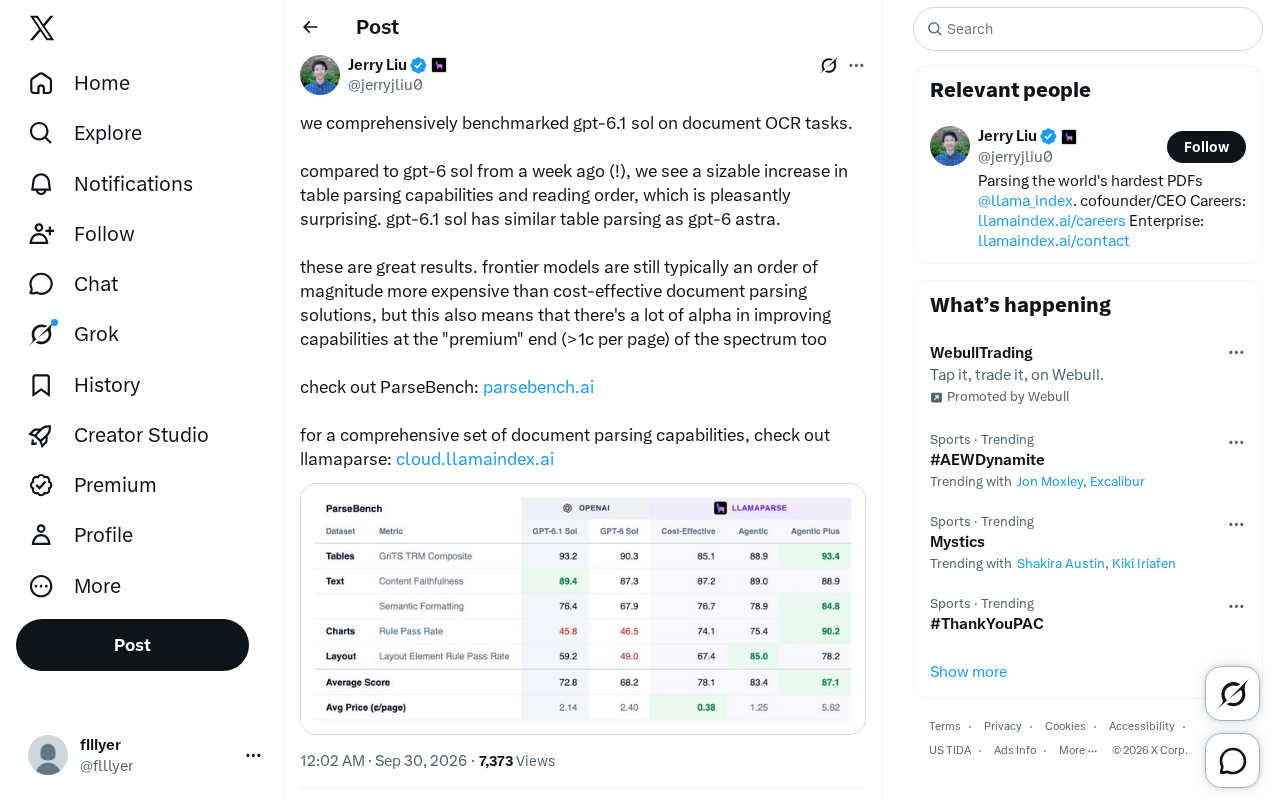
Table Parsing: Catching Up to the Higher-Tier GPT-4 Flagship
In enterprise document processing, table parsing has long been one of the hardest problems in OCR. Complex merged cells, multi-level headers, and nested structures often cause misalignment or data loss in parsed output.
According to the testing team, GPT-4.1 Mini's table parsing capabilities now approach the level of GPT-4 Flagship — a noteworthy finding when you consider the model tier hierarchy. "Flagship" typically refers to the top-tier version, while "Mini" is the more cost-efficient variant. The fact that GPT-4.1 Mini can match the previous generation's Flagship on table parsing signals real progress from OpenAI in improving core capabilities of mid-tier models.
The improvement in reading order is equally significant. Correct text sequencing in documents directly determines the accuracy of downstream tasks like information extraction and Q&A. Multi-column layouts and mixed text-image formatting make reading order particularly difficult to get right. The simultaneous improvement across both dimensions reflects a broader advance in how frontier models understand structured documents.
A note on Reading Order: This is an often-underestimated challenge in document parsing. While human readers naturally read left-to-right and top-to-bottom almost instinctively, models face a different reality — the text stream in formats like PDF is not always stored in visual order. Multi-column layouts (such as the two-column format common in academic papers), text wrapped around images, and the interleaving of footnotes and headers can all cause the underlying text stream to diverge significantly from visual reading order. When reading order is misidentified, downstream tasks like information extraction and summarization receive semantically garbled input, drastically reducing accuracy. For this reason, reading order is considered — alongside table parsing — a core metric for evaluating document understanding capability.
Cost Remains the Primary Barrier for Frontier Models
The testing team also offered a pragmatic assessment: the cost of using frontier models for document parsing tasks is typically still an order of magnitude higher than purpose-built, cost-efficient solutions.
This means that despite GPT-4.1 Mini's impressive capability gains, dedicated parsing solutions still hold a clear economic advantage for large-scale, cost-sensitive document processing pipelines. That said, the team also pointed to the flip side — precisely because frontier models occupy the "premium" tier (costing more than $0.01 per page), there remains substantial room for value creation ("a lot of alpha") in that high-end segment.
In other words, as baseline low-cost document parsing matures, the real technical opportunity may be shifting toward high-end use cases where organizations are willing to pay for higher accuracy and the ability to handle more complex document structures. For teams building differentiated products in the document intelligence space, this is a direction worth serious consideration.
Evaluation Tools: ParseBench and LlamaParse
This benchmark was conducted using ParseBench, a comprehensive evaluation suite for document parsing capabilities introduced by LlamaIndex. It enables side-by-side comparison of different models and solutions across OCR, table parsing, reading order, and other tasks.
For developers looking to deploy document parsing in production, the team also recommends LlamaParse, which provides a complete, production-ready document parsing toolkit. Combining a standardized benchmark (ParseBench) with a practical engineering tool (LlamaParse) creates a relatively objective path for evaluation and solution selection.
More on ParseBench and LlamaParse: ParseBench's significance lies in providing a common baseline for a field that has long lacked standardized metrics. Previously, different document parsing solutions each defined their own evaluation criteria, making "accuracy" figures nearly impossible to compare directly. ParseBench addresses this through standardized test sets and scoring dimensions — covering OCR text recognition, table structure reconstruction, reading order, and more — enabling researchers and engineering teams to evaluate GPT-4o, Claude, and dedicated parsing engines on equal footing. LlamaParse, meanwhile, is LlamaIndex's production document parsing service, integrating multiple parsing strategies under the hood and serving as a preprocessing module for RAG (Retrieval-Augmented Generation) pipelines — converting unstructured documents into structured text that models can consume. Together, they form a complete loop: ParseBench for evaluation, LlamaParse for deployment.
Summary
GPT-4.1 Mini's meaningful gains in table parsing and reading order — achieved within a single week — demonstrate the remarkable speed of frontier model iteration. But the order-of-magnitude cost gap is a reminder that model capability is not the only factor in solution selection. For most enterprises, the real challenge of deploying document intelligence lies in finding the right balance between capability, cost, and document complexity.
(Note: The above is based on benchmark findings published by the LlamaIndex team on Twitter. For specific data, refer to the official ParseBench results.)
Related articles

Felix Rieseberg Personal Homepage
Felix Rieseberg's personal homepage sparks attention on Hacker News. This article covers the Slack engineer's technical background, the rise and fall of nativefier, and the value of a developer homepage as a tech calling card.

@ai-sdk/vue 3.0.306 Patch Release Syncs with [email protected] Update
@ai-sdk/vue 3.0.306 released, synced with [email protected]. A routine patch release for the Vercel AI SDK ecosystem with no public API changes; the Vue adapter layer stays version-aligned with the core package.

Gemini 4 Argon API Launches: The Era of Million-Token Output Begins
Google launches Gemini 4 Argon with sparse MoE architecture, up to 1M output tokens, and a 68.90% Vals Index score, available across API, AI Studio, and the Gemini app.