GPT-4.5 for Website Building: Lu Songsong's 14-Day AI Web Development Journey

Lu Songsong uses multiple AI models in parallel for 14 days of web building with impressive results
Well-known blogger Lu Songsong spent 14 days building websites with AI, deploying GPT-4.5, Claude, Gemini, and Qwen in parallel and flexibly switching between models based on task requirements. He emphasizes a results-oriented pragmatic attitude — it doesn't matter which model you use, as long as it gets the job done. The AI-generated web interfaces have reached professional quality, dramatically lowering the barrier to web development for non-technical users.
Lu Songsong's AI Website Building Day 14: The 4 AM Excitement
Well-known Chinese blogger Lu Songsong has been consistently updating a series — building a website from scratch using AI. By day 14, his technical team had just deployed new large language models to assist with web design and development, pushing the entire project into a new phase.

Interestingly, Lu Songsong mentioned waking up at 4 AM, his mind buzzing with AI website building ideas. This state of mind says something: the AI-assisted web development experience genuinely exceeded his expectations. He had the AI design an "AI Diagnostic Analysis Report" page based on his own understanding, and the final interface impressed him considerably.
GPT-4.5 + Claude + Gemini: A Multi-Model Parallel Strategy for Web Building
In his video, Lu Songsong showed several large models running simultaneously on his computer:
- GPT-4.5 (OpenAI's latest model)
- Qwen 3.6 (Alibaba's Tongyi Qianwen series)
- Gemini 2.5 (Google DeepMind)
- Claude (Anthropic)

This multi-model parallel approach is becoming increasingly common in practical AI web development. The logic is simple: different models excel at different things. GPT-4.5 stands out in code generation, Claude is more nuanced when understanding complex requirements, and Gemini has advantages in multimodal tasks. Switching between models based on specific tasks is currently the most efficient approach to AI-powered web building.
Technical Background of Multi-Model Parallel Strategy
The multi-model parallel approach is backed by solid technical logic. Current mainstream large language models differ significantly in architecture design and training data: GPT-4.5 is deeply optimized through OpenAI's RLHF (Reinforcement Learning from Human Feedback), excelling in code completion and logical reasoning; Claude is trained by Anthropic using a "Constitutional AI" methodology, making it more robust when understanding long texts and complex instructions; Gemini 2.5 natively supports multimodal input, capable of handling mixed tasks involving images, code, and text. This "model routing" approach — dynamically selecting the most suitable model based on task type — is actually a mature practice in enterprise AI engineering, now being adopted by individual developers and creators in a more lightweight fashion.
Core Takeaway: Get the Job Done — Don't Obsess Over Which Model to Use
Lu Songsong said something very straightforward in his video: "It doesn't matter which model you install or use — as long as it gets the job done, that's all that matters."
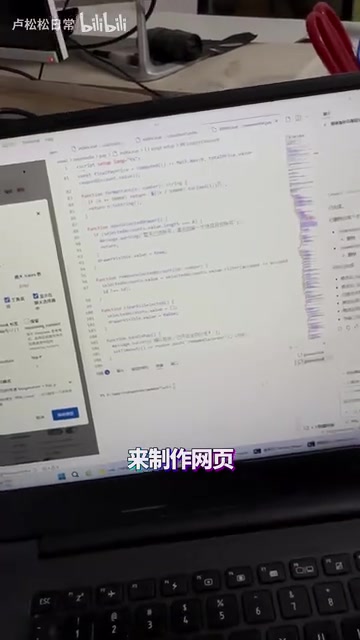
This might sound blunt, but it's incredibly practical advice for those still on the fence about AI tools. AI models iterate so fast that what seems like the strongest model today (GPT-4.5) might be surpassed by a new release in two weeks. Rather than spending excessive time on comparisons and benchmarks, it's better to just start using them and let the results speak for themselves.
What Do AI-Generated Web Pages Look Like? Real Results
Based on the interface screenshots Lu Songsong shared, the design quality of AI-generated web pages is already quite impressive. The "AI Diagnostic Analysis Report" page he had the AI independently understand and design features a reasonable layout and clear visual hierarchy — entirely presentable in a real project.

This is great news for entrepreneurs and content creators without technical backgrounds — AI is dramatically lowering the technical barrier to web development. Previously, building a decent website required knowledge of HTML, CSS, and basic front-end frameworks. Now, you can describe your requirements in natural language, and large models will generate usable page code.
Technical Evolution of AI-Generated Front-End Code
AI-assisted front-end development has undergone a qualitative leap in the past two years. Early code generation models could only output fragment-level HTML/CSS, lacking understanding of overall page structure and design systems. New-generation models like GPT-4.5 and Claude 3 can now comprehend design language concepts such as "visual hierarchy," "information density," and "responsive layout," directly translating natural language requirements into complete, runnable front-end code. This relies on the models' pre-training on massive open-source code repositories (like GitHub) and design documentation, giving them implicit UI/UX design knowledge. For non-technical users, this means prompt engineering is becoming the new "low-code" entry point — describing page requirements in accurate, structured natural language is itself a learnable core skill.
4 Practical Tips for Regular People Building Websites with AI
From Lu Songsong's 14-day AI web building experiment, here are several takeaways worth noting:
- Start now: AI website building tools already have practical value — you don't need to wait for the technology to fully mature before jumping in
- Use multiple models in combination: Don't fixate on a single tool — GPT-4.5, Claude, and Gemini each have their strengths, and flexible switching yields higher efficiency
- Focus on results, not principles: You don't need to understand how large models work internally — being able to use them and produce results is enough
- Move fast and iterate continuously: 14 days of continuous experimentation is more effective than spending a month on perfect planning
The AI Web Building Tool Ecosystem
AI-assisted web development has formed two main paths: First, "all-in-one platforms" represented by Webflow AI and Framer AI, which deeply integrate AI generation with visual editors. Second, the "native LLM + manual deployment" path represented by Lu Songsong's approach, directly calling foundational models like GPT/Claude to generate code and self-hosting it. The former has a lower entry barrier, while the latter offers greater flexibility and customization space. With the rise of AI code generation tools like Vercel v0 and Bolt.new, these two paths are gradually converging — developers can describe requirements in a chat interface, preview in real-time, and deploy with one click. The friction cost across the entire workflow has dropped to historic lows. For individual creators, choosing which path depends on the trade-off between "control" and "convenience."
As the capabilities of new-generation models like GPT-4.5 continue to improve, the ceiling for AI-assisted web development keeps rising. For individual creators and small teams looking to quickly build websites, the cost-effectiveness of AI-powered web development is already remarkably high.
Key Takeaways
- Lu Songsong has been building websites with AI for 14 consecutive days, with significant improvements after deploying GPT-4.5
- Multiple models working in parallel: GPT-4.5, Qwen, Gemini, and Claude simultaneously
- Core philosophy is results-oriented — don't obsess over which model to use, just solve the problem
- AI-generated web interfaces have reached professional quality, dramatically lowering the barrier for non-technical users
- Multi-model combination is the pragmatic strategy for current AI applications
Related articles
 Product Reviews
The Programmer's Desk Setup Guide: Building a Workspace That Feels Like Home
Discover how programmers build productive, comfortable workspaces. From multi-monitor setups to ergonomic design, explore the desk philosophy that drives focus and flow.
 Product Reviews
Qoder vs Cursor Real-World Comparison: Which $20/Month AI IDE Is Better?
Hands-on comparison of Qoder vs Cursor AI IDEs: Agent autonomy, human interaction count, and architecture decisions. Qoder needed only 2 interactions vs Cursor's 8.
 Product Reviews
Cursor Cloud Agent Demo: Eliminating Bottlenecks Across the Entire Software Development Lifecycle
Deep analysis of Cursor's Cloud Agent demo showing how cloud VMs, automated test artifacts, and a full-chain control plane systematically eliminate human bottlenecks across the software development lifecycle.