GPT-5.1 Pro Deep Dive: The Smartest AI Trapped in the Worst Interface

GPT-5.1 Pro shows stunning reasoning but is crippled by ChatGPT's terrible interface; Codex Max underdelivers.
OpenAI released GPT-5.1 Pro and Codex Max. GPT-5.1 Pro demonstrated remarkable reasoning by solving a DEF CON cryptography challenge in 30 minutes that took a human three days, but it's limited to ChatGPT's web interface with no API access and a terrible UX. Codex Max introduces agentic coding with context compaction technology, but real-world testing on an SDK upgrade task revealed frequent errors, severe type safety violations, and performance far below marketing claims.
Just one day after Gemini 3 Pro Preview launched, OpenAI dropped two new models: GPT-5.1 Codex Max and GPT-5.1 Pro. The former focuses on long-running agentic coding tasks, while the latter is a heavyweight reasoning model available only on the ChatGPT website. After gaining early access, well-known developer Theo conducted extensive testing and reached a bittersweet conclusion — this might be the smartest AI model currently available, but it's trapped in a terrible interface.
GPT-5.1 Pro Reasoning Test: Solving a 3-Day Cryptography Puzzle in 30 Minutes
To test GPT-5.1 Pro's reasoning capabilities, Theo chose an unconventional testing scenario — the DEF CON hacker conference's Goldbug cryptography challenge. This is a series of complex puzzles combining reasoning, research, and cryptography, with 12-13 challenges each year whose answers are all 12-character pirate-themed phrases.
Theo spent a full three days solving one puzzle called "Smuggler's Manifest." This puzzle involved the ADFGX cipher — an encryption system born during World War I, designed by German Colonel Fritz Nebel in 1918. The ADFGX cipher uses only five letters: A, D, F, G, and X (these letters are difficult to confuse in Morse code, making them ideal for radio transmission). It combines Polybius square substitution with columnar transposition encryption, making it extremely difficult to crack at the time — French cryptanalyst Georges Painvin eventually broke it in June 1918, directly influencing the course of the war. The puzzle required finding a gem smuggling route from a cargo manifest, then decrypting it with the correct key.
When Theo fed the same PDF and brief instructions to GPT-5.1 Pro, the model thought for nearly 30 minutes, then delivered a stunning analysis:
- Correctly identified the ADFGX cipher — no Claude model was able to do this, which itself demonstrates GPT-5.1 Pro's ability to integrate knowledge across historical cryptography and modern reasoning
- Discovered the connection to the film Romancing the Stone — Theo himself had to comb through the entire movie script to find this
- Found key clues Theo had missed — cargo weight imbalances across different locations, with the jungle having 2.1 extra units and the port missing 2.1 units, hinting at the gems' weight and smuggling path
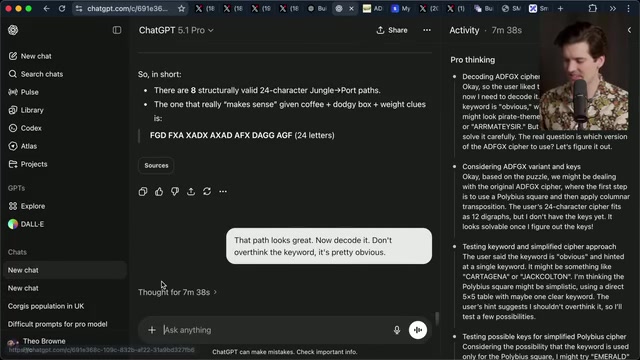
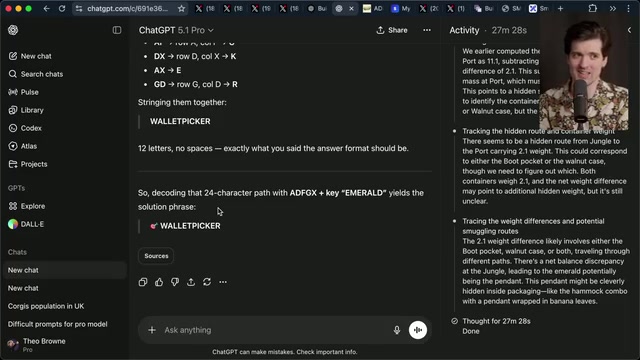
After several rounds of prompting and approximately 40 minutes of total computation time, the model ultimately produced the correct answer: "WALLET PICKER." Theo said he "felt a chill" when he saw the result — he had never expected an LLM to independently solve this type of puzzle.
ChatGPT's Interface Holds It Back: The Smartest Brain Trapped in the Worst Cage
However, the frustrating reality is that GPT-5.1 Pro currently has no API access — it can only be used through the ChatGPT website. And the website experience is nothing short of catastrophic.
Theo encountered numerous UI issues during use: new conversation titles failed to update properly, getting stuck in a broken state showing "thought-for-7-minutes-38-seconds"; pages frequently threw "Something went wrong" errors; and after long thinking sessions, you had to remember to come back and check the results.
Another reviewer, Matt Schumer, perfectly summarized this contradictory experience:
"GPT-5.1 Pro is a slow, heavyweight reasoning model. When facing truly difficult problems, it feels smarter than anything I've ever used. Instruction following is its standout strength — it can stay on the specified path throughout a 30-minute to 1-hour run without deviation. But its biggest weakness is the interface. It lives in ChatGPT, not in my IDE, not plugged into my existing toolchain."
For everyday work, Gemini 3 is still better for UI design and writing. But for tasks requiring deep thinking, planning, and research — especially things that need to be done right the first time — GPT-5.1 Pro is currently irreplaceable.
GPT-5.1 Codex Max Coding Evaluation: Big Promises, Harsh Reality
Codex Max is OpenAI's new model designed specifically for agentic coding. Agentic coding represents a new paradigm distinct from traditional "Q&A-style" code completion — in agent mode, the AI model is empowered to autonomously execute multi-step tasks, including reading and writing files, running terminal commands, searching documentation, iterative debugging, and more, without requiring human intervention at every step. Codex Max features several core capabilities:
Compaction Technology: When the context window approaches its limit, the model automatically compresses history, retaining the most important context. The core principle of this technology is semantic summarization of conversation history, compressing verbose intermediate steps into high-density structured memory while preserving key decision nodes and code states — similar to how humans maintain "work logs" during long-term projects. OpenAI claims this enables the model to maintain coherence across millions of tokens, with internal testing showing it can work continuously for over 24 hours — significant for scenarios like large codebase refactoring and cross-file dependency analysis.
Token Efficiency Improvements: On the SWE-Bench verified set, Codex Max outperforms the original GPT 5.1 Codex while using 30% fewer thinking tokens. SWE-Bench is the gold standard for evaluating AI software engineering capabilities, proposed by Princeton University researchers. It collects 2,294 real issues from GitHub open-source projects and requires models to automatically generate code patches that pass corresponding test cases — far more difficult than simple code completion, requiring models to understand complex codebase context and locate bug root causes. Fewer tokens mean faster speed — crucial for OpenAI models that have been criticized for being too slow.
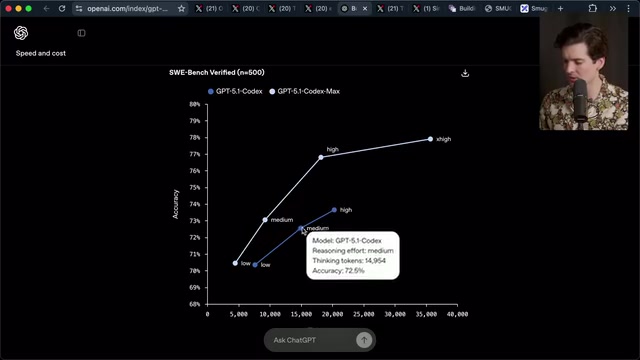
However, Theo's actual testing experience was far from what the marketing materials described.
AI Coding in Practice: A Painful SDK Upgrade Experience
Theo used a standardized test task to evaluate Codex Max — upgrading a project to the latest version of the AI SDK. He had already tested this task on multiple AI coding models, with notably different results.
The first attempt encountered catastrophic problems:
- The search tool crashed immediately with an error when enabled
- After disabling search, the model used curl to grab an entire webpage's HTML source and stuffed it into context, instead of extracting useful text
- It introduced severe TypeScript type safety issues, using
as anyeverywhere - It never proactively ran
tscfor type checking - After multiple fix attempts, the same bugs persisted
To understand the severity of the as any problem: TypeScript's core value lies in its static type system, catching type errors at compile time to reduce runtime bugs. as any is a type assertion syntax that allows bypassing type checking — essentially abandoning TypeScript's core guarantee. tsc --noEmit is the official compiler's full type-checking command. When an AI model doesn't proactively run it, the code can "look like it works" while silently planting type safety landmines — this is a universal pain point with current AI coding tools.
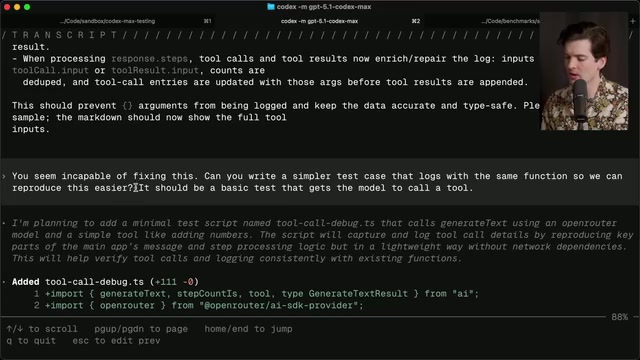
Theo wrote in his prompt: "You have completely destroyed the type safety and reliability of this project. What on earth are you doing?"
Related articles
 Product Reviews
The Programmer's Desk Setup Guide: Building a Workspace That Feels Like Home
Discover how programmers build productive, comfortable workspaces. From multi-monitor setups to ergonomic design, explore the desk philosophy that drives focus and flow.
 Product Reviews
Qoder vs Cursor Real-World Comparison: Which $20/Month AI IDE Is Better?
Hands-on comparison of Qoder vs Cursor AI IDEs: Agent autonomy, human interaction count, and architecture decisions. Qoder needed only 2 interactions vs Cursor's 8.
 Product Reviews
Cursor Cloud Agent Demo: Eliminating Bottlenecks Across the Entire Software Development Lifecycle
Deep analysis of Cursor's Cloud Agent demo showing how cloud VMs, automated test artifacts, and a full-chain control plane systematically eliminate human bottlenecks across the software development lifecycle.