GPT-5.2, Claude 4.5, Gemini 3 Pro Hands-On Comparison: 2025 Buying Guide

2025 hands-on comparison of four top AI models with budget-friendly access recommendations
This article benchmarks four top 2025 AI models via an aggregation platform: GPT-5.2 leads in overall capability, excelling at writing and deep research; Claude Sonnet 4.5 tops coding benchmarks; Gemini 3 Pro shines in copywriting; and Grok 4.1 offers superior real-time information integration. Aggregation platforms provide affordable one-stop access to all models, though users should be mindful of data privacy.
The 2025 AI Model Battle: GPT-5.2, Claude 4.5, Gemini 3 Pro — Which One Is Worth Using?
The AI landscape in 2025 is an all-out war among titans — OpenAI released its flagship model GPT-5.2, Google followed closely with Gemini 3 Pro, Anthropic made a strong comeback with Claude Sonnet 4.5, and Elon Musk's xAI entered the fray with Grok 4.1. These major models are fiercely competing across dimensions like writing, coding, and reasoning, leaving ordinary users spoiled for choice.
However, rather than "which AI model is the strongest," what most people actually care about is how to access these models at low cost. GPT-5.2 Pro's official subscription is a steep $200/month, and Claude 4.5 and Gemini 3 Pro each have their own paywalls. This article uses an AI aggregation platform that brings together all top-tier models to benchmark their real-world performance and help you find the best fit.
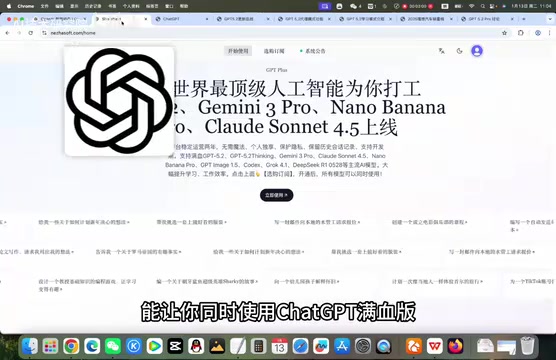
All Top AI Models in One Place: Platform Feature Overview
The core advantage of this AI mirror site is that it's one of the few aggregation platforms in the industry capable of simultaneously connecting to multiple top-tier AI models.
AI aggregation platforms (also known as AI Gateways) work by using a unified API gateway to wrap multiple LLM providers' interfaces into a single access layer. Users don't need to register separate accounts with OpenAI, Google, Anthropic, etc., nor deal with each provider's different API formats and authentication mechanisms. These platforms typically use a Reverse Proxy architecture, maintaining connection pools with various model providers on the backend while offering a unified web interface or API on the frontend. Their business model generally involves bulk-purchasing token quotas from each provider's API and reselling them to end users at slightly below official retail prices, leveraging economies of scale to reduce unit costs. Additionally, some platforms incorporate intelligent routing mechanisms that automatically select the most suitable backend model based on the type of user request (e.g., code generation, creative writing, data analysis), further optimizing cost and response quality.
Supported models include:
- OpenAI full lineup: GPT-5.2, GPT-5.2 Pro, GPT Image 1.5, Codex coding model, etc.
- Google lineup: Gemini 3 Pro, plus Nano, Flash, and other sub-models of varying specs
- Anthropic lineup: Claude Sonnet 4.5, currently a top performer in coding capability benchmarks
- xAI lineup: Grok 4.1, what Musk calls "the most powerful model on Earth"
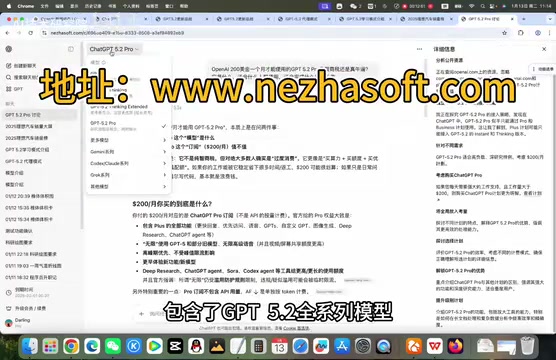
The platform interface is clean and intuitive: switch models in the upper left, input conversations in the center, and access chat history on the left side. Feature-wise, it supports deep research, agent mode, learning mode, web search, and canvas among other interaction methods, with hundreds of built-in GPT plugins covering writing, coding, research analysis, education, and more.
GPT-5.2 Image Generation Test: Chinese Text Rendering Finally Works
First, let's test the GPT Image 1.5 image generation capability built into GPT-5.2. The test task is to generate a "Northeastern Chinese restaurant menu" including dishes like braised pork belly, kung pao chicken, iron pot stewed goose, and chicken stewed with mushrooms, with prices labeled.
The results are impressive: the text in the image is clear and legible, dish names and prices are neatly arranged (braised pork belly ¥28, iron pot stewed goose ¥58, chicken stewed with mushrooms ¥38, rice ¥2), and the pricing follows real-world logic. This demonstrates that GPT-5.2 has reached practical usability in mixed text-image generation, especially with significantly improved Chinese text rendering quality — no longer the blurry garbled mess of before.
It's worth noting that text rendering in AI image generation has long been a recognized industry challenge, particularly for non-Latin characters like Chinese. Early diffusion models (such as Stable Diffusion, DALL-E 2) would produce garbled or blurry text in generated images because traditional diffusion models work in pixel space and lack sufficient control over elements requiring precise stroke structures. GPT Image 1.5's breakthrough likely benefits from several technical improvements: first, a significant increase in training data containing clear text-image pairs; second, potentially introducing a glyph-aware encoding mechanism that allows the model to reference standard character glyphs during generation; and third, employing a higher-resolution generation pipeline that preserves stroke details. Chinese rendering is far more difficult than English because Chinese characters have complex strokes and compact structures, demanding higher pixel-level precision — which is why virtually all AI image generation tools previously performed poorly in Chinese scenarios.
GPT-5.2 Deep Research Mode: Professional Research Reports with Citations
Next, let's test GPT-5.2's Deep Research mode. Input task: "OpenAI released its latest flagship model GPT-5.2. Summarize the updates in 1000 words in Chinese."
Deep Research mode is a major innovation direction in the LLM field during 2024-2025. Its essence is upgrading traditional single-turn Q&A into multi-step autonomous Agent workflows. Unlike regular conversation mode where the model generates an answer in one pass, Deep Research mode has the model autonomously plan research paths, decompose tasks into sub-questions, then progressively collect evidence by calling search engines, browsing web pages, and extracting key information through tool chains, ultimately synthesizing all information into a structured report. This process involves the fusion of RAG (Retrieval-Augmented Generation), Chain-of-Thought reasoning, and Agent autonomous decision-making. From a user experience perspective, it's like having an AI research assistant that can independently browse the web, organize notes, and write reports.
The Deep Research mode workflow differs fundamentally from regular conversation:
- Guidance phase: The system first analyzes the user's prompt to confirm research direction and scope
- Research phase: The model enters deep retrieval mode, taking roughly ten-plus minutes, with real-time thinking activity previews on the right side. The extended duration is because the model needs to perform multiple iterations of retrieval-reading-reasoning cycles, where each round may trigger new sub-questions and information retrievals. During this process, the model may visit dozens of web pages, cross-verify information from different sources, and automatically filter low-quality or contradictory content
- Output phase: Generates a structured research report with real source links attached
The final output was a complete "GPT-5.2 Performance Enhancement Report" covering model architecture improvements, benchmark comparisons, practical application scenario analysis, and more, with all cited sources listed on the right side. This deep research capability with citations is extremely valuable for users who need to conduct industry research or technical analysis.
GPT-5.2 Writing and Reasoning: In-Depth Testing
Style Imitation: Writing About 996 Overtime Culture in Lu Xun's Voice
Giving GPT-5.2 a challenging writing task: "Describe the suffering of 996 overtime culture in the style of Lu Xun."
The model output indeed captured the core characteristics of Lu Xun's essays — cold irony, profound social criticism, and that distinctive "interrogation" narrative structure. Sentences like "The interrogator is none other than that invisible great machine" appeared in the text with genuine Lu Xun spirit, demonstrating that GPT-5.2 has considerable skill in Chinese literary style imitation.
Style Transfer is a high-difficulty task in the NLP field, requiring the model to understand not only the target author's vocabulary choices and sentence structures but also their deeper thinking patterns and emotional undertones. Lu Xun's writing style is particularly difficult to imitate because its uniqueness lies not just in rhetorical devices but in a special critical perspective and intellectual depth. GPT-5.2's ability to accomplish this task reasonably well indicates that its training on Chinese literary corpora has reached considerable depth, with the model forming high-dimensional representations of different authors' styles internally.
GPT-5.2 Pro Deep Reasoning: Is 14 Minutes of Thinking Worth $200?
Next, testing GPT-5.2 Pro, officially priced at $200/month. Posing a somewhat self-referential question: "Is GPT-5.2 Pro an intelligence tax or genuinely impressive?"
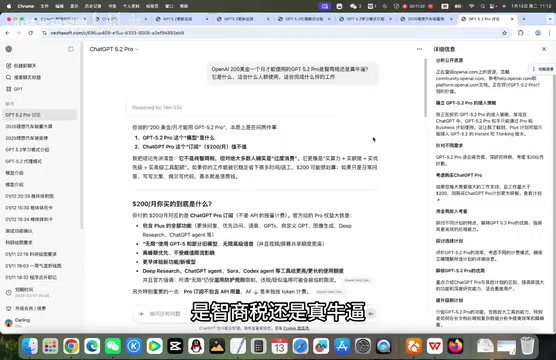
The Pro model clearly separates itself from the standard version:
- Thinking time: A full 14 minutes — virtually impossible in normal conversations
- Thinking depth: The right side displays detailed reasoning processes, including multi-layered analysis like "establishing approach strategy" and "considering purchase scenarios for different needs"
- Output quality: Provides structured analysis, clearly distinguishing Pro's target users — engineers, R&D leads, architects, heavy coding users, and professionals who need to process large volumes of material
GPT-5.2 Pro's ability to perform deep reasoning for up to 14 minutes involves an important concept called "Inference-time Scaling Law." Traditional Scaling Laws focus on the training phase — more data, larger models, and more compute yield better performance. The Inference-time Scaling Law reveals another dimension: investing more computational resources during inference (i.e., letting the model "think" longer) can also significantly improve output quality. OpenAI began exploring this direction with the o1 series models, using reinforcement learning to train models to perform multi-step internal reasoning before answering. The Pro version essentially allocates a larger inference compute budget, allowing the model to explore more reasoning paths, perform deeper self-verification and error correction, thereby producing higher-quality answers on complex problems. This also explains why the Pro version is priced far higher than the standard version — each inference may consume tens of times more GPU compute than the regular version.
This long-duration deep reasoning capability is GPT-5.2 Pro's core differentiator. Casual chat users genuinely don't need it, but for professionals requiring complex reasoning in specialized scenarios, those 14 minutes of "deep thinking" may truly be worth the price.
Four-Model Showdown Summary: Who Is Each Model Best For?
After this round of testing, the positioning and strengths/weaknesses of GPT-5.2, Claude 4.5, Gemini 3 Pro, and Grok 4.1 are fairly clear:
| Model | Core Strength | Best Use Case |
|---|---|---|
| GPT-5.2 / Pro | Strongest overall, outstanding deep research | Writing, academic research, general tasks |
| Claude Sonnet 4.5 | Leading coding ability | Code generation, technical development |
| Gemini 3 Pro | Excellent copywriting | Marketing copy, content creation |
| Grok 4.1 | Real-time information integration | News tracking, real-time information retrieval |
Regarding Claude Sonnet 4.5's coding advantage, its leading position is primarily measured through industry-standard code benchmarks such as SWE-bench, HumanEval, and MBPP. Among these, SWE-bench is currently one of the most challenging code evaluations, requiring the model to understand real GitHub open-source project codebases and autonomously fix bugs — testing not just code generation ability but also contextual understanding of large codebases and engineering reasoning. Anthropic specifically strengthened code comprehension and generation capabilities in training the Claude series, employing a strategy combining RLHF (Reinforcement Learning from Human Feedback) with code-specific training data. Their proprietary Constitutional AI method also helps the model better adhere to safety and correctness constraints when generating code. For developers, Claude 4.5 particularly excels at handling complex multi-file project refactoring, understanding design patterns, and generating code that meets engineering standards.
Regarding Gemini 3 Pro's copywriting ability, Google leveraged the massive high-quality copywriting data accumulated through its search engine and advertising businesses when training the Gemini series. Gemini 3 Pro's understanding of marketing language, brand tone, and audience psychology is noticeably superior to competitors, making it excel in writing ad copy, social media content, product descriptions, and other commercial writing scenarios. Additionally, Gemini's multimodal capabilities provide unique advantages for copywriting — it can simultaneously understand images, videos, and other visual materials, generating text descriptions that highly match the visual content.
Regarding Grok 4.1's real-time information capability, its technical foundation comes from xAI's deep integration with the X (formerly Twitter) platform — Grok can directly access X platform's real-time post stream to obtain the latest news events, public opinion dynamics, and user discussions. From a technical architecture perspective, this is a special implementation of RAG (Retrieval-Augmented Generation): before generating an answer, the model first retrieves relevant information from X platform's real-time data stream, then injects this latest information as context into the generation process. In contrast, other models' knowledge typically has a "cutoff date," or they need additional search tools to access the latest information. xAI has also invested heavily in building its own supercomputing cluster Colossus, reportedly housing over 100,000 NVIDIA H100 GPUs, providing compute support for training and inference of the Grok model series.
From an industry landscape perspective, AI model competition in 2025 has shifted from a pure "parameter scale race" to a "differentiated capability competition." Providers are no longer blindly pursuing larger model sizes but are instead deepening expertise in specific capability dimensions — which is actually good news for users, meaning you can choose the most suitable tool based on your core needs rather than being forced to pay for capabilities you'll never use.
For users who want to experience these AI models, aggregation mirror sites are indeed the most cost-effective approach. Subscribing to each platform separately could total over $500/month, while AI aggregation platforms can offer a one-stop experience at much lower prices. However, a reminder: when using mirror sites, be sure to pay attention to data privacy and service stability — for scenarios involving sensitive information, it's recommended to operate through official channels.
Key Takeaways
- The 2025 AI model battle is fierce, with GPT-5.2, Claude Sonnet 4.5, Gemini 3 Pro, and Grok 4.1 each excelling in different areas
- AI aggregation mirror sites offer one-stop, low-cost access to all top models, supporting deep research, agent mode, and other features
- GPT-5.2 excels in image generation, Chinese writing, and deep research, with the Pro version capable of 14-minute extended deep reasoning
- Models are increasingly differentiated: GPT-5.2 is strongest overall, Claude 4.5 leads in coding, Gemini 3 Pro stands out in copywriting
- When using mirror sites, be mindful of data privacy and service stability; use official channels for sensitive information
Related articles
 Product Reviews
The Programmer's Desk Setup Guide: Building a Workspace That Feels Like Home
Discover how programmers build productive, comfortable workspaces. From multi-monitor setups to ergonomic design, explore the desk philosophy that drives focus and flow.
 Product Reviews
Qoder vs Cursor Real-World Comparison: Which $20/Month AI IDE Is Better?
Hands-on comparison of Qoder vs Cursor AI IDEs: Agent autonomy, human interaction count, and architecture decisions. Qoder needed only 2 interactions vs Cursor's 8.
 Product Reviews
Cursor Cloud Agent Demo: Eliminating Bottlenecks Across the Entire Software Development Lifecycle
Deep analysis of Cursor's Cloud Agent demo showing how cloud VMs, automated test artifacts, and a full-chain control plane systematically eliminate human bottlenecks across the software development lifecycle.