GPT-5.4 In-Depth Review: A Quantum Leap in Coding Ability, But One Flaw Is a Dealbreaker

OpenAI releases GPT-5.4 with major coding and computer use gains, but at a higher price.
OpenAI has officially released GPT-5.4, supporting a 1 million token context window with significant improvements in coding, computer use, and web search. Its 75% score on OS World Verified surpasses the human baseline for the first time, marking AI computer operation's leap from "demo-grade" to "production-grade." On the coding front, Codex's new Fast mode delivers impressive results, though OCR recognition remains unstable in complex scenarios. The price increase reflects OpenAI's confidence in its differentiated capabilities.
Article
OpenAI has officially released GPT-5.4, bringing significant improvements across multiple dimensions including coding, computer use, and web search — with prices rising accordingly. As a power user, I put GPT-5.4 through comprehensive testing immediately upon release, and my final verdict is a mix of amazement and frustration.
Pricing & Core Specs: More Expensive, More Powerful
GPT-5.4 supports an ultra-long context window of 1 million tokens, with a knowledge cutoff date of August 31, 2024. On pricing, OpenAI has adopted a tiered strategy — the standard version is noticeably more expensive than GPT-5.2, though output pricing remains largely unchanged.
There's clear business logic behind this pricing structure: large models typically charge separately for input tokens and output tokens, with differentiated pricing based on context length, whether Prompt Caching is enabled, whether reasoning mode is active, and other dimensions. Input pricing being higher than output pricing primarily reflects the fact that KV Cache computation for long contexts is the core driver of inference costs. GPT-5.4's higher input pricing with essentially flat output pricing suggests that OpenAI has made progress in output generation efficiency, while also nudging users toward crafting more concise prompts. The very fact that OpenAI dares to raise prices signals clear confidence in GPT-5.4's capability improvements — in the industry, a model commanding higher prices typically means it has established sufficient differentiation in key capability dimensions.
Looking at official benchmarks, GPT-5.4 performs excellently across multiple dimensions including Computer Use, GPT Value, web search, and SWE Bench Pro. Particularly noteworthy is GPT-5.4's score of 75% on OS World Verified, surpassing the human baseline of 72.4% for the first time.
OS World Verified is a benchmark developed by academia specifically to evaluate AI models' ability to autonomously complete tasks in real operating system environments, covering complex scenarios such as file management, application operation, and web browsing — it's considered one of the gold standards for measuring "computer use" capability. This capability is essentially multimodal Agent ability — the model needs to understand the current screen state through screenshots, then decide the next mouse click or keyboard input action, forming a perception-decision-execution loop. When Claude first introduced computer use capability, its OS World score was below 30%, and the industry widely believed this capability was still far from practical use. GPT-5.4 pushing this number to 75% and surpassing the human baseline marks a critical leap from "demo-grade" to "production-grade" in AI's ability to autonomously operate computers — the speed of model evolution is staggering.
Multimodal Capabilities: Notable Progress in Visual Understanding, But OCR Still Has Shortcomings
In visual understanding and reasoning, GPT-5.4 has reached a fairly high standard, though its performance in actual testing isn't flawless.
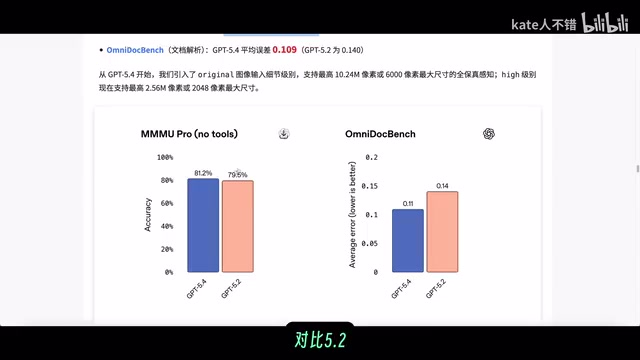
I tested GPT-5.4's OCR image recognition capability, asking it to identify all text in an image. However, it stated "there are issues with the body text, cannot guarantee word-for-word accuracy" and only recognized partial content. I then sent an image with severe glare — the left main description section was recognized fairly well, but the middle technique description section suffered obvious misrecognition due to heavy reflections — for example, misidentifying certain characters. Overall, while GPT-5.4's multimodal capabilities have improved, they remain unstable in complex scenarios.
Coding Ability: Codex Shines, Game Generation Is Impressive
Coding is the headline feature of GPT-5.4's upgrade. The new Codex adds a Fast mode with 1.5x speed improvement (consuming double the quota), scoring higher than GPT-5.3 Codex on SWE Bench Pro.
SWE Bench (Software Engineering Benchmark) is a coding ability evaluation benchmark released by a Princeton University team. Its core approach extracts Issues from real GitHub open-source projects and requires models to automatically generate code patches that pass corresponding test cases. Compared to simple code completion tasks, SWE Bench more closely resembles the "bug fixing" work engineers do daily.
Related articles
 Product Reviews
The Programmer's Desk Setup Guide: Building a Workspace That Feels Like Home
Discover how programmers build productive, comfortable workspaces. From multi-monitor setups to ergonomic design, explore the desk philosophy that drives focus and flow.
 Product Reviews
Qoder vs Cursor Real-World Comparison: Which $20/Month AI IDE Is Better?
Hands-on comparison of Qoder vs Cursor AI IDEs: Agent autonomy, human interaction count, and architecture decisions. Qoder needed only 2 interactions vs Cursor's 8.
 Product Reviews
Cursor Cloud Agent Demo: Eliminating Bottlenecks Across the Entire Software Development Lifecycle
Deep analysis of Cursor's Cloud Agent demo showing how cloud VMs, automated test artifacts, and a full-chain control plane systematically eliminate human bottlenecks across the software development lifecycle.