GPT 5.4 vs Claude 4.6: How to Choose Your AI Coding Tool? In-Depth Comparison & Best Setup

Claude Code comprehensively outperforms Codex in coding capability and ecosystem integration.
This article compares OpenAI's Codex and Anthropic's Claude Code as AI coding tools. Codex offers a $20 entry point with rich perks but struggles with frontend development and prompt instability across model updates. Claude Code requires a $200 subscription but delivers superior coding with Opus 4.6, a more mature integration ecosystem, and pioneering innovations like the MCP protocol and Agent Skills, along with better model iteration stability.
With the successive releases of GPT 5.4 and Opus 4.6, competition among AI coding tools has reached a fever pitch. Codex (OpenAI) and Claude Code (Anthropic) represent the strongest offerings from each camp, but with monthly subscriptions at $200, most developers can only pick one.
This article is based on an experienced user's long-term hands-on experience, providing an in-depth comparison across product features, coding capabilities, ecosystem integration, and more—helping you make the smartest choice.
Codex: The All-Rounder You Can Start Using for Just $20
Even if you only subscribe to the $20 ChatGPT Plus plan, you can access GPT 5.4 or GPT 5.3 Codex. Even if your account hasn't received the update rollout yet, you can still use the Codex web interface—just specify a Git repository and let it handle your coding tasks directly.
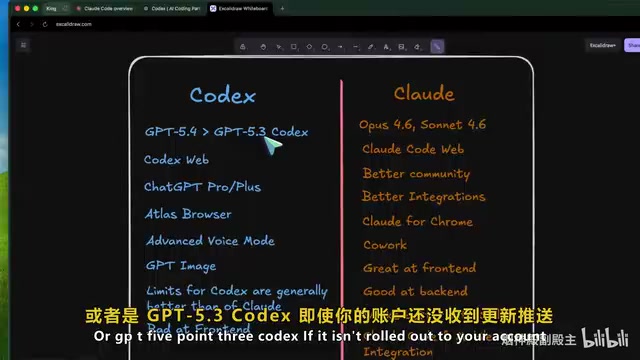
Beyond core coding capabilities, a Codex subscription comes with plenty of additional perks: all ChatGPT Pro/Plus features, the Atlas browser for agentic web browsing, advanced voice mode, and the GPT image generation model. Currently, Codex usage quotas tend to be more generous than Claude's—though this is likely just a promotional strategy that will be tightened as the user base grows.
Codex's Obvious Weakness in Frontend Development
Codex's biggest issue lies in frontend development. It has a tendency to impose its own aesthetic preferences across all projects, and this "opinionated" behavior significantly detracts from the actual development experience.
Additionally, OpenAI's model updates involve drastic changes that often force developers to completely overhaul their prompts—a serious challenge to workflow stability. Prompt Stability is a severely underestimated engineering problem in enterprise-grade AI applications. When the underlying model version updates, even if overall model capabilities improve, response patterns to the same prompt can drift significantly—including output format changes, altered reasoning paths, and differences in handling edge cases. This is especially damaging for automated pipelines that rely on fixed prompt templates: at best, you need to re-tune dozens of prompts; at worst, your entire workflow breaks down. OpenAI has historically exhibited this problem multiple times across model iterations (e.g., behavioral differences from GPT-4 to GPT-4-turbo), and it remains one of the core pain points repeatedly mentioned by Codex users.
Codex's SDK and documentation are also somewhat cumbersome to work with, creating a steeper learning curve for developers who want to build custom tools on top of it.
Claude Code: The $200 Programming Powerhouse
Claude Code comes equipped with both Opus 4.6 and Sonnet 4.6 models, both performing exceptionally well, with generous usage quotas. More importantly, Claude Code demonstrates clear advantages across multiple dimensions.
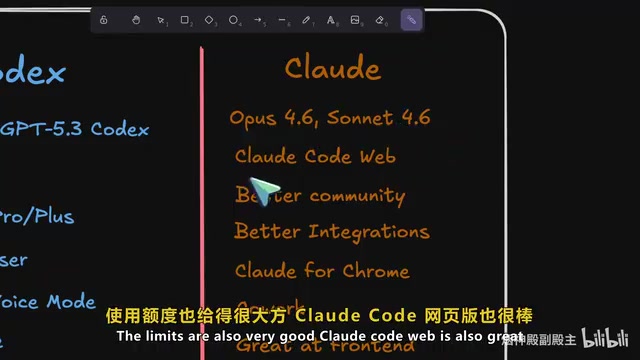
More Mature Ecosystem Integration, Smoother Toolchain Connectivity
Claude Code offers better integration support and a more mature community ecosystem. When new development tools or frameworks emerge, Claude Code typically provides native support faster. You can also use Chrome extensions to achieve agentic browsing functionality similar to OpenAI's Atlas, resulting in smoother overall toolchain connectivity.
Opus 4.6's Coding Capabilities Comprehensively Outperform Codex
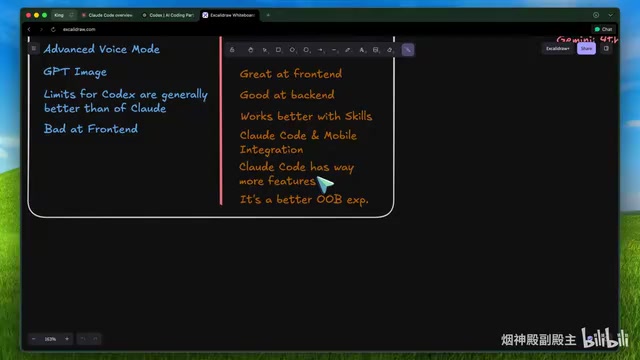
Opus 4.6 excels at writing frontend code, and its backend performance is equally impressive. If you configure it with the appropriate Skills plugins, its performance far surpasses Codex. Particularly in its ability to understand knowledge and elegantly apply it in practice to solve complex problems, Opus demonstrates the caliber of a top-tier model.
Continuous Innovation: New Features Ship Weekly
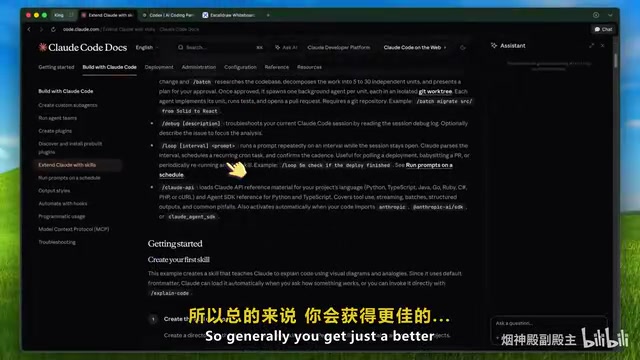
Claude Code rolls out useful new features every week, while competitors mostly follow in its footsteps. For example, the core concepts of Agent Skills and the MCP protocol were both pioneered by Anthropic, with other vendors only adopting them afterward.
MCP (Model Context Protocol) is a standardized protocol open-sourced by Anthropic in late 2024, designed to solve the fragmentation problem of integrating AI models with external tools and data sources. Before MCP, every AI application needed custom adapter code for different data sources (databases, APIs, file systems, etc.), making maintenance costs extremely high. By defining a unified client-server communication specification, MCP enables AI models to invoke any external tool in a standardized way, dramatically lowering the barrier to ecosystem development. There are now hundreds of MCP server implementations covering mainstream scenarios like GitHub, Slack, and databases.
Agent Skills are reusable task execution units within Claude Code—essentially packaging domain-specific operational workflows (such as code review, test generation, documentation writing) into callable skill modules. Unlike simple function calls, Skills support context memory and cross-step state passing, allowing the model to maintain coherent execution logic when handling complex engineering tasks rather than starting from scratch each time to understand the task context.
Recently, Claude Code also launched mobile integration, letting developers track task progress from their phones even when they're away from their desks.
Furthermore, Anthropic's agent SDK has become more mature and refined, enabling developers to build personalized coding tools tailored to their workflow for handling specific tasks. In contrast to OpenAI, Anthropic has maintained excellent stability across model iterations—deliberately preserving higher behavioral consistency in the migration from the Claude 3 series to the Claude 4 series. Unlike OpenAI, where every update requires major prompt adjustments, this consistency holds significant value for developers building stable production environments.
On "AI Fluff"
Related articles
 Product Reviews
The Programmer's Desk Setup Guide: Building a Workspace That Feels Like Home
Discover how programmers build productive, comfortable workspaces. From multi-monitor setups to ergonomic design, explore the desk philosophy that drives focus and flow.
 Product Reviews
Qoder vs Cursor Real-World Comparison: Which $20/Month AI IDE Is Better?
Hands-on comparison of Qoder vs Cursor AI IDEs: Agent autonomy, human interaction count, and architecture decisions. Qoder needed only 2 interactions vs Cursor's 8.
 Product Reviews
Cursor Cloud Agent Demo: Eliminating Bottlenecks Across the Entire Software Development Lifecycle
Deep analysis of Cursor's Cloud Agent demo showing how cloud VMs, automated test artifacts, and a full-chain control plane systematically eliminate human bottlenecks across the software development lifecycle.