GPT-5.5 Deep Dive: Coding, Automation & Agent Capabilities Tested

GPT-5.5 evolves from a chat assistant into an autonomous task-executing agent.
GPT-5.5 marks OpenAI's strategic shift from conversational models to Agents. It features autonomous planning, execution, and error correction capabilities, can complete hours of coding work in 20 minutes, enables end-to-end automated workflows for knowledge work, and delivers notable improvements in research assistance and Token efficiency.
GPT-5.5 Core Positioning: From Chat Assistant to Task-Executing Agent
The release of GPT-5.5 marks a major strategic shift for OpenAI. This time, the focus isn't on making the model better at conversation — it's about positioning it as an Agent capable of completing real work. OpenAI President Greg Brockman called it "a new class of intelligence for real work."
Agent is one of the core concepts in AI, referring to a system that can perceive its environment, make autonomous decisions, and take actions to achieve goals. Unlike traditional "input-output" large language models, Agents possess four core capabilities: Planning, Memory, Tool Use, and Self-reflection. Architecturally, Agents typically use a large language model as their "brain," leveraging frameworks like ReAct (Reasoning + Acting) or Chain-of-Thought to decompose complex tasks into executable sub-steps, observing results after each step and dynamically adjusting subsequent plans. GPT-5.5's Agent positioning means it's no longer just a text generator — it's an autonomous execution system capable of continuously cycling through "think-act-observe" in real digital environments.
What does this positioning mean? Previous large language models were more like knowledgeable consultants — you ask questions, they give answers. GPT-5.5 is more like a super executor: understanding goals, planning steps, executing tasks, correcting errors when they arise, and pushing complex work to completion.
The core change lies in autonomy. Previously, many models required users to break down requirements into granular steps. GPT-5.5 better understands ambiguous goals — give it a direction, and it will plan the task path on its own, checking progress along the way and proactively adjusting when things fail. This leap from "passive response" to "proactive execution" is GPT-5.5's most fundamental evolution.
GPT-5.5 Coding Capabilities Tested: Hours of Work Done in 20 Minutes
Coding and computer operation are the top priorities in this GPT-5.5 upgrade. It can work like an experienced engineer — from understanding requirements to writing code, debugging, and deploying — completing an entire development workflow. More critically, GPT-5.5 can even understand screen content and perform clicks, inputs, and other operations, truly achieving autonomous computer control.
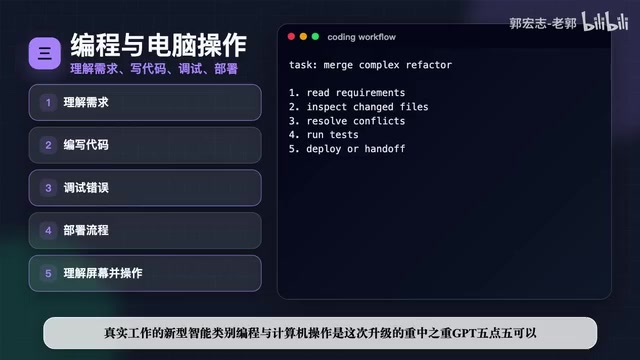
Real feedback from developers has been impressive:
- One developer used GPT-5.5 to complete a complex code merge in 20 minutes that previously took hours
- Another reported it solved a bug in 3 minutes that had blocked them for 4 hours
This reflects the fundamental difference between end-to-end engineering capability and traditional code completion. Traditional code completion tools (like early GitHub Copilot) are essentially context-based sequence prediction, good at completing single lines or functions but lacking understanding of overall project architecture. The "end-to-end engineering capability" GPT-5.5 represents involves a more complex cognitive chain: first understanding project-level context (cross-file dependencies, module relationships, business logic), then debugging reasoning (tracing root causes from error stacks), and finally executing deployment operations (running terminal commands, modifying config files). Code merge scenarios especially highlight this difference — they require the model to simultaneously understand the intent differences between two branches, rather than mechanically merging text. This is a qualitative leap from "code assistant" to "AI engineer."
Knowledge Work Automation: GPT-5.5 Enables End-to-End Workflows
GPT-5.5's second key capability is knowledge work automation. It can deeply understand text, conduct online research, analyze data, and automatically create documents, spreadsheets, and presentations.
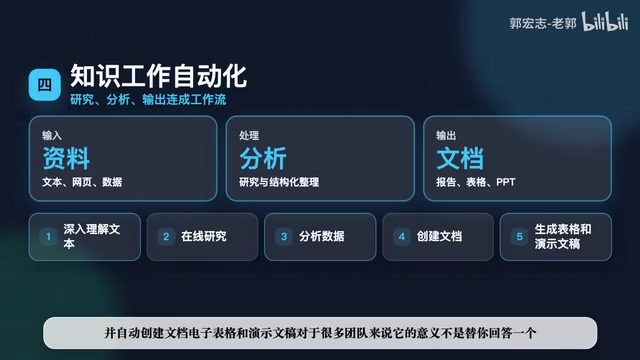
For many teams, GPT-5.5's significance isn't answering a single question — it's connecting research, organization, analysis, and output into one automated workflow. For example: ask it to research a market's competitive landscape, and it will automatically search for information, filter key data, generate an analytical report, and even output a ready-to-use presentation.
This capability will have profound implications for knowledge-intensive roles in consulting, research, and operations. GPT-5.5 doesn't replace human judgment — it dramatically compresses the execution time between "having an idea" and "having a deliverable."
Scientific Research & Efficiency: Smarter with Fewer Tokens
The third capability category focuses on scientific research and efficiency optimization. GPT-5.5 can assist with complex mathematical calculations and preliminary scientific research, potentially becoming a powerful tool for researchers.
On the efficiency front, one notable improvement: while maintaining the same response speed as GPT-5.4, GPT-5.5 is smarter and requires fewer Tokens to complete tasks. Tokens are the basic units that large language models use to process text, roughly corresponding to 3/4 of an English word or 1-2 Chinese characters. Token count directly determines computational cost. For large-scale enterprise deployments, Token cost optimization carries significant financial implications: if a company makes 1 million API calls per day, averaging 2,000 output Tokens each, and the new model reduces average Token consumption by 20%, annual savings could reach tens of thousands of dollars or more. GPT-5.5's ability to "compress expression"
Related articles
 Product Reviews
The Programmer's Desk Setup Guide: Building a Workspace That Feels Like Home
Discover how programmers build productive, comfortable workspaces. From multi-monitor setups to ergonomic design, explore the desk philosophy that drives focus and flow.
 Product Reviews
Qoder vs Cursor Real-World Comparison: Which $20/Month AI IDE Is Better?
Hands-on comparison of Qoder vs Cursor AI IDEs: Agent autonomy, human interaction count, and architecture decisions. Qoder needed only 2 interactions vs Cursor's 8.
 Product Reviews
Cursor Cloud Agent Demo: Eliminating Bottlenecks Across the Entire Software Development Lifecycle
Deep analysis of Cursor's Cloud Agent demo showing how cloud VMs, automated test artifacts, and a full-chain control plane systematically eliminate human bottlenecks across the software development lifecycle.