GPT-5.5 Free Access Hands-On: A Multi-Model Aggregation Platform Review

A free aggregation platform lets you try top AI models, but comes with privacy and compliance risks.
This article reviews a free multi-model AI aggregation platform integrating GPT-5.5, Grok 4.2, Claude Opus 4.7, Gemini 3.1 Pro, and DeepSeek V4. It supports cross-model switching within a single chat window while maintaining context memory. The platform achieves free access through an account pool mechanism with hundreds of built-in official accounts, but carries risks including data privacy leaks, service instability, and potential violations of platform terms of service.
Introduction: One Platform to Access All Major AI Models for Free
OpenAI has been making waves recently, and the release of GPT-5.5 has once again set the AI community ablaze. Meanwhile, Grok 4.2, Claude Opus 4.7, Gemini 3.1 Pro, and other top-tier models from various companies are also rolling out rapid updates. Want to subscribe to all these services individually? The monthly costs easily exceed a thousand yuan combined. Recently, a blogger shared an aggregation-style AI platform that claims to offer free access to full-powered versions of multiple mainstream AI models. This article breaks down the platform's features and performance based on hands-on experience.
GPT-5.5 Syncing: Reasoning and Generation Capabilities Tested
In actual testing, GPT-5.5 Syncing demonstrated noticeable improvements in response quality — replies are clearer, more accurate, and more logically coherent. During testing, the blogger asked GPT-5.5 to generate an interactive mini-game directly. After a period of reasoning, the model output complete game code that could be played directly in a panel on the right side of the interface. This is precisely the Canvas interactive feature available only on OpenAI's official full-powered GPT.
Canvas is an interactive collaboration feature introduced by OpenAI that allows users to preview, edit, and run AI-generated code or documents directly within the chat interface. Unlike traditional plain-text output, Canvas provides a dedicated workspace where users can modify code in real-time, view rendered results, and even run small applications directly. The core philosophy behind this feature is to upgrade AI from a "Q&A tool" to a "collaboration partner." Its technical implementation relies on frontend sandbox environments and real-time code interpreters, capable of safely executing code snippets in languages like JavaScript and Python.
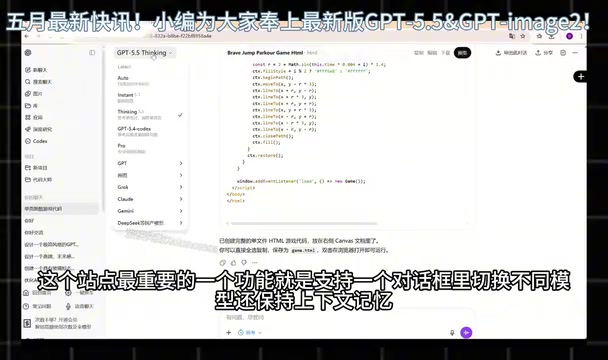
This experience is completely consistent with the GPT interactive features on OpenAI's official website, indicating that the platform has indeed connected to the official API or uses an account pool approach to provide services. It's worth noting that these two technical approaches are fundamentally different: API integration uses officially provided application programming interfaces to programmatically invoke AI model capabilities, billed by token count, and represents a compliant commercial usage method. The account pool mechanism, on the other hand, involves bulk-registering or purchasing official subscription accounts and using automation scripts to rotate between multiple accounts to circumvent single-account rate limits. While the user experience may appear similar, there are massive differences in compliance, stability, and cost structure.
GPT Image Generation: AI Art Capabilities Tested
In terms of image generation, GPT's AMG2 image model performed impressively. Tests produced images in various styles, including:
- Triangular prism crossover with Genshin Impact and other anime-style art
- Humorous scenes of Lei Jun and Tim Cook live-streaming phone sales
- Creative composite images of Elon Musk endorsing Lao Gan Ma chili sauce
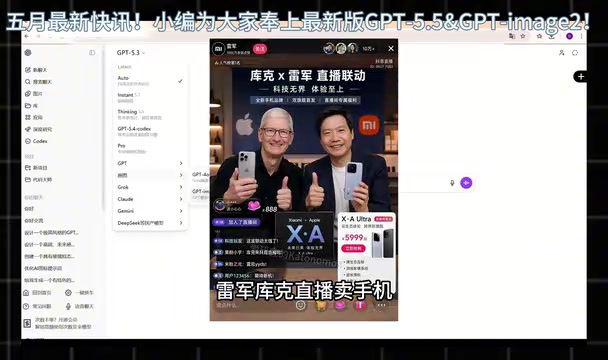
These AI-generated images have reached a remarkably high level of realism and detail processing — almost indistinguishable from real photos. AI image generation technology has undergone a major paradigm shift from GANs (Generative Adversarial Networks) to Diffusion Models. The core idea behind diffusion models is to first add noise to an image until it becomes completely random, then train a neural network to learn the gradual denoising process, thereby enabling high-quality image generation from random noise. The image generation capability integrated into the GPT series represents a deep fusion of text understanding and visual generation — the model can not only understand complex textual descriptions but also accurately map semantics to visual elements, including facial expressions, scene composition, lighting effects, and other details. This improvement in multimodal capabilities has significantly increased the practical value of AI-generated images in commercial design, content creation, and other fields. GPT's progress in AI image generation has indeed widened the gap with some competitors.
Core Features of the Multi-Model Aggregation Platform
Single Chat Window Model Switching with Context Memory
The platform's most distinctive feature is switching between different AI models within the same chat window while maintaining context memory. The workflow is simple:
- Start by asking GPT-5.5 a question and getting an initial response
- Switch to the Gemini model, which automatically reads the previous conversation with GPT
- Achieve seamless context continuity between different models
The technical implementation behind this feature is actually quite clever. Traditionally, each AI model has an independent conversation context window, and Model A's conversation history cannot be read by Model B. The aggregation platform maintains a unified conversation history at the middleware layer. When users switch models, the platform sends all previous conversation content (including user inputs and AI responses) as context to the new model. This essentially leverages the In-Context Learning capability of large language models — the model requires no additional training and can understand the current task's background simply by reading the conversation history. However, it's important to note that this approach consumes significant Context Window capacity, and when conversations get too long, earlier content may be truncated, affecting the model's understanding of the complete background.
This cross-model joint memory feature is extremely practical in actual use. For example, you can first have a model that excels at reasoning analyze a problem, then switch to a model that excels at creative writing to refine the output — all without repeating background information.
AI Model Lineup Coverage
Based on hands-on testing, the platform integrates the following mainstream AI models:
| Provider | Model Versions |
|---|---|
| OpenAI | GPT-5.5 Syncing, AMG2 image model, and full series |
| xAI | Grok 4.2 full series, SuperGrok |
| Anthropic | Claude Opus 4.7 |
| Gemini 3.1 Pro series | |
| DeepSeekAd | DeepSeek V4 (with web search + deep thinking) |
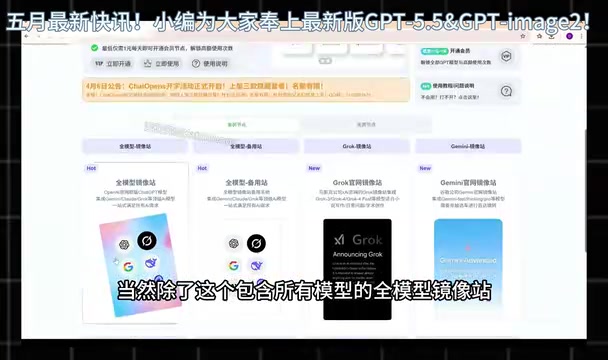
The current AI industry exhibits a clear multimodal competitive landscape. Google's Gemini series has a natural advantage in the multimodal domain, as Google possesses massive multimodal training data from YouTube, Google Images, Google Scholar, and other sources. Anthropic's Claude is known for its safety and long-text processing capabilities, with its Constitutional AI training method leading the industry in reducing harmful outputs. xAI's Grok leverages real-time social data from the X platform (formerly Twitter), creating differentiated advantages in timeliness and conversational naturalness. This competitive landscape where each has its strengths is the fundamental reason multi-model aggregation platforms have value — no single model performs optimally across all tasks.
Direct Official Website Access and Account Pool Mechanism
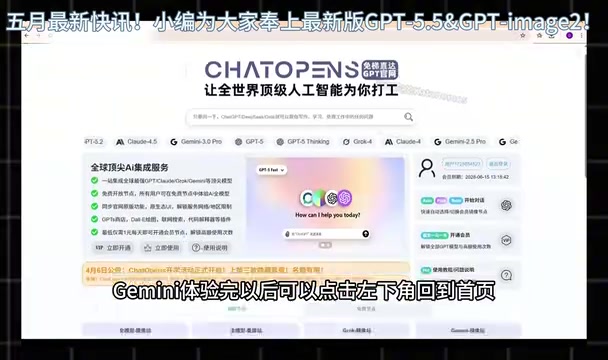
The platform not only provides an aggregated chat interface but also equips each model with independent official website entry points. Users can jump directly to each AI product's official chat page without needing special network configurations.
Its operating mechanism relies on a large pool of built-in official website accounts. When one account reaches its usage limit, users can switch to other accounts via a "switch" function to continue using the service, thereby bypassing official rate limits. The platform reportedly has hundreds of built-in official website accounts available for rotation.
Model Characteristics and Use Case Comparison
Grok Series: Fast Speed, More Human-Like Language
Grok's core advantages lie in fast response speed and a more human-like language style — it's currently one of the most "human-sounding" AIs. It's particularly suited for:
- Daily conversations and quick task handling
- Novel writing and literary creativity
- Work scenarios requiring immediate feedback
DeepSeek V4: The Latest Achievement in Chinese AI Models
The platform integrates the latest full-powered version of domestic DeepSeek V4, supporting web search and deep thinking features. DeepSeek's web search function is an application of RAG (Retrieval-Augmented Generation) technology. Traditional large language models have knowledge cutoffs at the training data's time point and cannot access real-time information. RAG retrieves relevant information from external data sources (such as search engines and knowledge bases) before generating answers, then inputs the retrieval results as context to the model, enabling AI to answer questions about the latest events. The "deep thinking" feature corresponds to Chain-of-Thought reasoning technology, where the model displays intermediate reasoning steps before providing a final answer, similar to a human's step-by-step analysis process. The combination of these two features makes DeepSeek particularly outstanding at handling tasks requiring real-time information and complex logical reasoning.
Combined with multi-model switching capabilities, you can leverage DeepSeek's Chinese language comprehension advantages together with other models' strengths, playing to each model's forte.
Gemini 3.1 Pro: Google's Multimodal Powerhouse
Through the Gemini official website entry, users can directly access multiple versions including Gemini 3.1 Pro, with full support for official features like web search. The Gemini series' core competitive advantage lies in its native multimodal architecture — unlike models that bolt on image capabilities after the fact, Gemini was designed from the ground up to simultaneously process text, image, audio, and video data, giving it a structural advantage in cross-modal understanding and reasoning tasks. In testing, model response speed was fast, and the experience was essentially identical to Google's official website.
Usage Recommendations and Risk Warnings for Free AI Platforms
While these aggregation platforms offer convenient free access, there are several points to keep in mind:
- Data Privacy Risks: When using AI services through third-party platforms, conversation content may pass through intermediary servers — avoid entering sensitive personal information or business secrets. Especially under the account pool model, your conversation records may remain in shared accounts and be visible to other users who subsequently use the same account
- Service Stability: Services relying on account pool mechanisms have uncertain long-term stability, as official platforms may adjust their ban policies at any time. Major AI platforms are continuously strengthening detection of abnormal usage patterns, including frequent IP address switching, high-volume requests in short timeframes, and other behavioral characteristics. Once risk control mechanisms are triggered, related accounts may be banned in bulk
- Compliance Issues: Using shared accounts may violate the terms of service of various AI platforms — users should assess risks independently. According to most AI platforms' Terms of Service, accounts may not be transferred, shared, or used for commercial proxy services. Violating terms may result in permanent account bans or even legal consequences
- Experience Differences: Despite claims of full-powered versions, actual experience may differ from official websites due to factors like account type and network conditions
Conclusion: Is a Multi-Model Aggregation Platform Worth Using?
From a feature completeness perspective, these multi-model aggregation platforms have indeed significantly lowered the barrier for ordinary users to experience top-tier AI models like GPT-5.5 and Grok 4.2. The cross-model context memory and one-click official website access features, in particular, represent clear innovations in practicality.
However, the sustainability of the free model and potential compliance risks remain factors that require serious consideration. If you want to quickly compare the capabilities of different AI models, this platform is worth trying. But for long-term, high-frequency usage needs, subscribing to each provider's official service remains the more reliable choice.
Key Takeaways
- GPT-5.5 shows significant improvements in reasoning and image generation, capable of directly generating interactive mini-games and highly realistic AI images
- The aggregation platform supports switching between GPT, Grok, Claude, Gemini, DeepSeek, and other models within a single chat window while maintaining cross-model context memory
- The platform achieves unlimited free access to full-powered versions of various AI models through an account pool mechanism with hundreds of built-in official website accounts
- Each model has its strengths: Grok excels at human-like dialogue, DeepSeek V4 supports web search, and Gemini 3.1 Pro has outstanding multimodal capabilities
- Using third-party aggregation platforms requires attention to data privacy, service stability, and compliance risks
Related articles
 Product Reviews
The Programmer's Desk Setup Guide: Building a Workspace That Feels Like Home
Discover how programmers build productive, comfortable workspaces. From multi-monitor setups to ergonomic design, explore the desk philosophy that drives focus and flow.
 Product Reviews
Qoder vs Cursor Real-World Comparison: Which $20/Month AI IDE Is Better?
Hands-on comparison of Qoder vs Cursor AI IDEs: Agent autonomy, human interaction count, and architecture decisions. Qoder needed only 2 interactions vs Cursor's 8.
 Product Reviews
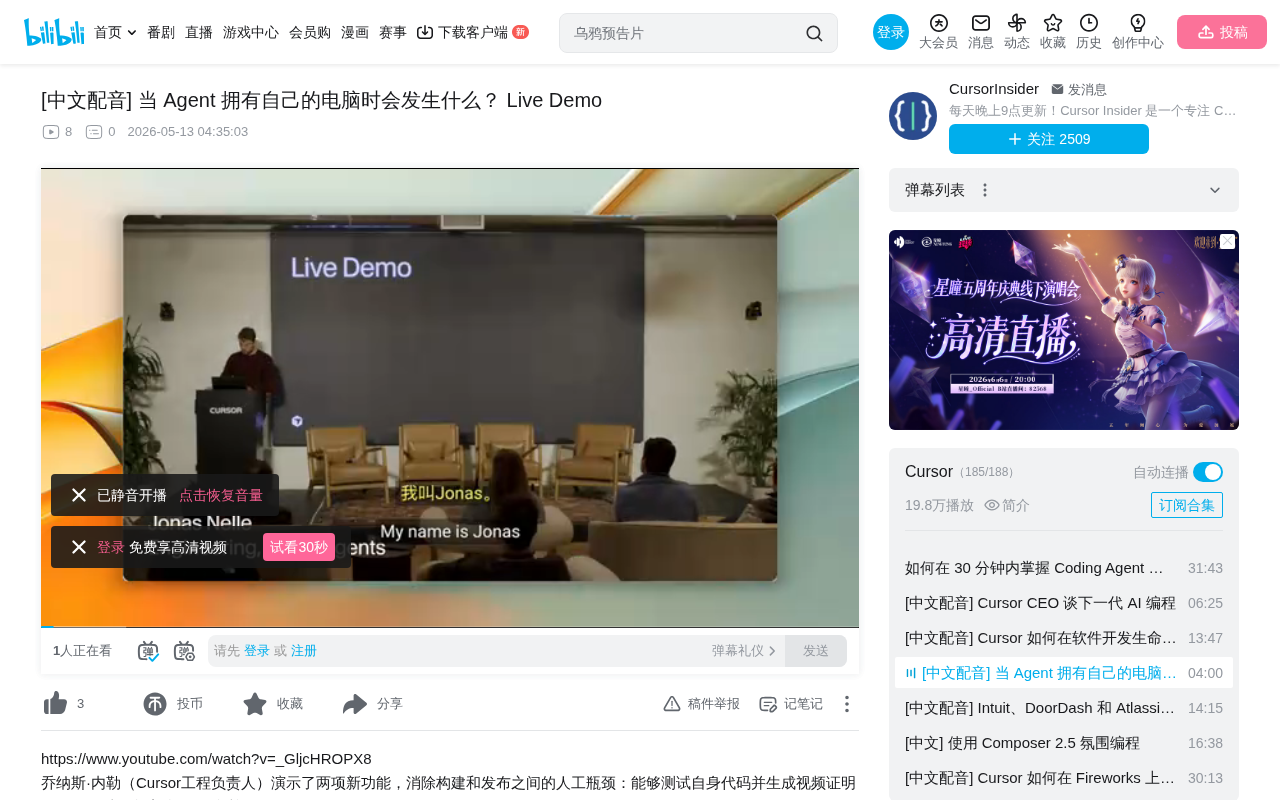
Cursor Cloud Agent Demo: Eliminating Bottlenecks Across the Entire Software Development Lifecycle
Deep analysis of Cursor's Cloud Agent demo showing how cloud VMs, automated test artifacts, and a full-chain control plane systematically eliminate human bottlenecks across the software development lifecycle.