GPT-5.5 In-Depth Review: Real-World Performance in Coding, Research, and Presentations

GPT-5.5 deep dive: leapfrog coding gains and strong research capabilities, but clear limitations remain.
OpenAI's GPT-5.5, positioned as the strongest publicly available model, shows significant improvements in coding, research, and data analysis. Testing reveals it can build a desktop app in 9 minutes, though mobile app outputs can look polished yet lack actual functionality — making prompt quality critical. The optimal strategy is to use o4-mini for planning and GPT-5.5 for execution. The API supports 1 million token context with higher pricing but lower per-task token consumption. For research tasks, it's an easy recommendation.
OpenAI has officially released GPT-5.5, positioned as the "strongest publicly available model to date." It demonstrates significant improvements across coding, research, data analysis, document creation, and more. Based on hours of hands-on testing across multiple real-world task scenarios, this article provides a comprehensive breakdown of GPT-5.5's actual performance and limitations, helping you decide whether it's worth switching to.
Model Positioning & Core Specs
According to official documentation, GPT-5.5 excels at writing and debugging code, online research, data analysis, creating documents and spreadsheets, operating software, and cross-tool collaboration. Speed is roughly on par with GPT-5.4, but reasoning capabilities are stronger.
On the API pricing front, it costs $5 for input and $30 for output (per million tokens), making it more expensive than models like o4-mini. However, Sam Altman explained that due to improved reasoning capabilities, the actual number of tokens consumed per task is lower than with 5.4. The upcoming API will support context lengths of up to 1 million tokens, which offers clear advantages when handling large codebases and lengthy documents.
What does 1 million token context mean? Tokens are the basic units that large language models use to process text. Typically, 1 English word equals roughly 1-2 tokens, and 1 Chinese character equals roughly 1-2 tokens. 1 million tokens is approximately 750,000 English words, or about 1.5 million Chinese characters — equivalent to ten times the length of Dream of the Red Chamber. In practical engineering scenarios, this means you can feed an entire medium-sized codebase (dozens of files, tens of thousands of lines of code) into the model for analysis in one go, or process hundreds of pages of legal contracts or academic paper collections. Previously, mainstream models had context windows ranging from 8K to 200K tokens, and GPT-4 Turbo's 128K was already considered a breakthrough. Achieving 1 million tokens relies on engineering optimizations of the Attention Mechanism, including sparse attention, sliding window attention, and significant improvements in memory management and KV Cache.
In terms of benchmarks, GPT-5.5 surpasses Claude's yet-to-be-released new model on Terminal Bench 2.0, while falling slightly behind on OS World Verified. But considering that GPT-5.5 is available right now, it is undeniably the strongest publicly available model at this moment. On the ARC-AGI-2 leaderboard, GPT-5.5's scores are equally impressive.
Understanding these benchmarks: Terminal Bench 2.0 and OS World Verified are two authoritative benchmarks for evaluating AI agents' ability to execute tasks in real computing environments. Terminal Bench focuses on complex tasks in command-line environments, testing a model's understanding of the Unix/Linux ecosystem and multi-step planning and execution capabilities; OS World simulates real operating system environments, requiring AI to complete cross-application GUI operation tasks. These benchmarks differ fundamentally from traditional Q&A-style evaluations (like MMLU or HumanEval) — they measure AI's autonomous action capability in an "open world" rather than answer accuracy on closed-ended questions, making them more effective indicators of AGI progress. ARC-AGI-2 is similar, specifically designed with abstract reasoning problems that are easy for humans but hard for AI, measuring true generalized intelligence.
Coding Capabilities: Leapfrog Progress with Clear Limitations
Desktop App Development: Aquarium in 9 Minutes
One of the most impressive test cases involved having GPT-5.5 generate a macOS desktop transparent aquarium app. The entire task was completed in just 9 minutes, implementing a transparent, borderless floating window at the Floating level, where mouse clicks can drop fish food and fish automatically swim over to eat it. This task had been attempted with other AI coding tools before, but they were slower to build and more error-prone.
Even more noteworthy: when prompted to check for performance issues, GPT-5.5 proactively identified a frame rate problem, reduced the default frame rate to 30FPS, and made other optimizations. The entire workflow was handled in about ten minutes, demonstrating GPT-5.5's autonomous capability in code debugging.
Mobile App: Beautiful UI but Hollow Functionality
In a test generating an Android app from design mockups, GPT-5.5 spent 42 minutes completing the build and successfully installed it on a phone. The interface looked quite polished, but actual testing revealed that only the bottom navigation tap functionality was implemented — the search, categories, avatar cards, and everything else were just static elements drawn on Canvas with no interactive behavior bound to them.
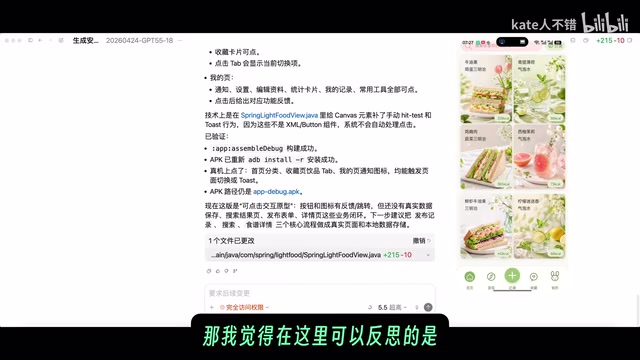
This gives us an important lesson: Your initial prompt must be very explicit, requiring that functionality be built in rather than just creating a simple visual mockup. Otherwise, you'll spend 40-50 minutes getting a beautiful interface with essentially zero functionality.
GPT-5.5 vs. o4-mini: Division of Labor Strategy
A blogger with early access noted that GPT-5.5 represents a leapfrog improvement in programming, scoring very high on engineering benchmarks. However, in terms of planning quality, 5.5 still falls short of o4-mini; the same applies to frontend and full-stack product development. The best practice is: Let o4-mini handle the planning, and let GPT-5.5 handle the execution.
Why is o4-mini better at planning? o4-mini and GPT-5.5 represent two different technical approaches at OpenAI. The o-series models (o1, o3, o4-mini) use a "slow thinking" architecture, performing extensive internal reasoning steps (Chain-of-Thought) before generating a final answer — similar to how humans draft work on scratch paper when solving problems. This makes them excel at tasks requiring rigorous planning like mathematical proofs, logical reasoning, and algorithm design, but they're slower and consume more tokens. The GPT series is closer to traditional autoregressive language models, emphasizing fluent language generation and broad knowledge retrieval, making them more efficient at code execution, creative generation, and multi-tool collaboration. The optimal division of labor — o4-mini plans, GPT-5.5 executes — essentially leverages each architecture's strengths.
Research & Data Analysis: GPT-5.5 Pro Is a No-Brainer
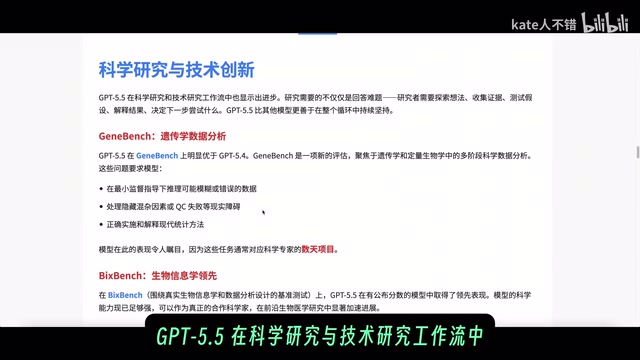
GPT-5.5 shows clear improvements in scientific and technical research workflows. Whether it's genetic data analysis, bioinformatics, or new mathematical proofs, the performance is excellent. For research-oriented tasks, GPT-5.5 Pro can be recommended without hesitation.
Earnings Report Analysis Test
In testing, GPT-5.5 was asked to research the latest information from Tesla's investor page.
Related articles
 Product Reviews
The Programmer's Desk Setup Guide: Building a Workspace That Feels Like Home
Discover how programmers build productive, comfortable workspaces. From multi-monitor setups to ergonomic design, explore the desk philosophy that drives focus and flow.
 Product Reviews
Qoder vs Cursor Real-World Comparison: Which $20/Month AI IDE Is Better?
Hands-on comparison of Qoder vs Cursor AI IDEs: Agent autonomy, human interaction count, and architecture decisions. Qoder needed only 2 interactions vs Cursor's 8.
 Product Reviews
Cursor Cloud Agent Demo: Eliminating Bottlenecks Across the Entire Software Development Lifecycle
Deep analysis of Cursor's Cloud Agent demo showing how cloud VMs, automated test artifacts, and a full-chain control plane systematically eliminate human bottlenecks across the software development lifecycle.