GPT 5.5 vs DeepSeek V4 Hands-On Comparison: Who Wins at Logic, Frontend Generation, and 3D Scenes?

GPT 5.5 vs DeepSeek V4 tested across three dimensions—each has strengths; hybrid use is optimal.
This article compares GPT 5.5 and DeepSeek V4 through hands-on tests in logic reasoning, frontend page generation, and 3D scene animation. Results show DeepSeek V4 excels at identifying logic traps, functional completeness, and iteration efficiency while offering superior cost-effectiveness. GPT 5.5 wins on visual expressiveness and generation speed, remaining more robust for complex reasoning scenarios. The author recommends a hybrid approach for optimal results and cost control.
When DeepSeek V4 stormed the market with its million-token context window and extreme cost-effectiveness, going head-to-head with OpenAI's flagship GPT 5.5, who is the real champion in practice? This article puts GPT 5.5 and DeepSeek V4 through actual tasks across three dimensions—logic reasoning, frontend page generation, and 3D scene animation—to reveal the real performance differences.
GPT 5.5 vs DeepSeek V4: Basic Parameter Comparison
Before diving into the hands-on tests, it's worth clarifying the fundamentals of both contenders.
DeepSeekAd V4 currently comes in two versions: V4 Pro and V4 Flash. Its most eye-catching feature is the million-level context window (1M), combined with API compatibility for both OpenAI and Anthropic calling conventions, making migration costs extremely low. GPT 5.5 continues OpenAI's flagship model line positioning, focusing on complex reasoning and code capabilities, with advantages in its mature ecosystem toolchain and stable general-task performance.
The context window refers to the maximum text length a large language model can "see" and process in a single conversation, typically measured in tokens—where 1 token corresponds to roughly 0.75 English words or 0.5 to 1 Chinese characters. A million-level context (1M tokens) means the model can process approximately 750,000 English words or hundreds of thousands of Chinese characters at once, equivalent to reading over a dozen complete books in one go. This is revolutionary for long-document analysis, large codebase comprehension, and complex multi-turn conversations. Previously, mainstream models had context windows between 128K-200K, so the million-level breakthrough makes "full input without segmentation" possible, dramatically reducing the risk of information loss and context fragmentation.
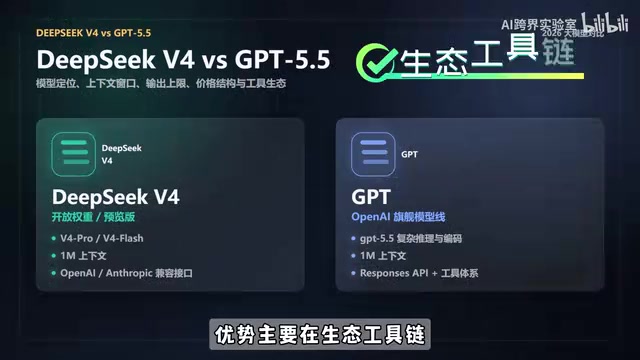
Significant Differences in Price and Output Limits
While both models have reached million-level context windows, the differences in output limits and pricing are substantial:
- Maximum Output: DeepSeek V4 can reach 384K, while GPT 5.5 is capped at 128K. For long reports or large-scale code generation scenarios, this gap is very direct.
- Price: DeepSeek's input and output prices are significantly lower, with Flash and Pro versions covering different cost requirements; GPT 5.5's unit price is higher, and the cost gap widens rapidly with high-frequency calls or batch generation.
Put simply, DeepSeek V4 is the "high cost-performance long-context contender," while GPT 5.5 is the "robust complex-task contender."
Benchmark Scores: GPT 5.5 and DeepSeek V4 Each Have Their Strengths
It's important to emphasize that benchmarks are only references—real usability depends on specific tasks. However, based on public metrics, the two models clearly excel in different areas:
- DeepSeek V4 Pro performs more impressively on Codeforces, Aero, and MRCR 1M long-context retrieval, indicating advantages in competition-level code generation and ultra-long context retrieval.
- GPT 5.5 scores higher on Humanities Last Exam and GPQA Diamond, meaning it's still stronger on complex problems involving comprehensive logical reasoning and research-level scientific Q&A.
Here's a brief explanation of what these benchmarks measure. Codeforces is a world-renowned competitive programming platform, and benchmarks based on it measure a model's ability to solve algorithmic contest problems. GPQA Diamond (Graduate-Level Google-Proof Q&A) consists of graduate-level science questions written by domain experts that are difficult to answer even with search engines, specifically designed to measure deep knowledge reasoning. MRCR 1M (Multi-Round Co-reference Resolution) tests a model's ability to track and resolve references in ultra-long contexts. Humanities Last Exam is a comprehensive humanities examination covering high-difficulty questions across philosophy, history, literature, and other fields. These metrics characterize model capability boundaries from different dimensions—no single metric is sufficient for drawing conclusions.
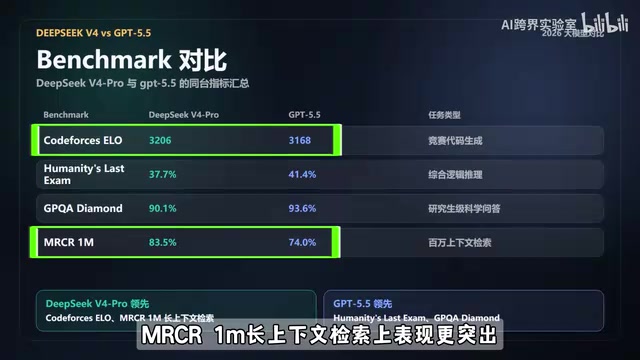
These data points provide a clear expectation framework, but the real winner must be determined through practical testing.
Test 1: Logic Reasoning—Who Can Spot the Classic Trap?
The first test is a carefully designed logic reasoning problem: a classic solvable logic puzzle modified to be unsolvable, deliberately setting a trap.
GPT 5.5's Performance: It thought quickly and gave results almost immediately—but fell right into the trap, outputting an incorrect solution. It failed to recognize that the problem had been modified to be unsolvable and instead applied a classic solving template, "confidently" providing an answer.
DeepSeek V4's Performance: After noticeably longer deep thinking, it correctly identified that the problem was unsolvable and provided a reasonable reasoning process.
This result is quite telling: without explicit instructions hinting that "no solution may exist," GPT 5.5 tends to quickly produce answers, exhibiting a "lazy thinking" problem. DeepSeek V4's deep thinking mechanism, while slower, is actually more reliable on these trap problems. This phenomenon is known in AI research as the "pattern matching trap"—models have seen large quantities of similar classic problem types and their standard solutions in training data, and when encountering variants that appear similar on the surface but are fundamentally different, they tend to apply existing patterns while skipping deep verification. DeepSeek V4's ability to avoid this trap suggests its reasoning chain may include stronger self-verification mechanisms.
Test 2: Frontend Page Generation—Shader Effects and Interaction
The second task asked both models to use shaders to create a webpage with "a sense of life," requiring animation effects, mouse interaction response, and a hidden easter egg.
Shaders are small programs that run on the GPU, originally used for lighting and color calculations in 3D graphics rendering, later widely applied to web visual effects. In frontend development, WebGL and GLSL (OpenGL Shading Language) allow developers to write shader code directly in browsers, enabling particle systems, fluid simulations, ray tracing, and other complex visual effects. Shaders come in two types: vertex shaders (handling geometry) and fragment shaders (handling pixel colors). Having AI models generate shader code is a high-difficulty task because it requires not only understanding programming logic but also comprehensive abilities in mathematics (vector operations, matrix transformations) and visual aesthetics.
DeepSeek V4 Result: Mosaic Rhythm
DeepSeek's generated webpage adopted a mosaic-style animation effect, responding to mouse movement with rhythmic text changes and an overall unique style. The easter egg feature was correctly implemented as required, with impressively high completion in a single generation.

GPT 5.5 Result: Stunning Smoke Effects
GPT's output featured smoke-like effects that were visually more stunning. The smoke movement and mouse interaction response felt natural, and the "Live" handwritten text with shake effects added vitality to the page. However, there was one small disappointment—while the easter egg trigger was set up as requested, the actual easter egg effect wasn't implemented.
Round Verdict: GPT 5.5 wins on visual expressiveness, but DeepSeek V4's single-generation completeness and functional integrity are equally impressive. Choose GPT 5.5 for visual impact; choose DeepSeek V4 for functional completeness.
Test 3: 3D Scene Animation—Airplane Flying Over a City
The final task was to generate a 3D simulation scene of "an airplane flying over a city skyline," which is a significant test of both spatial understanding and code generation capabilities.
First Generation: Both Models Stumbled
GPT 5.5: Generated faster, but the results had numerous issues—the airplane wings were placed on the same side, and it was flying backwards. The scene was extremely choppy, with clipping issues (penetrating through buildings), and the dark sky contradicted the sunset effect in the upper left corner.
Clipping (Collision Penetration) is a common problem in 3D graphics and game development, where two 3D objects penetrate each other during rendering, violating the basic physical rule that objects cannot occupy the same space. In professional 3D engines, collision detection algorithms are typically used to prevent this, including AABB bounding box detection, ray casting, and physics engine simulation. When AI models generate 3D scene code without properly setting collision boundaries or flight path planning, clipping issues like airplanes passing through buildings easily occur, reflecting AI's ongoing limitations in spatial reasoning and physical rule understanding.

DeepSeek V4: Correctly generated the airplane, city buildings, clouds, and blue sky, but the airplane's flight attitude was wrong and the flight speed was too fast.
Iterative Correction Comparison: DeepSeek V4 Fixes Issues More Efficiently
After providing correction feedback for both sides, the differences became clear:
- DeepSeek V4 made targeted corrections after receiving feedback, resolving the issues in a single iteration.
- GPT 5.5 went in circles and required multiple rounds of revision to achieve the expected results.
DeepSeek V4 performed better in this round, with both higher baseline completion in the first generation and superior iteration efficiency.
Conclusion: How to Choose Between GPT 5.5 and DeepSeek V4?
After three rounds of testing, the characteristics of both models are crystal clear:
| Dimension | GPT 5.5 | DeepSeek V4 |
|---|---|---|
| Generation Speed | Faster | Slightly slower |
| Logic Reasoning (Trap Questions) | Prone to "lazy" errors | More reliable with deep thinking |
| Frontend Visual Effects | More stunning | Better functional completeness |
| 3D Scene Generation | More first-gen issues, slower iteration | Better baseline, faster corrections |
| Price | Higher | Extremely cost-effective |
Recommended Strategy: Hybrid Use Works Best
A pragmatic approach is hybrid use: start with GPT 5.5 for research and planning (leveraging its complex reasoning advantages), then switch to DeepSeek V4 for implementation (leveraging its cost-effectiveness and long-context advantages), maximizing token savings.
This hybrid strategy is known in the industry as Model Routing and has become a best practice for LLM applications. The core logic behind it is token economics—each API call's cost is determined by both input and output token counts, with unit price differences between models reaching several times or even tens of times. In real production environments, a complex project may involve hundreds of API calls consuming millions of tokens, where price differences directly impact project economic viability. Open-source frameworks like LiteLLM and OpenRouter already provide infrastructure support for multi-model routing, allowing developers to automatically assign the most suitable model based on task complexity.
For everyday programming tasks, DeepSeek V4 is fully capable and even surpasses GPT 5.5 in some areas. But for truly complex reasoning and scientific Q&A scenarios, GPT 5.5 remains the more robust choice. The ultimate winner may not be any single model, but rather the user who knows how to flexibly switch based on task characteristics.
Related articles
 Product Reviews
The Programmer's Desk Setup Guide: Building a Workspace That Feels Like Home
Discover how programmers build productive, comfortable workspaces. From multi-monitor setups to ergonomic design, explore the desk philosophy that drives focus and flow.
 Product Reviews
Qoder vs Cursor Real-World Comparison: Which $20/Month AI IDE Is Better?
Hands-on comparison of Qoder vs Cursor AI IDEs: Agent autonomy, human interaction count, and architecture decisions. Qoder needed only 2 interactions vs Cursor's 8.
 Product Reviews
Cursor Cloud Agent Demo: Eliminating Bottlenecks Across the Entire Software Development Lifecycle
Deep analysis of Cursor's Cloud Agent demo showing how cloud VMs, automated test artifacts, and a full-chain control plane systematically eliminate human bottlenecks across the software development lifecycle.