GPT-5.6 Deep Dive: SOL, TERRA & LUNA — Performance Benchmarks and Pricing Breakdown

GPT-5.6's three models deliver strong backend gains and competitive pricing, but still trail on frontend visual tasks.
OpenAI's GPT-5.6 series introduces three tiers — SOL (flagship), TERRA (balanced), and LUNA (speed) — with aggressive pricing and notable performance improvements. PinBash 3 benchmarks show near-perfect scores on math and adaptive fine-tuning tasks, but frontend and visual tasks remain a persistent weakness compared to Fable 5. SOL scores nearly double GPT-5.5, making this a solid incremental upgrade worth considering for backend-heavy workloads.
OpenAI Quietly Previews GPT-5.6: Meet SOL, TERRA, and LUNA
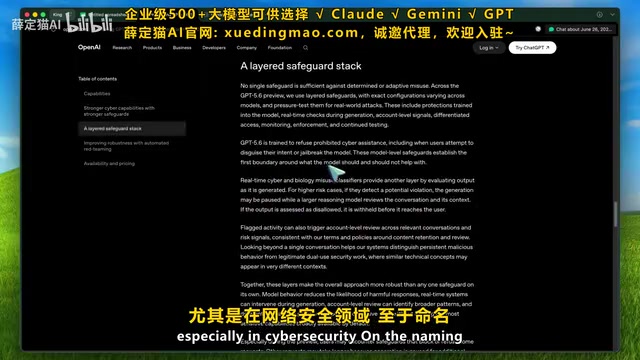
OpenAI officially announced the GPT-5.6 model series on June 26, currently available as a limited API preview to select partners and deployed in a small rollout via Codex. According to the company, a full public release is expected within the coming weeks.
The series consists of three models with distinct positioning: SOL (Flagship) targets maximum performance, TERRA (Balanced) is designed for everyday workloads, and LUNA (Speed) prioritizes ultra-fast response times and cost efficiency. This tiered naming logic is reminiscent of Anthropic's recent product strategy — and indeed, capability-tiered model lineups are quickly becoming the industry standard. Anthropic set the benchmark with its three-tier Haiku / Sonnet / Opus architecture, Google followed suit with Gemini Flash / Pro / Ultra, and now OpenAI is aligning with this mainstream approach. The underlying logic is the same: slice a common base capability along dimensions like reasoning depth, context window size, and compute budget to serve everyone from indie developers to enterprise deployments with varying cost sensitivities. OpenAI previously operated a dual-track strategy with GPT-4o mini and GPT-4o. The three-tier naming in GPT-5.6 signals a deliberate shift toward a platformized ecosystem rather than a single flagship model.
One notable detail: OpenAI briefed the U.S. government on these models' capabilities before launch, and subsequently adopted a phased release schedule at the government's request — a first in OpenAI's history. This strongly suggests a meaningful capability leap in specific domains, particularly cybersecurity. The move aligns closely with U.S. AI safety executive order expectations around high-risk capability models, and signals that AI capability oversight is becoming increasingly normalized.
Pricing Strategy: Across-the-Board Price Cuts Sharpen Cost Competitiveness
Based on official benchmark data, SOL achieves a state-of-the-art result on Terminal Bench 2.1 — a benchmark specifically designed to evaluate AI models in command-line environments handling complex workflows. Key assessment dimensions include multi-step task planning, iterative shell script debugging, cross-tool coordination (e.g., simultaneously calling curl, grep, awk, and other system tools), and error recovery. The rise of such benchmarks reflects a broader industry shift from "code completion" toward "autonomous end-to-end development task execution" in AI coding agents. SOL also performs impressively on the GenNet evaluation.
Perhaps more noteworthy is SOL's performance on Exploit Bench, which focuses on cybersecurity vulnerability analysis: SOL matches Anthropic's Codex — while generating roughly one-third the output tokens. This reveals an important but often-overlooked model capability dimension: reasoning density. Traditional evaluation frameworks tend to focus on accuracy alone, but in real production environments, the number of tokens consumed to complete an equivalent task directly determines API call costs. At $30 per million output tokens, if SOL can accomplish the same task with only 1/3 the tokens of a competitor, its effective total cost may be comparable to — or even better than — lower-priced alternatives. In practice, SOL's cost efficiency per completed task is significantly higher.
The new version also introduces "maximum reasoning" and a "super mode" that can invoke agents to handle complex multi-step workflows.
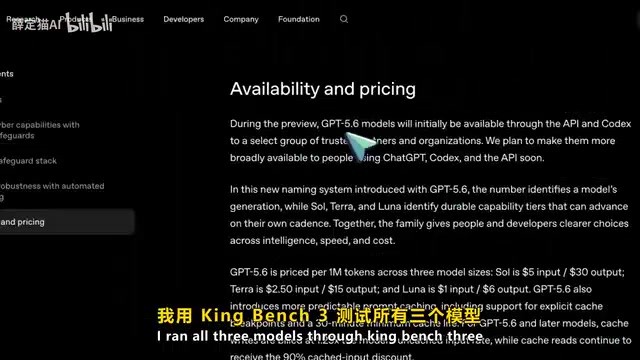
On pricing, all three models come in aggressively:
| Model | Input (per million tokens) | Output (per million tokens) |
|---|---|---|
| SOL | $5 | $30 |
| TERRA | $2.5 | $15 |
| LUNA | $1 | $6 |
OpenAI states that TERRA is more competitive than GPT-5.5 and priced at roughly half the cost. All three models support prompt caching optimized through explicit cache breakpoints, with a minimum cache duration of 30 minutes. Prompt caching is a critical cost-optimization technique in large model API services — when system prompts or long context prefixes remain unchanged across multiple requests, the server can cache the KV attention computation results for that content, allowing subsequent requests to reuse the cache and avoid redundant computation, significantly reducing both latency and cost. GPT-5.6's "explicit cache breakpoint" mechanism lets developers actively annotate caching boundaries, offering more control than the previous implicit caching approach. The 30-minute minimum cache duration means high-frequency enterprise applications — such as customer service bots or code review pipelines — can continuously benefit from caching within a single session window. For long-document processing scenarios with context windows spanning tens of thousands of tokens, the savings are especially significant. Enterprise deployments can reach up to approximately 750 tokens per second, providing a clear advantage in real-time applications.
Benchmark Results: Strong on Backend Tasks, Still Weak on Frontend Visuals
For this evaluation, all three models were tested using the proprietary PinBash 3 benchmark suite, covering frontend tasks, Three.js content, difficult math problems, and adaptive fine-tuning tasks.
Final scores:
- SOL: ~78.6%
- TERRA: ~62.9%
- LUNA: ~44.3%
At face value, SOL's 78.6% might seem like a middling result — but breaking it down by category reveals more valuable insights.
Math and Backend Tasks: All Three Models Reach New Heights
On difficult math problems, both SOL and TERRA scored a perfect 10/10 — a bar very few models have cleared. On adaptive fine-tuning tasks, all three GPT-5.6 models achieved perfect scores. Even LUNA, the lowest-tier model, seamlessly handled the entire workflow of dataset generation, model fine-tuning, and accompanying UI development without a single misstep.
For comparison, the previous GPT-5.5 and even Opus 4.7 only managed two or three points on the same tasks. This demonstrates a genuine generational leap for GPT-5.6 across compute-intensive workloads and backend tasks.
Frontend and Visual Tasks: OpenAI's Traditional Weakness Persists
The picture looks quite different for frontend and visual tasks. On challenges that test visual fidelity — Three.js animations, SVG graphics, and similar tasks — the models generally scored in the 6–7 range, while competitor Fable 5 consistently lands at 9–10.
OpenAI's persistent underperformance on frontend and visual generation tasks has deep technical roots. Tasks like Three.js animations and SVG graphics require the model to maintain awareness of "visual-spatial logic" while generating code — for example, understanding coordinate system transformations, color gradient curves, and the visual effect of animation interpolation, rather than simply outputting syntactically correct code. This requires the model to be trained on large volumes of paired "code + rendered output" samples and to build cross-modal mappings from code representations to visual representations. Anthropic's Fable series has built a notable advantage in this dimension, widely attributed to its long-term investment in multimodal alignment data. For OpenAI, this gap cannot be bridged in the short term by simply scaling parameters — it requires targeted adjustments at the level of the data flywheel and training objective design.

It's worth noting that this benchmark suite weights frontend and visual tasks more heavily, since these tasks most intuitively surface quality differences. As a result, GPT-5.6's overall score skews conservative — this isn't a reflection of weak overall capability, but rather that frontend performance has never been OpenAI's strong suit.
Head-to-Head Comparison: SOL Closes the Gap, But Hasn't Surpassed Fable 5
Across the overall benchmark leaderboard, the final rankings among major models are:
- Fable 5: 88.57% (Top)
- Opus 4.8: 87.14%
- GN 5.2: 81.43%
- SOL: 78.57%
- GPT-5.5: 38.57%
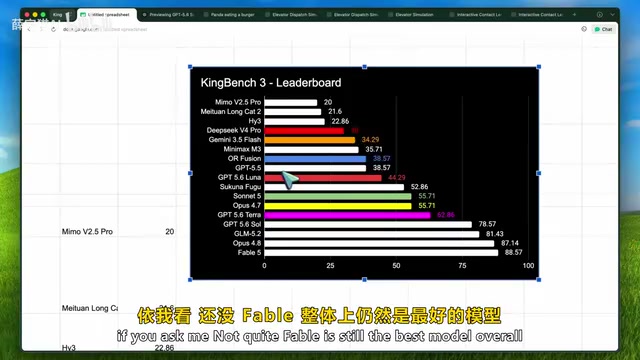
The most striking takeaway: SOL's score is nearly double that of the previous GPT-5.5 — a genuine generational leap. While it still trails Fable 5 in overall ranking, the gap has narrowed substantially. On certain dimensions (such as token efficiency on the Cybergenic benchmark), SOL can even match or slightly edge out Fable.
Selection Guide and Summary: Incremental Upgrade — Find the Right Use Case
Taken as a whole, GPT-5.6 represents a solid incremental upgrade, not a new paradigm shift.
OpenAI's "three models with parallel naming" strategy carries some marketing intent — framing the release with more fanfare to counter Anthropic's positioning of Fable as an entirely new model category. The narrative battle between "incremental upgrade" and "paradigm revolution" is fundamentally a competition for marketing authority in the AI space. Anthropic positions Fable as a "new model category," emphasizing the qualitative shift brought by its hybrid reasoning architecture (dynamic switching between fast and slow thinking). OpenAI's release cadence and messaging for GPT-5.6 is notably more understated, focusing on quantifiable performance gains and cost reductions. From a product lifecycle perspective, when a market enters its maturity phase, "reliable incremental iteration" often has stronger persuasive power for enterprise procurement than "radical paradigm jumps" — the latter implies higher migration costs and adaptation risks. SOL's nearly 2x score jump over GPT-5.5 is a significant technical achievement, but the deliberate choice to frame it as "pragmatically credible" rather than "disruptive" is itself a strategic positioning decision aimed at enterprise buyers.
Based on the test results, here are model selection recommendations for different use cases:
- Frontend development or visually intensive tasks: Fable 5 or Opus 4.8 remain the top choices
- Backend development, compute-intensive tasks, or long-horizon workflows: SOL is an excellent option, at significantly lower cost
- Cost-sensitive lightweight applications: LUNA may currently offer the best overall price-to-performance ratio
Note that all conclusions above are based on preview version testing, and performance data may still change before the official release. Overall, GPT-5.6 is not the "disruptive revolution" the framing might suggest — but it is reasonably priced, delivers meaningful performance gains, and has successfully closed the gap with top competitors. It deserves close attention from developers working on backend and compute-intensive workloads.
Key Takeaways
Related articles
Xi Jinping Proposes Open Source AI Cooperation Zone Among BRICS Nations
Xi Jinping proposed an open source AI cooperation zone at the BRICS summit. Analyzing the strategic intent, open source rationale, and global AI governance implications.
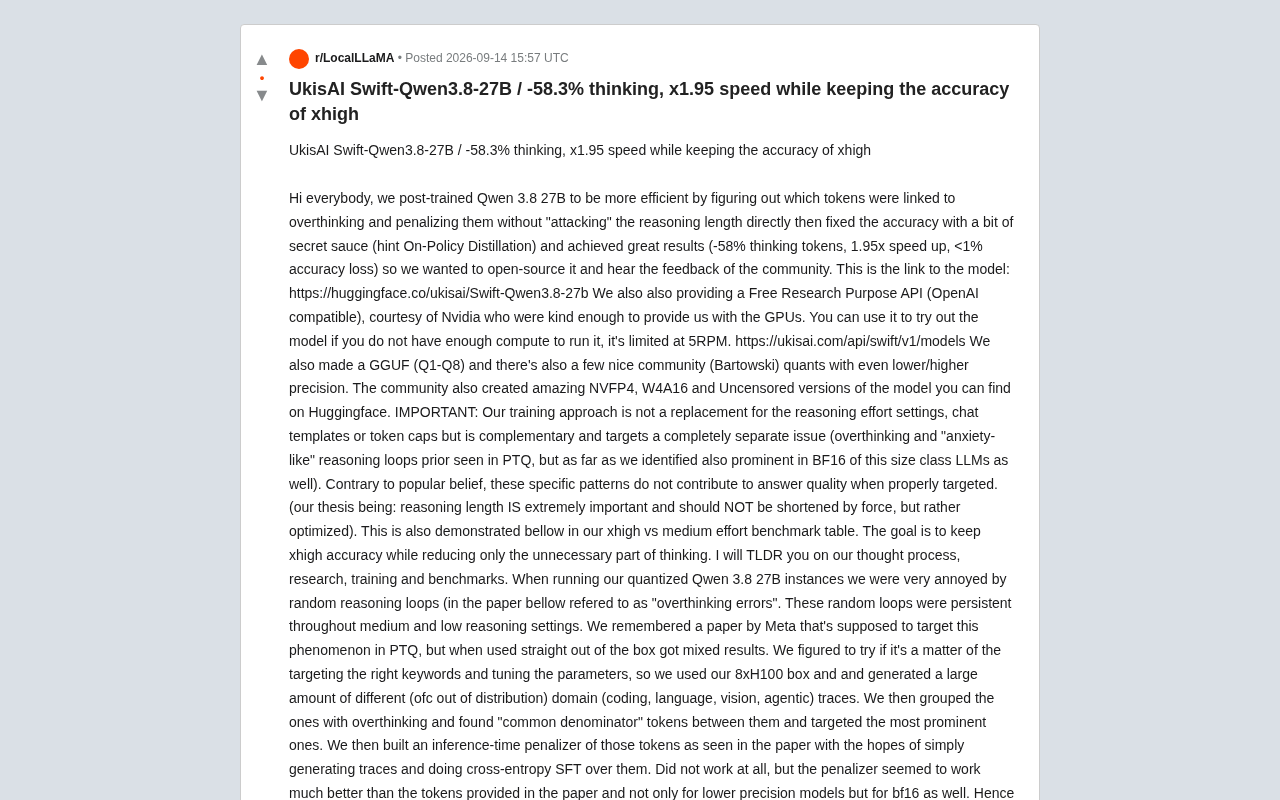
Swift-Qwen3.8-27B: 58% Fewer Thinking Tokens, Nearly 2x Faster Inference
UkisAI open-sources Swift-Qwen3.8-27B, cutting thinking tokens by 58% and boosting inference speed 1.95x via overthinking token penalties and on-policy distillation — with under 1% accuracy loss.

Netflix Partners with Sega: Crazy Taxi Movie and New Sonic Animated Series on the Way
Netflix announces three Sega game adaptations: a Crazy Taxi movie, a new Sonic animated series with edge, and a live-action film based on RGG Studio's Stranger Than Heaven.