GPT-5.6 Free Trial Is a Scam: How to Spot AI Marketing Traps

"GPT-5.6" doesn't exist—here's how to spot AI scams pushing shady third-party platforms.
This article exposes the "GPT-5.6 free trial" scam circulating on social media, explaining that OpenAI has never released such a model. It deconstructs the marketing playbook—creating FOMO, exploiting real pain points, then funneling users to unauthorized third-party mirror platforms that pose serious data security and financial risks. The piece provides practical criteria for identifying AI marketing traps and recommends using official, compliant AI channels instead.
A Suspicious "Breaking News" Announcement
Recently, promotional videos claiming "GPT-5.6 is now open for free trial" have surfaced across various social media platforms, alleging this is OpenAI's latest model and offering "detailed tutorials for mobile and desktop." These posts typically open with highly sensational language, hyping up how we're "one step closer to even more powerful AI," before pivoting to recommend a third-party platform called "ChatShare Room."
As discerning readers of technical content, we need to stay clear-headed: As of now, OpenAI has not released any model called "GPT-5.6." The version number itself is an obvious red flag. OpenAI follows a strict versioning system—from GPT-1 through GPT-4, each major generation release is accompanied by official papers, technical reports, and formal announcements. Between major versions, OpenAI uses suffixes like GPT-4o or GPT-4 Turbo to identify variants, rather than decimal point version numbers like "5.6." As of 2025, OpenAI's latest released model series includes GPT-4o and the o1/o3 reasoning models. Any claimed "GPT-5.6" is fundamentally inconsistent with official naming conventions. The real purpose of such content is typically not to share cutting-edge technology, but to funnel traffic to third-party paid or gray-market platforms through fabricated "latest models."

Deconstructing the Marketing Playbook of AI Scams
These promotional videos follow a highly templated structure that can be distilled into a formulaic pattern worth examining step by step.
Step 1: Create Anxiety and Scarcity
The videos typically start by emphasizing how "everyone's feeds are blowing up" and "you'll fall behind if you miss this," manufacturing an urgent sense of FOMO (Fear of Missing Out). FOMO is a widely studied psychological phenomenon of the social media age, first coined by marketing scholar Patrick McGinnis in 2004. It exploits humans' innate fear of social exclusion—when we feel that everyone else is using a new technology while we're being left behind, our capacity for rational judgment drops significantly. Marketers understand this well, using phrases like "everyone's already using it" and "limited spots available" to trigger this psychological mechanism, pushing users to act before fully assessing the risks.
Next, the videos enumerate users' "pain points" with official AI tools: complex registration processes, getting kicked off shared accounts, insufficient free quotas, network access difficulties, and so on. These pain points are indeed real, but they're being leveraged specifically to set up the next step's "solution."
Step 2: Present the "Perfect Solution"
After thoroughly dramatizing the problems, the video seamlessly introduces a "hidden gem platform," claiming it can "bypass all the hassles," offer "completely dedicated and stable access," with "absolutely no limitations." These absolutist promises—"buttery smooth," "data absolutely safe and private," "inspiration never interrupted"—are precisely the hallmarks of marketing rhetoric. Genuine technology products rarely use such vague and absolute language.

The Real Risks of Third-Party AI Mirror Platforms
These "all-in-one" third-party platforms may appear convenient, but they harbor multiple hidden dangers that users should be extremely wary of.
Data Security Risks
The videos claim "data is absolutely safe and private," but the reality is exactly the opposite. When you access AI through a third-party platform, everything you input—work documents, business data, personal information—passes through that platform's servers.
From a technical standpoint, these platforms are essentially API proxies (also known as "mirror sites" or "wrapper sites"). Operators purchase or steal API keys from companies like OpenAI, set up a middle layer on their own servers, and route user requests through their platform before forwarding them to the official API. This means all user input data—conversations, uploaded files, prompts—is fully recorded on the intermediary server. You have no way to verify whether they're logging, storing, or even reselling this data. The so-called "single-user exclusive mode" is nothing more than an unverifiable verbal promise.
Service Instability and Financial Risk
These platforms typically operate by making unauthorized API calls or sharing accounts in violation of terms. Since they breach the "no resale" provisions in API usage terms, their keys can be revoked by the official provider at any time, causing sudden service interruptions. If you've already paid, getting a refund is nearly impossible. The video's promise of "stable, no disconnections" fundamentally contradicts the platform's own business model—a service built on rule violations simply cannot guarantee long-term stability by logic alone.
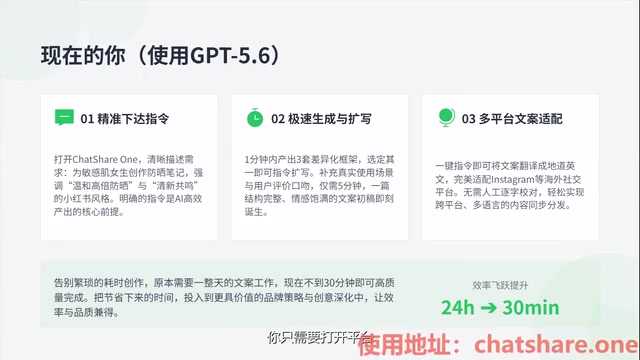
Are Those "Double Your Efficiency" Scenarios Real?
The videos also showcase two application scenarios to attract users: writing Xiaohongshu (RED) copywriting "reduced from a full day to half an hour," and data analysis "compressed from two days to one hour."
The Capabilities Are Real, But You Don't Need a Gray-Market Platform
Objectively speaking, modern large language models can indeed assist with copywriting, generate charts, and draft analytical reports—these capabilities themselves are not exaggerated. The issue is that to access these capabilities, you absolutely don't need to go through a dubious third-party platform.
OpenAI's official ChatGPT, Anthropic's Claude, and domestically compliant options like Tongyi Qianwen, Wenxin Yiyan, Kimi, and DeepSeek all provide free or low-cost official access points. It's worth noting that China formally implemented the "Interim Measures for the Management of Generative Artificial Intelligence Services" in August 2023, requiring enterprises providing generative AI services to complete algorithm filing, security assessments, and other compliance procedures. The domestic platforms mentioned above have all passed relevant approvals and possess legitimate operating qualifications—user data is subject to Chinese data protection laws, and platforms bear data security responsibilities. Unregistered third-party mirror sites, however, operate entirely outside regulatory oversight. If a data breach occurs, users have virtually no legal recourse. Using official channels provides both genuine model capabilities and guarantees for data security and service stability.

Data Analysis Still Requires Human Verification
Furthermore, even with genuine AI analytical capabilities, outputs still require human verification. Large models suffer from "hallucination" problems—one of the most pressing safety concerns in AI today—where models generate content that appears fluent and logically coherent but is factually incorrect. The root cause lies in how large models work: they're fundamentally performing probabilistic next-token prediction rather than retrieving from factual databases. Research shows that even the most advanced models still exhibit significant hallucination rates in scenarios involving specific data, source citations, and mathematical calculations.
Therefore, claims in these videos that analysis "far exceeds human depth" and "can be used directly for decision-making" ignore the critical step of professional judgment for AI outputs. Using AI outputs directly for business decisions or academic research without verification poses serious risks of misguidance.
How to Identify These AI Marketing Traps
To help readers develop discernment, here are several practical criteria:
- Verify model version authenticity: When you encounter unreleased version numbers like "GPT-5.6," be immediately suspicious. Check OpenAI's official website (openai.com) or their official social media accounts for the latest release information. Any truly significant model launch will be accompanied by widespread coverage in tech media, not just appear on short-video platforms.
- Be wary of absolutist promises: Terms like "unlimited," "absolutely safe," and "completely exclusive" are typically marketing rather than fact. Genuine technology products clearly state usage limitations, data handling practices, and disclaimers in their terms of service.
- Prioritize official channels: Any third-party platform claiming to "bypass official" or "crack limitations" carries compliance and security risks. Official channels may have certain usage barriers, but those barriers are precisely the mechanisms that protect user rights.
- Pay attention to the video's true intent: If a "tutorial's" core purpose is to guide you to download a specific app or visit a specific link, it's essentially advertising rather than education. Watch for whether the video includes promotional interest disclosures, and whether the comment section is flooded with cookie-cutter positive reviews from fake accounts.
Conclusion: Embrace AI, But Stay Rational
AI tools are genuinely transforming how we work—this trend is undeniable. But precisely because AI's value is enormous, marketing traps, gray-market platforms, and fraudulent information have also proliferated around it.
The truly smart approach is not to be swept up by phrases like "latest version" or "free for a limited time" into impulsive action, but to experience and use these tools through official, compliant channels. The value of tools lies in helping us create—but the prerequisite is that the tools themselves are trustworthy. When facing the deluge of AI promotions, one extra moment of calm verification means one less risk of being exploited.
Related articles

Will Outdated LLMs Become Nostalgia Symbols? The Cultural Value and Era Memory of AI Technology
Will ChatGPT and GPT-4 from 2023 become nostalgia symbols like retro game consoles? Exploring old LLMs' historical value, emotional significance, and how open-source models preserve AI history.

GPL vs MIT License: The Copyleft Philosophy Debate in the Open Source Community
An in-depth analysis of the core divide between GPL and MIT/BSD permissive licenses, exploring the pros and cons of Copyleft's viral clauses, the Rust rewrite movement's impact on license ecosystems, and how developers can choose the right open source license.

Seed7 Language Memory Safety Mechanisms: A Unique Path Through Value Semantics and Deterministic Reclamation
Deep dive into Seed7's memory safety mechanisms including bounds checking, value semantics, null pointer elimination, and deterministic reclamation, compared with Rust's ownership model.