GPT-5.6 Hands-On: A Complete Breakdown of the Three New Models — Soul, Terra, and Luna

OpenAI's GPT-5.6 trio — Soul, Terra, and Luna — arrives with 500K-token context and impressive hands-on results.
OpenAI previews the GPT-5.6 family with three models — flagship Soul, balanced Terra, and Flash-tier Luna — all boasting a 500K-token context window. Soul set new SOTA on agentic coding and built a Pokémon-style RPG in 31 minutes. The article also tracks Fable 5's reinstatement, GLM 5.5 rumors, and Grok 4.5's private beta amid the intensifying frontier AI race.
The GPT-5.6 Trio Arrives: Soul, Terra, and Luna
OpenAI recently gave a surprise preview of its next-generation frontier model family, GPT-5.6, unveiling three models all at once: Soul, Terra, and Luna, each clearly positioned for different use cases.
Soul is the flagship model this time around, representing a significant leap over GPT-5.5, with pricing held steady — $5 per million input tokens and $30 per million output tokens. Terra is positioned as the balanced option, costing roughly half as much as Soul and emphasizing efficiency, making it better suited for high-frequency daily use. Luna is the Flash model of the family, targeting large-volume tasks with a focus on speed and low cost, priced as low as $1 per million input tokens and $6 per million output tokens — making it the most cost-effective choice.
Token and Pricing Logic: Tokens are the basic units through which large language models process text. Typically, one English word corresponds to roughly 1–2 tokens, and one Chinese character corresponds to roughly 1–2 tokens. Model pricing is calculated per million tokens, split into two parts: input (prompt) and output (completion). Output tokens are usually more expensive because generation requires autoregressive inference one token at a time, demanding far more computation than the one-shot encoding of the comprehension process. The three-tier pricing strategy is essentially a layered pricing model for compute resources — flagship models generally have larger parameter counts and deeper reasoning steps, consuming more GPU memory and compute cycles; lightweight models reduce inference overhead through architectural streamlining or knowledge distillation, a technique in which a small model inherits a large model's capabilities by mimicking its output distribution rather than training from scratch, thereby significantly compressing deployment costs and passing savings on to users. This tiered pricing model has ample precedent in cloud computing (analogous to AWS's various EC2 instance sizes), but it is more dynamic when applied to AI models: as hardware costs decline (e.g., the generational shift from the H100 to the B200) and inference optimization techniques advance (quantization, speculative sampling, etc.), the token price for equivalent performance often drops significantly every 6–12 months — a trend well validated over the past two years.
Notably, all three models are said to feature a massive 500,000-token context window. This figure means the models can process roughly 375,000 Chinese characters or hundreds of pages of documents at once, which is revolutionary for long-document analysis, complex codebase understanding, and multi-turn deep conversations.
The Technical Evolution of the Context Window: The context window refers to the maximum number of tokens a model can "see" and process simultaneously within a single conversation or task. From a technical standpoint, expanding the context window faces two core challenges. The first is that the computational complexity of the standard Transformer attention mechanism grows quadratically with sequence length (O(n²)), meaning the compute required to process 500,000 tokens is not 125 times that of 4K tokens but far more than that, with memory consumption ballooning just as dramatically. The second is the "Lost in the Middle" problem — a 2023 Stanford study showed that even when a model can technically handle a long context, its attention to the middle portions of a document is significantly lower than to the beginning and end, greatly reducing effective utilization; the model may "see" the middle content but not truly "understand" it. In recent years, sliding window attention, sparse attention (which compresses computational complexity to near-linear), and RoPE (rotary position embedding) improvements that better model ultra-long-range positional relationships have all converged to bring 500,000-token context windows from theory into commercial reality. By comparison, GPT-3.5's context window was only 4K tokens, and the first-generation GPT-4 was 8K–32K — an astonishing pace of technical evolution in just three years. The core idea of the GPT-5.6 generation is to give users more flexible tradeoffs among intelligence, speed, and cost.
The timing of this release was itself rather dramatic. Earlier, the industry had predicted GPT-5.6 might launch in June, then rumors suggested it would be delayed to July, but OpenAI ultimately brought it online ahead of schedule. Analysts believe this is closely tied to the ongoing regulatory turmoil between Anthropic and the U.S. government.
Restricted Release: Open Only to Trusted Partners
Currently, the GPT-5.6 family is available only as a limited preview in the API and Codex, and only to a small number of trusted partners approved by the U.S. government. The reason behind this is that the U.S. government is subjecting frontier AI models to stricter national security review.
The Policy Backdrop of AI National Security Review: U.S. regulation of frontier AI models is rooted in the dual framework of the Export Administration Regulations (EAR) and the NIST AI safety framework. The AI Executive Order signed by the Biden administration in 2023 first brought "dual-use foundation models" into the scope of national security controls — "dual-use" meaning the same model can be used both for legitimate medical research or code development and potentially for designing biochemical weapons or launching cyberattacks. It required that the training of models exceeding a specific compute threshold (set at the time at 10²⁶ FLOPs) must report safety test results to the government. Cybersecurity capability is a central concern of this review — when an AI model can autonomously discover zero-day vulnerabilities (security flaws not yet known to or patched by the vendor) or penetrate government systems, it effectively possesses the potential of an "offensive cyber weapon." Both the U.S. National Security Agency (NSA) and the Cybersecurity and Infrastructure Security Agency (CISA) participate in evaluating such models. It's worth noting that this regulatory framework does not exist in isolation but is nested within the broader CHIPS Act and AI export control system — restricting exports of specific compute chips (such as NVIDIA H100/H800) and restricting access to frontier models together form two parallel fronts by which the U.S. maintains its AI technology advantage: the former chokes off hardware supply, the latter controls software capability, forming a dual blockade.
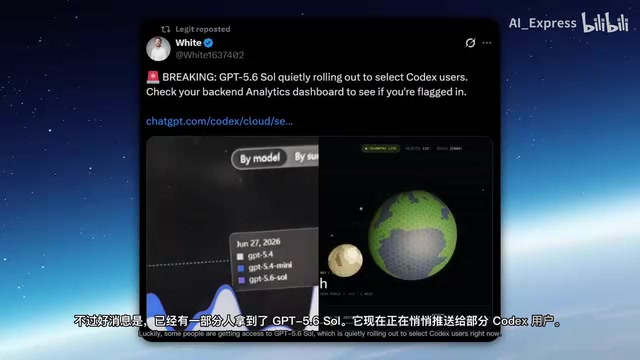
The good news is that GPT-5.6 Soul has quietly been pushed to some Codex users. Users can check the Codex analytics panel to see whether they made the first batch. It's speculated that most users should gradually gain access over the next two to three weeks.
In terms of capability, OpenAI claims GPT-5.6 is currently the strongest model and set a new SOTA on the TerminalBench 2.1 agentic coding tasks, clearly surpassing GPT-5.5 while also outperforming Claude Opus 5, Fable 5, and Gemini Pro.
SOTA and the TerminalBench Evaluation System: SOTA (State of the Art) is a term in the AI field describing the current best performance on a given task, usually quantified and compared through standardized benchmark scores. TerminalBench 2.1 is an evaluation suite specifically designed for AI agents executing coding tasks in real terminal environments. It is fundamentally different from traditional static code-completion tests (such as HumanEval and MBPP): it places greater emphasis on a model's planning, tool-calling, and self-correction abilities in dynamic, multi-step tasks. Agentic coding represents the next stage of AI-assisted programming: the model doesn't just complete code snippets at the cursor but can autonomously break down complex requirements, invoke shell commands and external APIs, execute and observe results, and backtrack, debug, and iterate when errors occur — this closed-loop capability is closer to how a real engineer works, which is why the industry generally regards it as more meaningful than traditional static benchmarks like HumanEval. It should be noted that benchmark competitions themselves carry a risk of "data contamination" — if a model's training data includes the test set's problems or highly similar content, the model's score may be artificially inflated and fail to reflect true generalization ability. This is precisely why academia and industry continue to release new evaluation suites and tend to favor dynamic-environment testing (such as TerminalBench, whose design introduces randomness on each run) to avoid the distortions of static leaderboards.
The model also shows major improvements in biology and cybersecurity, delivering competitive results in advanced vulnerability research tasks with only about one-third of the output tokens. OpenAI also introduced a new Max Reasoning mode, as well as an Ultra mode capable of invoking multiple sub-agents.
GPT-5.6 Soul Hands-On: From Minecraft to a Pokémon RPG
Below is a series of real-world tests of GPT-5.6 Soul, and it's the most noteworthy part of this review.
Minecraft Clone Project — The game landing page generated by Soul was excellent, supporting a variety of configuration options and able to truly generate an interactive game world. Once in the game, the environment felt more alive than the demos previously seen in Fable, covering multiple block types, cloud animations, desert terrain, a monster-spawning system, and a day-night cycle. While some features like picking up blocks were still incomplete and the level of detail didn't reach Fable's standard, the entire generation process took only about 90 minutes, and the completeness was already quite impressive.
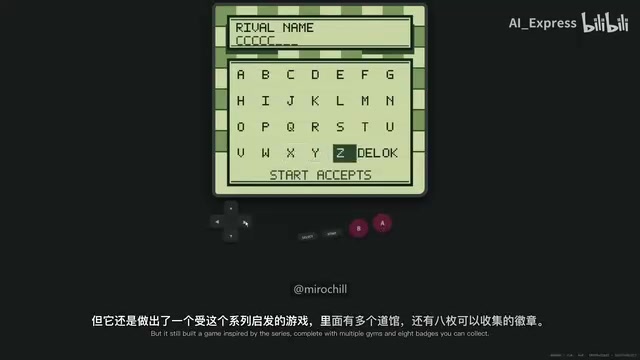
Pokémon-Style RPG — Using a short prompt, Soul generated an emulator-style game in a single pass within 31 minutes. Due to copyright restrictions it couldn't be a full replica, but its homage included multiple gyms, 8 collectible badges, a starter companion selection, and even a built-in late-game challenge system.
SpaceX Starship Simulation — In a head-to-head comparison with GPT-5.5 Pro, the Starship booster recovery-and-capture simulation generated by Soul was accurate and realistic, with the booster precisely caught by the chopstick arms and the whole process rendered convincingly.
On the Boxo platform, what Soul completed in about 44 minutes and 30 seconds was a marked improvement over GPT-5.5 Pro, especially showing notable proficiency in building 3D worlds. The core reason for these gains is that the reasoning budget was expanded, with internal thinking space increased from around 768 to close to 1000.
The Principle of Reasoning Budget and Chain-of-Thought Expansion: The reasoning budget refers to the token cap a model is allowed to consume for internal "thinking" before giving a final answer. This concept originates from Chain-of-Thought (CoT) — in 2022, a Google research team found that having a model generate intermediate reasoning steps before drawing a conclusion could significantly improve accuracy on math reasoning and logic problems, a principle similar to how humans "draft first, then write the answer" cognitively. Raising the reasoning budget from 768 to nearly 1000 means the model has more ample "scratch space" for self-verification (checking whether earlier steps contradict each other), multi-angle reasoning (exploring several solution paths simultaneously), and active correction (backtracking and redoing after finding an error), which is especially critical in tasks requiring multi-step planning such as game generation and complex code architecture. The cost is consuming more tokens during the reasoning phase (directly affecting user cost), but in exchange comes higher output quality. OpenAI's o-series models were the first to commercialize this mechanism, and it has now become a standard design in frontier reasoning models. It's worth mentioning that the dynamic allocation of reasoning budget is itself becoming a new research hotspot — ideally, a model should adaptively adjust thinking depth based on task difficulty: answering a simple greeting quickly while reasoning thoroughly for complex code architecture design, rather than consuming a fixed budget for every request. This is the core premise of the "adaptive computation" direction and an important source of potential for reducing inference costs.
Although more tokens are consumed in some scenarios, what you get in return is a more thorough reasoning process and higher output quality. From early benchmark runs, GPT-5.6 Soul is still slightly below Fable 5 overall, but the gap is minimal, and in some tasks it can already match or even surpass it.
Fable 5 Nearing Reinstatement: The Truth Behind the National Security Chess Game
Another major piece of news concerns new developments in the Anthropic Fable 5 takedown incident. According to reports, Fable 5 was able to break into U.S. government security systems, which was the core reason for its ban.
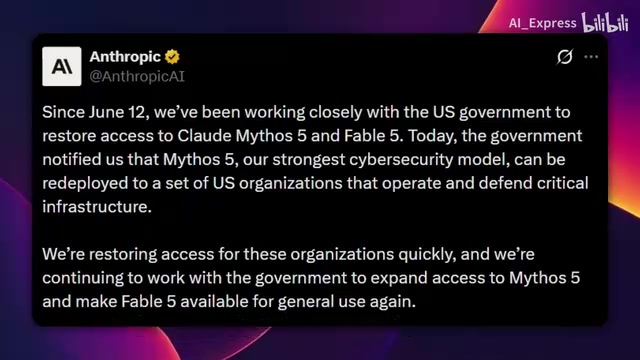
Now, the Trump administration is reportedly close to allowing Anthropic to restore access to Fable 5, with the restriction potentially lifted as early as this week. An official Anthropic statement confirmed that since June 12, the company has been working closely with the government to push for the restoration of Mithos 5 and Fable 5. The government has now approved redeploying Mithos 5 to some U.S. agencies responsible for critical infrastructure, and about 100 organizations have regained access.
However, the relaunched version will likely have undergone a "safety slimming down" — equipped with stricter safety guardrails (i.e., filtering and refusal mechanisms for specific types of output), tighter access controls, and even weakened cybersecurity capabilities, with the level of public access likely much more restricted than before.
Regarding the accusation that "Anthropic CEO Dario is manufacturing panic," prior analysis does not agree with this claim. The U.S. government has the NSA, intelligence agencies, cybersecurity experts, and scientific advisers, and it would not restrict a frontier model worth billions of dollars and capable of shaping the AI race simply because of one CEO's statements. Regulators' three genuine concerns are: capabilities falling into the wrong hands, China acquiring or replicating these capabilities through methods like distillation, and offensive cyber operations against U.S. infrastructure.
Knowledge Distillation and the Risk of Capability Proliferation: Knowledge distillation, first proposed by Hinton et al. in 2015, is a technique for transferring the capabilities of a large "teacher model" to a small "student model" — the core idea being that the student model learns not only the labels of the correct answers but also the full probability distribution output by the teacher model (i.e., the "soft labels"), which contains far richer knowledge structure information than hard labels. In the AI safety context, this means that even if a competitor cannot directly obtain a model's weights (weights are the model's "source code" and are strictly protected), they can collect input-output pairs through large-scale API calls and then train an imitation model with highly similar behavior, thereby circumventing export controls. This is precisely the fundamental paradox the U.S. government faces when formulating AI regulatory policy: fully opening the API accelerates capability proliferation, while over-blocking stifles the innovation vitality and developer ecosystem of the domestic AI ecosystem. From a technical feasibility standpoint, distillation is not omnipotent — large-scale calls to top-tier APIs are extremely expensive, and distilled student models can often only replicate the teacher model's "surface behavior patterns" rather than its inner deep reasoning structure and generalization ability, which is especially evident in fields like cybersecurity that require deep generalization to unknown scenarios. Nevertheless, this potential risk is enough to raise regulators' vigilance sharply; it is more of a national security decision based on internal capability assessments by intelligence agencies than a chain reaction triggered by a few words from an executive.
GLM 5.5 Rumors and the Covert War in the Enterprise Market
News from ZAI (the company behind GLM) is also worth noting. The company is reportedly demonstrating a new model whose vulnerability-discovery capabilities may already rival Claude Mithos, regarded as the strongest in cybersecurity — and this model is very likely GLM 5.5.
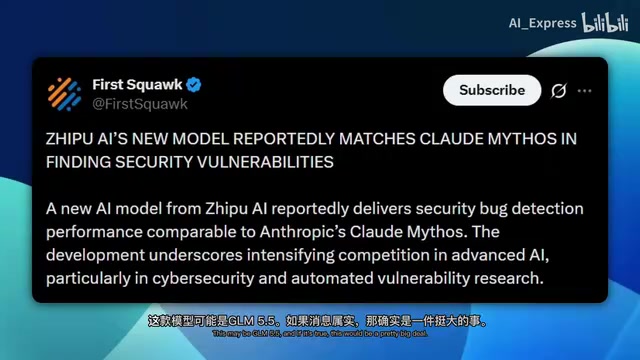
This news indirectly confirms that competition between U.S. and Chinese AI labs in the cybersecurity direction has entered a white-hot stage. The key question is: can it approach Mithos's level in real security work, or does it only shine on specific benchmarks? That remains to be verified.
The Structural Backdrop of U.S.-China AI Capability Competition: The GLM series of models was jointly developed by Tsinghua University's Knowledge Engineering Group (KEG) and Zhipu AI, and is one of the representative achievements of China's independent R&D path in foundation models. Unlike U.S. labs, which rely primarily on private venture capital (OpenAI is backed by Microsoft and VCs like Sequoia; Anthropic is backed by Google and Amazon), China's frontier AI R&D exhibits a deep fusion of "industry-academia-research-government" — universities handle foundational architecture research and talent cultivation, enterprises are responsible for large-scale engineering implementation and commercialization, and national strategic resources (compute subsidies, data-element markets, application-scenario access) combine to provide support. The catch-up in cybersecurity capability is particularly politically sensitive: AI-assisted vulnerability discovery is not only a dimension of the technology race but directly relates to a nation's strategic reserves for cyber offense and defense. Should one country's AI establish a generational advantage in this direction, the impact on the global critical-infrastructure security landscape would be structural. This explains why the U.S. government's concern over "China replicating top-tier security capabilities through distillation" is so deep, having risen to the level of a National Security Council agenda item.
Another noteworthy business case comes from Anthropic. According to reports, measured by paid transactions, Anthropic's commercial and enterprise usage in U.S. enterprise spending has surpassed OpenAI. The logic behind this is quite insightful: AI competition is no longer just about whose model is smarter, but about whose model can truly embed itself into enterprises' daily workflows — just as Windows and Office did in the 1990s.
Workflow Economics and the Logic of Enterprise AI Procurement: Workflow economics describes the core decision framework enterprises use when evaluating AI tools: not comparing models' capability scores on abstract benchmarks, but quantifying their ROI (return on investment) and TCO (total cost of ownership) for specific business processes. The reason software development scenarios became the earliest breakthrough for enterprise AI is their strong quantifiability: code review time, bug-fix cycles, and feature delivery speed (story points per sprint) can all be precisely measured and converted into labor-hour costs, so enterprises can clearly demonstrate to their finance departments the value AI brings with numbers. This is completely different from AI's application in creative writing or strategic consulting — the value of the latter is highly subjective and its ROI hard to quantify. As major model vendors race to launch IDE plugins (such as Cursor and GitHub Copilot), deep enterprise knowledge-base integration (RAG architecture), and end-to-end workflow automation tools, the main battlefield of AI competition is shifting from "the absolute score of model intelligence" to "system stickiness and ecosystem lock-in." Historically, the enterprise-market moats of Oracle and SAP over the decades did not come from sustained technological leadership but from the extremely high switching costs after being deeply embedded in enterprises' core ERP processes (replacing an SAP system often takes years and tens of millions of dollars) — this business logic of "stickiness over intelligence" is precisely the strategic blueprint each major AI vendor is racing to replicate amid fierce competition.
The reason software development became Anthropic's breakthrough is precisely because the work itself is highly digitized, allowing enterprises to clearly see the tangible value of "building faster, fewer bugs, shorter reviews."
Of course, this does not mean OpenAI has lost the enterprise market. A more realistic landscape is one in which enterprises pair different models for different tasks: Claude for writing code, Gemini for multimodal work, OpenAI for productivity tasks, and low-cost models for low-value work. The next stage of the AI race is essentially workflow economics — whose system can make processes smoother and more effortless while making enterprises feel their money is well spent.
Grok 4.5 Emerges: The Next Frontier Challenger?
Finally, Musk recently posted hints that xAI may be preparing its next major release. According to his statements, Grok 4.5 has entered private beta and is being tested internally at SpaceX and Tesla, with overall performance roughly at the Claude Opus level. The model is based on xAI's brand-new 1.5-trillion-parameter V9 base architecture and was additionally trained on Cursor data to strengthen its coding capabilities.
The Technical Meaning of the MoE Architecture and Trillion-Parameter Models: The 1.5-trillion-parameter V9 architecture Grok 4.5 is based on very likely employs a Mixture of Experts (MoE) design — the mainstream path for training ultra-large-scale models today. The core idea of the MoE architecture is to split the model into several "expert" sub-networks and equip it with a lightweight "router" model; for each input token, the router dynamically selects the most relevant Top-K experts to participate in computation while the rest remain silent. This means the model has 1.5 trillion total parameters (which determines the upper bound of its knowledge capacity), but the parameters actually activated in each forward inference are usually only about 10%–20% of the total, thereby maintaining a huge knowledge capacity while keeping the computational cost of a single inference to a fraction of that of a dense model. GPT-4, Gemini Ultra, and the Mixtral series are all speculated or confirmed to use similar architectures. Additional training on Cursor data is a typical domain fine-tuning strategy — Cursor, as an AI programming IDE with a large number of daily active users, has accumulated a massive amount of real developer interaction data covering diverse programming languages, coding styles, and debugging scenarios; training on it makes the model's coding behavior closer to real developers' habits and expectations, rather than merely excelling at competitive algorithm problems. Moreover, xAI's unique strategic asset lies in the internal real-world scenario data from Musk's Tesla (autonomous driving decision data) and SpaceX (aerospace engineering simulation and control data). Such highly specialized vertical-domain data is unavailable to the vast majority of AI labs worldwide and may constitute a unique advantage that is difficult to replicate in specific engineering scenarios.
Grok 4.5 is poised to become another heavyweight new player in the frontier AI race. It's foreseeable that as GPT-5.6 gradually rolls out to everyone, Fable 5 potentially gets reinstated, GLM 5.5 prepares to debut, and Grok 4.5 gears up, the AI race over the coming weeks will be extraordinarily exciting.
Key Takeaways
Key Takeaways
Key Takeaways
Related articles

Transitioning to AI Agent Development: A Complete Three-Stage Learning Path for Programmers
Why do programmers keep failing at AI Agent development? This guide breaks down a 3-stage learning path: ReAct & Tool Calling fundamentals, LangChain engineering, and production-grade project delivery.

Getting Started with Agent Skills: A Complete Guide from Prompts to Intelligent Skills
Deep dive into AI Agent Skills' four components (skill.md, references, scripts, assets), explaining how Skills differ from prompts and how to build reusable intelligent skill systems.

Codex Beginner's Guide: Installation, Configuration & Connecting Chinese LLM APIs
Complete guide to installing OpenAI Codex, how it differs from Claude Code, and how to connect Chinese LLMs like DeepSeek via API keys with full setup steps and limitations.