GPT-5.6 Launches: Flagship Model Sol Personally Trains Smaller Models, Recursive AI Self-Improvement Becomes Reality

OpenAI's GPT-5.6 flagship Sol trains smaller model Luna, bringing recursive AI self-improvement into reality.
OpenAI released the GPT-5.6 series (Sol/Terra/Luna), with flagship model Sol directly completing the post-training of the smaller Luna—the first production-grade recursive self-improvement case. The article analyzes the three models' performance, cost advantages, the new ChatGPT Work app, and major leaps in computer use and design capability.
In-Depth Analysis of OpenAI GPT-5.6: Sol Trains Luna, Recursive Self-Improvement Enters Reality
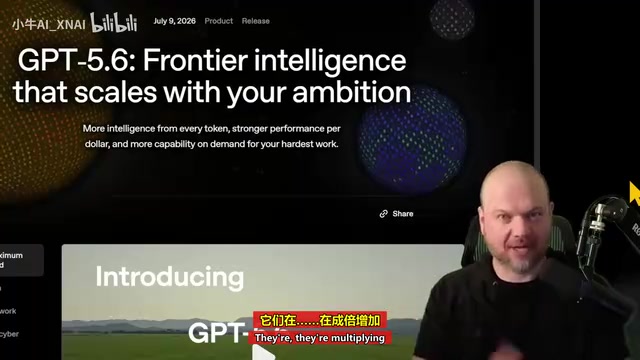
OpenAI has officially released the GPT-5.6 series of models, but what truly sparked discussion wasn't the benchmark scores—it was a thought-provoking detail: during the launch livestream, OpenAI revealed that the flagship model Sol personally completed the post-training of the smaller model Luna. This means AI has begun participating in the development of the next generation of AI, and "recursive self-improvement" is no longer just theory.
So-called recursive self-improvement is a core proposition long debated in the field of AI safety. Its philosophical roots can be traced back to 1965, when British mathematician I.J. Good first systematically articulated the "intelligence explosion" hypothesis in his paper "Speculations Concerning the First Ultraintelligent Machine": once a machine can design a version of itself slightly more powerful than itself, this process can iterate indefinitely, forming an accelerating loop that far exceeds human control. This hypothesis later became a central source of anxiety in AI safety research, and Nick Bostrom developed it into the theoretical framework of the "control problem" in his 2014 book Superintelligence. In terms of technical implementation pathways, recursive improvement splits into two threads: capability improvement (making AI smarter) and efficiency improvement (doing the same thing with fewer resources). Sol training Luna is closer to the latter—using a more powerful flagship model to systematically optimize the training pipeline of a smaller model. This constitutes limited, supervised recursive improvement, rather than the completely runaway autonomous evolution depicted in science fiction. Even so, this publicly acknowledged production-grade implementation marks the topic's formal transition from thought experiment to engineering reality.
Sol Training Luna: The Key Experiment in "AI Training AI"
The GPT-5.6 family includes three models, named with a celestial theme: Sol (the sun) is the largest, smartest, and most expensive flagship; Terra (the earth) is positioned in the mid-tier, aimed at everyday professional work; and Luna (the moon) is a cost-controlled model geared toward large-scale, repetitive tasks.
The most striking detail OpenAI disclosed was a real prompt used by a researcher in Codex, instructing Sol to autonomously kick off the post-training task for Luna. The prompt was remarkably brief—essentially "find the training configuration, find the right GPUs, launch the script, and make sure it runs." The rest was left for Sol to complete on its own.
It's worth understanding in depth that post-training is not a simple fine-tuning of the model, but the critical stage that determines the model's ultimate "personality" and capability boundaries—also the most decisive engineering phase in modern large language model development. Its technical evolution reflects the deepening understanding across the entire industry: the first stage, supervised fine-tuning (SFT), uses high-quality human-annotated question-answer pairs to transform the pretrained model's "next-word prediction machine" nature into a "task-executing assistant"; the second stage, reinforcement learning from human feedback (RLHF)—systematically proposed by OpenAI in the InstructGPT paper (2022)—introduces reward models and the PPO algorithm, letting human preference signals drive model behavior optimization, and much of ChatGPT's leap in conversational quality stems from this; the more recent reinforcement learning from AI feedback (RLAIF) attempts to replace human annotators with more powerful AI models, with Anthropic's Constitutional AI being a representative practice. Pretraining is responsible for the model learning language patterns and world knowledge, consuming an enormous share of compute; while post-training determines safety boundaries and task-execution style, with significant impact on the end-user experience. Sol leading Luna's post-training means that the judgment criteria for data filtering, the logic for constructing reward models, and the tuning strategies for training hyperparameters—processes that once relied on the intuition and experience of senior researchers—are being systematically taken over by the flagship AI.
This aligns closely with the approach of the Auto Research project recently open-sourced by Andrej Karpathy. The "autonomous AI research" paradigm this project represents technically continues the core ideas of neural architecture search (NAS) and meta-learning, but extends them to a more complete research cycle: giving an AI agent a real language model training environment, letting it autonomously propose hypotheses, design experiments, run training, interpret results, and iterate—keeping results if experiments bring improvements, otherwise discarding them, and repeating the loop. Google DeepMind's AlphaCode, FunSearch, and other projects have already validated the feasibility of similar pathways in mathematics and algorithm optimization. The difference is that OpenAI isn't running this approach with small models on home computers, but rather using the most cutting-edge flagship model available to drive the entire process—when the most powerful frontier model is used to optimize the training of the next generation of models, the iteration speed of AI development will theoretically accelerate at a pace previously unimaginable. An OpenAI researcher candidly admitted that the arrival of the "automated researcher" no longer seems far off.
Notably, Anthropic recently recruited Karpathy, and the industry widely speculates this is precisely aimed at a similar direction. Multiple frontier labs are all pushing toward the goal of "AI accelerating AI development."
Five Frontier Labs Competing on the Same Stage
This release comes at a moment of white-hot competition. According to the video's author, xAI/Grok and Meta also released frontier-competitive models within the past 24 hours, expanding the number of "frontier AI labs" from a handful to five overnight—a dizzying pace.
OpenAI also introduced a new reasoning intensity tier this time—Ultra mode. This design is the product of merging two major research directions: "Chain-of-Thought" and test-time compute scaling. In a 2022 paper, Google researchers found that allowing a model to generate intermediate reasoning steps before giving its final answer can significantly improve accuracy on complex tasks. OpenAI's o-series models advanced this idea into a controllable "thinking token" mechanism: before generating a visible answer, the model performs extensive internal reasoning in latent space, and the depth and length of this reasoning can be controlled by external parameters—the "Thinking Budget." Previously, Anthropic also had a similar tiered reasoning design (low / medium / high / extra high), and OpenAI has now added an ultra tier above max, specifically for handling the most intensive complex tasks. Ultra mode is equivalent to giving the model an almost unlimited space for thinking—but this also raises the "overthinking" problem: on simple questions, the model consumes large amounts of reasoning tokens yet instead introduces more uncertainty. The essence of this tiered reasoning design is to let the model dynamically allocate its thinking budget based on task difficulty—responding quickly to simple tasks and reasoning deeply on complex ones—thereby finding the optimal balance between cost and quality.
Performance Comparison: Stronger, Cheaper, Faster, More Token-Efficient
The core narrative of GPT-5.6 isn't just "higher scores," but that at equal or even higher scores, it comprehensively wins on cost, latency, and output tokens. OpenAI specifically emphasized this efficiency curve of "intelligence vs. cost" with charts.
Some key data points:
- On Agent's Last Exam, Claude Fable 5 scored 40.5% at a cost of up to $2,300; GPT-5.6 Sol scored 53.6% at a cost of only $763.
- On the Artificial Analysis coding agent index, GPT-5.6 Sol scored 80, setting a new SOTA—2.8 points higher than Fable 5—while using less than half the output tokens, less than half the time, and about one-third the cost.
- On multiple benchmarks including Terminal Bench 2.1, DeepSWE 1.6, and BrowseComp, GPT-5.6 Sol sits at the optimal position on the "intelligence-cost curve."
It should be noted that Agent's Last Exam (ALE) represents the core design philosophy of a new generation of evaluation paradigms. Traditional AI evaluation benchmarks (such as MMLU and HumanEval) are essentially static knowledge tests—given an input, judge whether the output is correct. As AI agent capabilities improve, such benchmarks increasingly struggle to distinguish the real gaps between top models, because strong models' static accuracy has approached its ceiling. ALE moves the evaluation scenario into real tool-calling environments, requiring the model to complete full task chains involving multi-step planning, tool calling, and error correction, scoring based on the quality of the final deliverable rather than single-step accuracy—this design is closer to real work scenarios, and it also makes the evaluation cost itself a meaningful dimension: the fewer tokens consumed to complete the same task, the higher the model's planning efficiency and the more optimized its path. For enterprise decision-makers, the "score/cost" ratio is far more valuable as a reference than the absolute score: in large-scale batch task scenarios, the gap between $2,300 and $763 directly determines business viability and actual ROI.
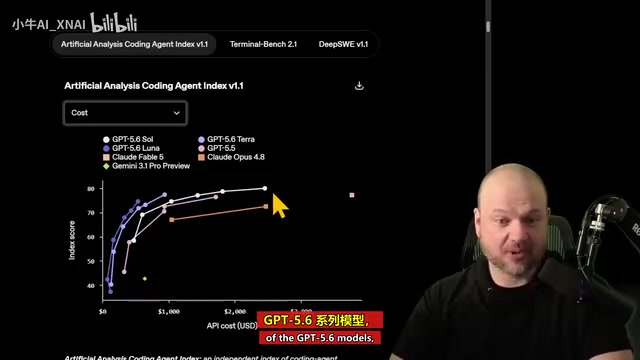
An interesting detail: the score under max mode was actually slightly lower than ultra, which corroborates the aforementioned "overthinking" phenomenon—when a model is allowed to extend its reasoning chain indefinitely, it doesn't always yield better results. In addition, OpenAI is rumored to have made significant algorithmic improvements recently and adopted Cerebras chips, which reportedly boost GPT-5.6's inference speed by about 10x—this also explains its product positioning of "efficiency maxed out by default."
It should be noted that the Gemini 3.1 Pro compared in the charts is already an older version, and Google's 3.5 Pro has not yet been released, so the final landscape of this efficiency curve remains uncertain.
ChatGPT Work: Codex Goes Mainstream
OpenAI simultaneously launched a standalone desktop app, ChatGPT Work, which requires separate download and installation. Its positioning is similar to Anthropic's Claude Cowork—essentially "Codex for everyone," not just serving developers. Users can connect all their tools, workflows, and documents, letting it collaboratively complete tasks across finance, operations, marketing, sales, engineering, and other scenarios.
Dual Leaps in Computer Use and Design Capability
If the benchmark data was "as expected," then what was truly impressive this time is the deep integration of design capability and computer use.
The technical implementation of Computer Use capability spans three fields: computer vision, natural language understanding, and reinforcement learning. Its core challenge lies in transforming unstructured screen pixel information into meaningful semantic states, then decomposing high-level instructions into executable low-level operation sequences (mouse movement coordinates, key events, text input, etc.). Anthropic was the first to publicly demonstrate Computer Use capability in Claude 3.5 Sonnet in October 2024, launching industry competition in this direction. Compared to traditional RPA (robotic process automation) tools that require pre-recording fixed operation paths, AI-driven Computer Use possesses generalization capabilities, able to handle dynamic situations such as interface changes and unexpected pop-ups. Its technical core lies in closed-loop combination of visual understanding (reading the screen) and action planning (deciding the next operation)—essentially a continuous "perception-decision-execution" loop. Unlike API calls, Computer Use requires no dedicated interface from software and can theoretically control any graphical interface program, greatly expanding the action boundaries of AI agents. Notably, this capability also introduces new security risks—the model may be hijacked by malicious web pages through "Prompt Injection," executing operations not authorized by the user; this attack surface remains an important subject of security research.
The author ran a test: having the model create a survival zombie simulation game in a style similar to Project Zomboid, requiring a gloomy, realistic art style, using GPT Image 2.0 to generate large amounts of visual assets, self-checking the results via computer use, and finally building a complete landing page.

The results were quite astonishing. The landing page generated by the model stated: it "repeatedly launched the real game and Chromium, sent keyboard and pointer inputs, opened every panel, captured rendered pixels, and inspected the game state," and emphasized that "these are real screenshots from the development process, not design mockups." In other words, it actually built a runnable game—including pain, body temperature, systemic infection, a complete crafting system, and many other mechanics—then autonomously took screenshots and used them to build the demo website.

The author also showcased a museum website, an interior design demo, an interactive wave interference explainer, and a website visualizing the scales of a sci-fi universe (from the Millennium Falcon and the Enterprise to Dyson rings and Larry Niven's "Ringworld"). The overall design was clean, sharp, minimalist, and thoughtfully colored, showing clear progress over the previous generation.
However, the experience wasn't entirely smooth: when the author ran multiple ultra-mode Codex instances simultaneously, they all froze due to "the selected model has reached capacity"—presumably caused by excessive traffic in the early launch period.
Conclusion: How Far Is the "Automated AI Researcher"?
GPT-5.6 is clearly not an incremental update. From "Sol training Luna" to the comprehensively leading cost-performance curve, and to the fusion of computer use and design capabilities, this release ties together a clear main thread: AI is participating ever more deeply in its own development and production.
From I.J. Good's 1965 thought experiment, to RLHF letting human preferences drive model behavior, to today's flagship model directly taking over the post-training pipeline of a smaller model—this line of technical evolution converges into a concrete engineering reality in the release of GPT-5.6. As the author noted, when the model reaches a certain critical point in both "computer use" and "design" dimensions simultaneously, some "magical" things begin to happen. And the OpenAI researcher's remark that "the automated researcher is not far off" may be the one line from this release most worth pondering for the industry.
Key Takeaways
- Sol training Luna is the first production-grade recursive self-improvement case publicly acknowledged by a top lab, marking AI's participation in AI development moving from thought experiment to engineering reality
- The endpoint of the evolution of the post-training tech stack (SFT → RLHF → RLAIF) is precisely the most powerful model comprehensively taking over every stage of the training pipeline
- The tiered reasoning and thinking budget mechanism solves the problem of dynamically allocating compute resources by task difficulty, but also exposes the new engineering challenge of "overthinking"
- New-generation evaluation benchmarks such as Agent's Last Exam incorporate "cost efficiency" as a core dimension, making the "score/cost" ratio a key metric for enterprise deployment decisions
- Computer Use capability breaks AI's dependence on dedicated API interfaces and can theoretically control any graphical interface program, while introducing new security risks such as prompt injection
Related articles

Workbuddy for Absolute Beginners: How a Desktop AI Agent Fits Into Real Workflows
A beginner's guide to the Workbuddy desktop AI agent: installation, claiming credits, file management, and building automated workflows—compared with CodeX for fit and cost, helping professionals shift from AI question-askers to AI managers.

OpenAI's New Agent Stack: Computer Use, Decisions API, and Ultra-Fast Workflows
OpenAI Dev Day unveiled a new agent stack: Computer Use outperforms humans, Decisions API delivers ultra-low-latency classification via Luna, Agents API opens the same Computer Use capabilities, and GPT-6.1 Sol costs only one-seventh of Astra. Core updates, benchmark data, and developer insights.

Liang Wenfeng Open-Sources DeepInfo Inference Framework, Takes On U.S. Ban
DeepSeek open-sources its DeepInfo inference framework after its models, featuring GPU/CPU cross-pipelining, small-model prediction with large-model verification, and full Huawei Ascend and NVIDIA chip support—facing the U.S. federal ban head-on. This article analyzes its significance for AI deployment and open-source strategy.