GPT-5.6 Price Cut of 80%: The Industry Logic Behind the AI Price War and Opportunities for Developers

OpenAI slashes GPT-5.6 Luna pricing by 80%, igniting an industry-wide AI price war with major developer implications.
OpenAI's GPT-5.6 series undergoes dramatic price cuts, with the Luna model dropping 80% to $0.20 per million input tokens. This article analyzes the technical factors driving AI inference cost reductions, the competitive pressures from open-source models, and how developers can leverage tiered model routing strategies to optimize costs while maintaining quality.
A Long-Brewing AI Price War
Recently, a post from the Reddit community has drawn widespread attention: OpenAI announced a massive price reduction for its GPT-5.6 series of models. The fastest and most economical Luna model saw a direct 80% price cut, Terra was reduced by 20%, and a new Fast mode provides API users with quicker access to the Sol model.
The community immediately titled this news "The price wars have begun," reflecting that the entire AI industry is entering a new phase of rapidly declining costs. For developers and enterprise users, this isn't just a change in billing numbers — it signals a deeper transformation in the large model business landscape.
Note: The data cited in this article comes from an official announcement shared on the Reddit community. Some product names (such as GPT-5.6, Luna/Terra/Sol) may be specific to the community context. Readers are encouraged to verify through official channels.

Specifics of the GPT-5.6 Price Reduction
According to the announcement, the adjustments focus on three levels:
Luna: The Primary Price-Cut Target
Luna is positioned as OpenAI's "fastest and most economical" model, designed specifically for large-scale tool invocations and multi-step workflows. Officially, it can deliver performance comparable to frontier-level models from a year ago at "roughly 6 cents on the dollar per task," while being nearly 9x faster.
After the price cut, Luna's pricing is:
- Input: $0.20 per million tokens
- Output: $1.20 per million tokens
To understand what this pricing means, it helps to explain how large model APIs are billed. A token is the basic unit that large language models use to process text — approximately every 750 English words correspond to 1,000 tokens, while Chinese characters correspond to roughly 1.5-2 tokens each. Model providers typically charge separately for input and output, with output prices higher than input because generating each new token requires a full forward inference pass, making it far more computationally expensive than encoding input text. For reference, when GPT-4 launched in early 2023, input was priced at $30 per million tokens and output at $60 — meaning Luna's input price is just 1/150th of GPT-4's original pricing, fully demonstrating the stunning speed of cost reduction over the past two years.
This price level has pushed the cost of calling high-performance models to an extremely low range. For use cases requiring massive concurrency and long-context processing (such as batch document processing, customer service automation, and data annotation), the cost reduction is almost decisive.
Terra and Sol: A Tiered Positioning Strategy
Terra's 20% reduction is a moderate adjustment, suggesting it likely sits in the mid-to-high performance tier with relatively limited room for price cuts. Sol's new Fast mode provides API customers with a faster access channel — this is more of an "experience tiering" strategy than a pure price cut.
The differentiated pricing across all three models creates a clear product matrix: attract scale-oriented users with Luna's extreme cost-efficiency, while covering scenarios demanding higher quality and speed with Terra and Sol. This multi-model tiered strategy has long precedent in cloud computing — AWS's EC2 instances range from general-purpose to compute-optimized and memory-optimized types, forming a complete spectrum that lets users choose the best price-performance for their specific needs. OpenAI's move shows that large model APIs are evolving from a single product line into a full-spectrum service platform.
Why Launch an AI Price War Now?
The Inevitable Result of the Inference Cost Curve
AI inference costs are declining along a steep curve. As model architectures are optimized, inference engines are upgraded, and dedicated hardware becomes widespread, the computational cost per token continues to drop.
Specifically, several key technologies are driving this rapid cost reduction:
-
KV Cache Optimization: In the Transformer architecture's self-attention mechanism, each generation step requires computing attention weights against all previous tokens. KV (Key-Value) caching stores previously computed key-value pairs in GPU memory to avoid redundant computation. Recent technologies like PagedAttention, Multi-Query Attention (MQA), and Grouped-Query Attention (GQA) have dramatically reduced cache memory usage, enabling more concurrent requests on the same hardware.
-
Speculative Decoding: Traditional autoregressive generation proceeds token by token in serial fashion, resulting in low GPU utilization. Speculative decoding uses a small "draft model" to quickly generate multiple candidate tokens, which the large model then verifies in parallel, confirming multiple correct tokens at once. This technique can improve inference speed by 2-3x without sacrificing output quality.
-
Quantization: Compressing model weights from FP16 (16-bit floating point) to INT8 or even INT4 precision, trading minimal quality loss for 2-4x inference speedup and memory savings. Quantization algorithms like GPTQ and AWQ have matured, making it possible to run models with tens of billions of parameters on consumer-grade GPUs.
-
Dedicated Inference Hardware: NVIDIA's H100/H200 GPUs, Google's TPU v5, and various proprietary chips (such as Microsoft's Maia and Amazon's Trainium) continuously improve inference performance per watt and per dollar. Hardware iteration gains stacked with software optimizations create exponential cost reductions.
Luna's claim of "achieving frontier model performance from a year ago at 6% of the cost" is a direct manifestation of this curve — today's mid-tier model is last year's top-tier model, at a fraction of the price. When technological dividends accumulate to a certain point, price cuts become a natural consequence.
A Proactive Strike Under Multi-Front Competitive Pressure
More importantly, there's the competitive dimension. The current large model market features multiple strong players: Anthropic, Google, and numerous open-source models (such as Llama, DeepSeek, and the Qwen series) all continuously driving down prices and barriers to entry.
Open-source model competitiveness has achieved a qualitative leap in the past year. Meta's Llama 3.1 405B has approached GPT-4 levels in multiple benchmarks; DeepSeek-V3 stunned the industry with its extremely low training cost (reportedly about $5.6 million) and excellent performance, with API pricing far below closed-source models of comparable capability; Alibaba's Qwen2.5 series excels in multilingual tasks and code generation. These models can not only be called via API but, more critically, can be downloaded and deployed on enterprises' own infrastructure — with inference frameworks like vLLM and TGI, a single H100 GPU can efficiently serve models with tens of billions of parameters.
Open-source models create a particularly powerful price-anchoring effect — when users can self-host high-performance models at near-zero cost, closed-source APIs must offer sufficiently attractive pricing to retain developers. The value proposition of closed-source APIs is shifting from "exclusive capabilities" to the service value of "zero ops, high availability, and continuous upgrades."
"Price war" is no exaggeration. Whoever can offer "good enough" capabilities at lower prices will lock in more developer ecosystems and call volumes, creating scale effects and data flywheels.
What the Price Cut Means for Developers
A Complete Restructuring of Application Cost Models
For teams building AI applications, model API costs are often the largest operational expense. With Luna's 80% price drop, scenarios previously too expensive to implement become viable:
- Large-Scale Agent Workflows: Multi-step, multi-call autonomous agents see their costs significantly amortized. A typical agent task might involve 10-50 model calls (planning, execution, reflection, error correction). Before the price cut, a single task could cost several dollars; now it can be compressed to just a few cents, making it possible for agents to transition from "demo projects" to "production-grade products."
- Long-Text Processing: High-token-consumption tasks like document analysis and codebase comprehension become more accessible. A 300-page book is approximately 400,000 tokens, which at Luna's new pricing costs less than $0.10 to fully ingest.
- Experimentation and Iteration: Lower trial-and-error costs during development encourage more aggressive product innovation.
More Refined Model Selection and Routing Strategies
As different models form clear performance-price gradients, developer model selection becomes more granular. A mature approach is routing: assigning simple tasks to economical models like Luna, and only invoking high-end models for complex reasoning scenarios, thereby maximizing cost efficiency while maintaining quality.
Model routing has developed multiple mature approaches in engineering practice. The simplest is rule-based routing — selecting models based on hard conditions like input length and task type. More advanced solutions use classifier-based routing, training a lightweight model to predict the capability level required for each request. For example, next-generation AI gateway services like Martian and Unify have turned intelligent routing into an out-of-the-box product — developers simply set quality requirements and budget constraints, and the system automatically distributes requests across dozens of models dynamically. OpenAI's own product matrix (Luna/Terra/Sol) effectively encourages users to adopt such tiered invocation strategies.
An even more cutting-edge approach is cascading inference: first attempting to answer with an inexpensive model, then automatically escalating to a more powerful model if confidence is insufficient. In practice, this strategy can save 50-70% of costs with nearly negligible quality loss.
Long-Term Impact of the AI Price War
Accelerated Democratization or Industry Commoditization?
On the positive side, falling prices mean the democratization of AI capabilities. Small teams and individual developers can build powerful applications at lower thresholds, accelerating innovation across the entire industry.
But price wars also carry risks. Sustained price cuts squeeze vendor profit margins and test sustainability. As foundational model capabilities gradually become homogenized, the focus of competition shifts from "who's more powerful" to "who's cheaper, faster, and more stable" — demanding higher engineering capabilities and cost control from vendors. Notably, OpenAI reportedly generated about $3.7 billion in revenue in 2024, but operating losses may have exceeded $5 billion — launching a price war against this financial backdrop shows a heavy bet on the "volume for profit" strategy, and signals that the industry is entering an aggressive phase of burning cash for scale while betting on future profitability.
Value Accelerates Its Shift Toward the Application Layer
A deeper trend: as models themselves tend toward commoditization, industry value is migrating from the foundational model layer upward to the application layer. When the cost of calling a powerful model approaches zero, true competitive advantage will be found in product design, vertical domain understanding, data moats, and user experience.
This trend closely mirrors multiple paradigm shifts in tech history. In the 1990s, hardware commoditization pushed value toward operating systems and application software; in the 2000s, the maturation of open-source databases and middleware pushed value toward SaaS applications; in the 2010s, the proliferation of cloud computing turned infrastructure into a utility like water and electricity, concentrating value at the platform and application layers. Now, large models are following the same trajectory — transforming from scarce "magic black boxes" into abundant "infrastructure components."
For entrepreneurs, this means the simple strategy of "wrapping a GPT shell" will become increasingly unsustainable. Truly valuable companies need to build deep product moats on top of models: proprietary datasets, domain knowledge graphs, fine-tuned workflows, and complete solutions centered on specific user pain points. In other words, the model is the engine, but what you're actually selling is the complete car.
Conclusion
The GPT-5.6 series price cut is yet another footnote in the AI industry's rapidly declining costs. Behind the 80% reduction lies both the inevitability of technological progress and the pressure of fierce competition. For developers, this is good news — lower costs and faster speeds mean greater room for innovation.
Once a price war begins, it's hard to stop. It's foreseeable that large model API costs will continue to fall, and the adoption of AI applications will accelerate accordingly. The real question may no longer be "can you afford it?" but rather "what can you create with it?"
Key Takeaways
Related articles
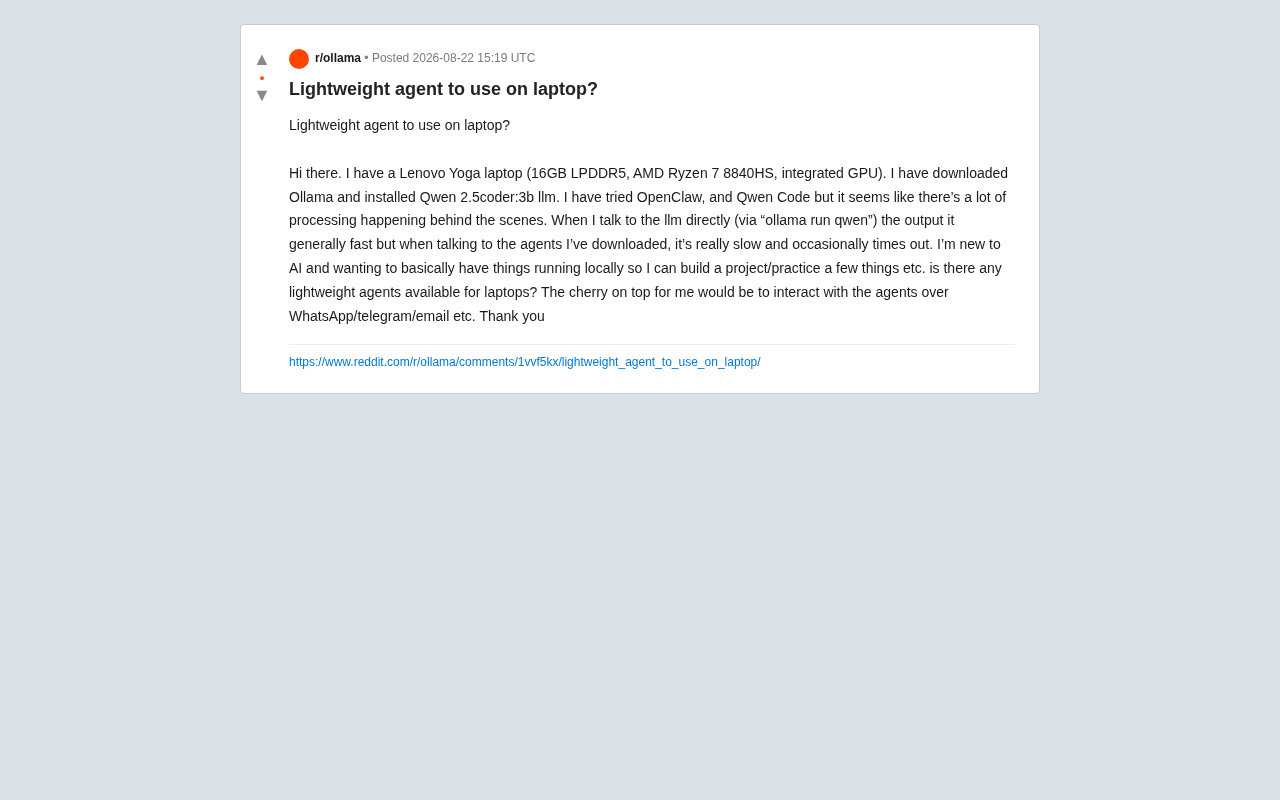
Local AI Agent Deployment Too Slow? A Lightweight Optimization Practical Guide
Local AI Agent deployment slow and timing out? This guide covers Agent framework overhead, hardware bottlenecks, and practical optimizations including context trimming, quantization, and Telegram Bot integration.

Choosing a Laptop for AI Studies: MacBook vs NVIDIA Laptop — An In-Depth Comparison Guide
In-depth analysis for AI students choosing laptops: MacBook Air M5 with remote GPU vs NVIDIA laptop, comparing CUDA support, portability, battery life, and value.

Self-Hosted LLM Tech Stack: A Complete Guide to Managing Your Local AI Cluster from the Terminal
A deep dive into self-hosting LLM tech stacks: inference engines, model management, vector databases, and how to manage your local AI cluster from the terminal.