GPT-5.6 Quietly Downgraded to 5.5-mini: Paying Users Uncover Stealth Rollback Through Network Inspection
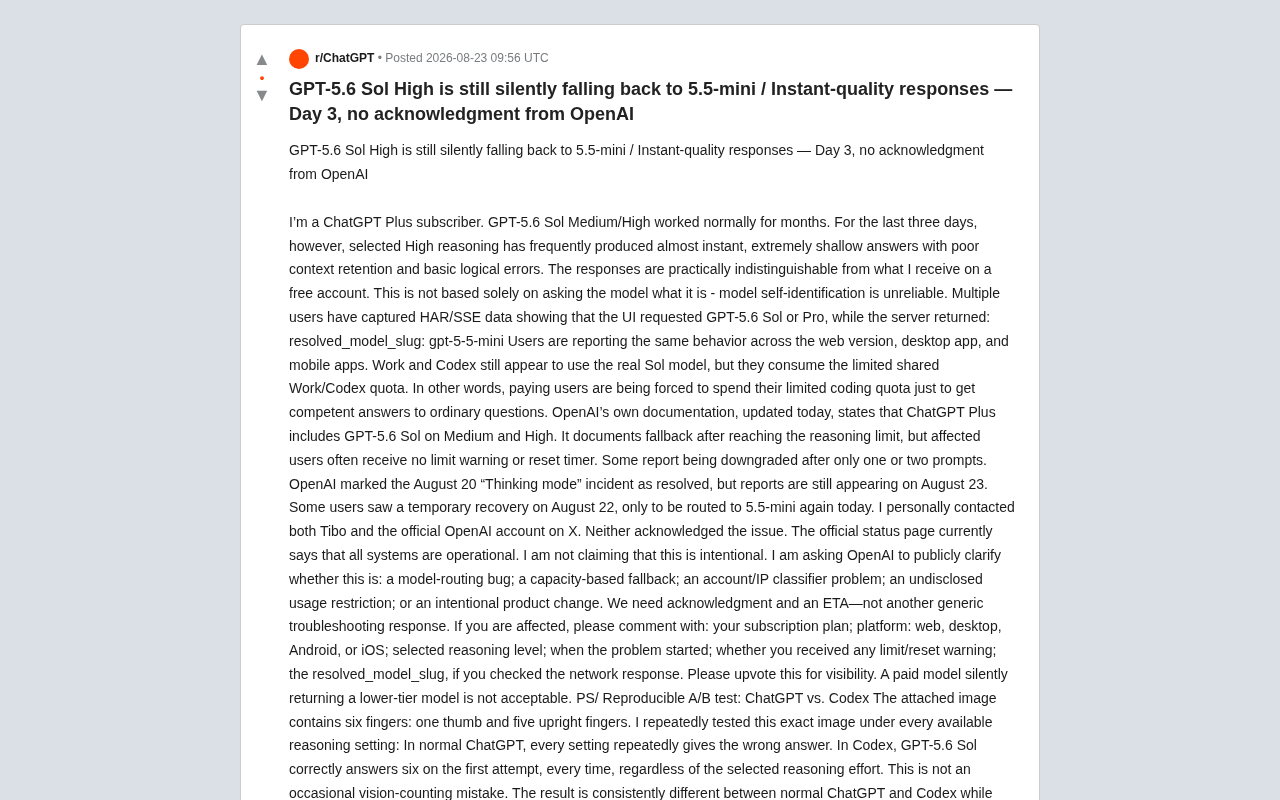
Paying ChatGPT users discover GPT-5.6 Sol requests are secretly routed to 5.5-mini via network inspection.
Multiple ChatGPT Plus subscribers used HAR/SSE packet capture to discover that their GPT-5.6 Sol High requests were being silently routed to gpt-5-5-mini on the backend. A reproducible six-finger image test confirmed consistent capability gaps between the standard chat and Codex interfaces. Users demand OpenAI acknowledge the issue and provide a resolution timeline.
Overview: Paying Users Hit with Stealth Model Downgrade
A ChatGPT Plus subscriber posted on Reddit accusing OpenAI of silently replacing their paid GPT-5.6 Sol High model with lower-quality 5.5-mini responses over the past three days. The accusation quickly resonated with the community, as multiple users confirmed experiencing the same issue in the comments. As of the time of posting, OpenAI had not issued any official response.
According to the original poster, GPT-5.6 Sol's Medium/High reasoning tiers had been working fine for months. However, over the past three days, even when manually selecting the High reasoning level, the model frequently returned "near-instant" shallow answers — with poor context retention and even basic logical errors. The user stated bluntly that the response quality was "almost indistinguishable from a free account."
Notably, within OpenAI's model naming hierarchy, GPT-5.6 Sol is a flagship-tier reasoning model featuring a larger parameter count, longer context window, and stronger multi-step reasoning capabilities — particularly excelling at complex logic, code generation, and visual understanding tasks. Models with the "mini" suffix (such as 5.5-mini) are typically distilled or pruned lightweight versions that perform adequately in everyday conversations but fall noticeably short in scenarios requiring deep reasoning. The inference cost difference between the two is also orders of magnitude apart — a single flagship model inference can consume several times or even ten times the compute resources of the mini version. This is the economic incentive for service providers to implement downgrade routing during peak periods.
Technical Evidence: HAR/SSE Packet Capture Reveals the Truth
What makes this complaint noteworthy is that it goes beyond the subjective level of "it feels worse." The poster explicitly noted that directly asking the model "who are you" as a self-identification method is unreliable, so they instead captured underlying network data as evidence.
Two key technical concepts need to be understood here: HAR (HTTP Archive) is a standardized JSON format file that records the complete interaction between a browser and server across all HTTP requests and responses, including request headers, response bodies, timestamps, and status codes. Developers can export these directly from the Network panel in browser DevTools. SSE (Server-Sent Events) is a protocol that allows servers to push data unidirectionally to clients. Streaming AI products like ChatGPT widely use SSE to achieve the typewriter-style token-by-token generation effect. Within the SSE data stream, the server carries metadata fields that include critical information identifying the actual model being called. It's precisely because these technical details are typically invisible to regular users that model routing inconsistencies go unnoticed during normal use.
The resolved_model_slug Field Exposes the Contradiction
Multiple users discovered a critical contradiction by capturing HAR and SSE data: when the UI explicitly requested GPT-5.6 Sol or Pro models, the server-returned field showed:
resolved_model_slug: gpt-5-5-mini
In other words, the frontend displayed the premium model the user selected, but the backend actually invoked and resolved a lower-tier mini model. This frontend-backend inconsistency became the most powerful technical evidence supporting the "stealth downgrade" accusation.
In OpenAI's architecture, model_slug is an internal codename identifying a specific model version. When a user selects a model in the frontend interface, the request is sent to the backend carrying the user's selected model identifier. The backend routing system then decides which model to actually invoke based on factors like subscription tier, current server load, and quota usage. The resolved_model_slug represents the final result of this decision process — it indicates the model the server actually resolved and called. This dynamic routing mechanism is similar to CDN load balancing strategies in large-scale distributed AI services and is a legitimate engineering practice in itself. However, when the routing result is inconsistent with the user's explicit selection and the system provides no notification whatsoever, it constitutes a substantive erosion of user choice.
Users reported this behavior occurring across platforms — the web version, desktop app, and mobile app were all affected.
The Reproducible Six-Finger Test: A Quick Way to Check if You've Been Downgraded
To help other users quickly self-diagnose, the poster designed a simple yet clever A/B comparison test — which also became the most viral element of this incident.
Test Method and Results
The test uses an image showing six fingers (one thumb plus five raised fingers) and asks the model: "How many fingers are shown in the image?" The correct answer is six.
The brilliance of this test lies in how it directly challenges a well-known difficulty in AI visual understanding — precise counting. Flagship models, with their stronger visual reasoning capabilities and finer image parsing precision, can overcome the common-sense bias of "defaulting to five fingers" and accurately identify non-standard quantities. Lightweight models, however, are more susceptible to interference from the statistical pattern in training data that "human hands typically have five fingers," leading to incorrect answers.
The test results showed a strikingly consistent disparity:
- Standard ChatGPT interface: Gave incorrect answers across all reasoning tiers, repeatedly;
- Codex interface: GPT-5.6 Sol correctly answered "six" on the first attempt every time, regardless of the reasoning intensity selected.
The poster emphasized this was not an occasional visual counting error but rather a "stable and reproducible" capability gap between two interfaces both claiming to use GPT-5.6 Sol. He added that Sol had previously always answered correctly on the first try, and the current performance "should make the issue self-evident."
However, he also cautiously clarified that this test is not a formal benchmark or definitive proof, but rather a "quick and useful indicator" to help users determine whether their account has been affected.
Codex's "Privilege" and the Quota Trap
What frustrated users even further was another layer to the model routing issue. According to reports, the Work and Codex interfaces appeared to still be using the genuine Sol model, but these two entry points consume from a limited shared Work/Codex quota pool.
Codex is OpenAI's specialized interface designed for developers and programming scenarios, featuring its own interaction mode and quota system within the ChatGPT ecosystem. Work mode is a workflow interface designed for enterprise and professional users. These two entry points are designed to prioritize model quality for high-value tasks like code generation, debugging, and technical documentation, so their model routing policies may differ from the standard chat interface. However, they share a limited quota pool, meaning every interaction through these interfaces consumes dedicated resources.
This creates an awkward dilemma: paying users are forced to burn through quota intended for programming tasks just to get a competent answer to an ordinary question. Model quality that should have been available in regular conversations now requires a detour through the coding interface. When the standard chat interface gets downgraded and users are forced to turn to specialized interfaces for normal-quality responses, they're effectively subsidizing everyday conversation needs with professional tool quotas. This resource misallocation accelerates quota depletion and clearly contradicts the purpose of the subscription service.
Contradictions Between Official Documentation and Status Page
The poster carefully compared OpenAI's official statements and identified several contradictions:
- OpenAI's documentation, updated that same day, stated that ChatGPT Plus includes Medium and High tiers of GPT-5.6 Sol;
- The documentation does mention a fallback mechanism after reaching reasoning limits, but affected users often received no limit warnings or reset timers, with some being downgraded after just one or two prompts;
- OpenAI marked the August 20 "Thinking mode" incident as resolved, yet related reports continued to appear on August 23;
- Some users saw a brief restoration on August 22, only to be routed back to 5.5-mini the next day;
- The official status page currently shows "All Systems Operational."
The "reasoning tier" mechanism deserves further explanation: OpenAI introduced Low, Medium, and High reasoning depth options for its advanced reasoning models. These tiers essentially control the depth and duration of the model's "thinking" before generating a final answer — the High tier allows the model to spend more computational resources on multiple rounds of internal reasoning (i.e., chain-of-thought reasoning), thereby producing more accurate answers on complex problems. This mechanism stems from the "test-time compute scaling" concept pioneered by OpenAI in its o1 series models, where investing more compute during inference can significantly improve model performance. Therefore, when the system routes High-tier requests to a mini model, it not only violates user expectations but renders the tier selection itself meaningless.
The poster stated that he had contacted both Tibo and OpenAI's official account on X, receiving no response from either.
Five Possible Causes and Users' Core Demands
To his credit, the poster maintained a relatively measured tone. He explicitly stated that he was not claiming this was intentional, but rather demanding that OpenAI publicly clarify the true nature of the issue. He listed five possible explanations:
- A model routing bug;
- A capacity-based fallback mechanism;
- An account/IP classifier issue;
- Undisclosed usage restrictions;
- An intentional product change.
His core demand was clear: what's needed is an official acknowledgment of the problem and a timeline (ETA) for resolution, not yet another generic troubleshooting suggestion.
Analysis and Implications: A Trust Crisis for AI Subscription Services
Regardless of whether the root cause of this incident is a technical bug or a cost-control strategy, it strikes at the heart of trust mechanisms in AI subscription services.
For users, the most unacceptable aspect is not that a model occasionally makes mistakes, but rather being silently swapped to a lower-tier model after paying for and explicitly selecting a premium model — with zero notification. If the frontend-backend inconsistency (the resolved_model_slug contradiction) is confirmed, it fundamentally represents a failure of informed consent.
From an industry perspective, large model inference services face unique infrastructure challenges: a single premium model inference may require multiple high-end GPUs for seconds or even tens of seconds, at costs far exceeding traditional web services. As inference costs remain elevated, capacity management, dynamic routing, and even downgrading during peak periods have become common engineering practices for service providers. Competitors like Google's Gemini and Anthropic's Claude face similar resource scheduling challenges. But transparency is the critical dividing line between whether users will accept such practices — industry best practices require that downgrades be transparent to users, communicated through pop-up notifications, UI indicators, or email alerts. There is a world of difference in user experience between documenting fallback conditions without providing real-time notifications and not disclosing them at all. The crux of the controversy in OpenAI's case lies precisely in the "invisible" nature of the downgrade — the information asymmetry between what the frontend displays and what the backend actually does.
For everyday users, this incident also offers a practical self-diagnostic approach: don't judge model quality based on subjective feelings alone. Instead, use reproducible tests (like the six-finger counting test) or capture network requests to gather more objective evidence. As AI services become increasingly opaque, this kind of "let the data speak" user oversight may become increasingly important.
Related articles
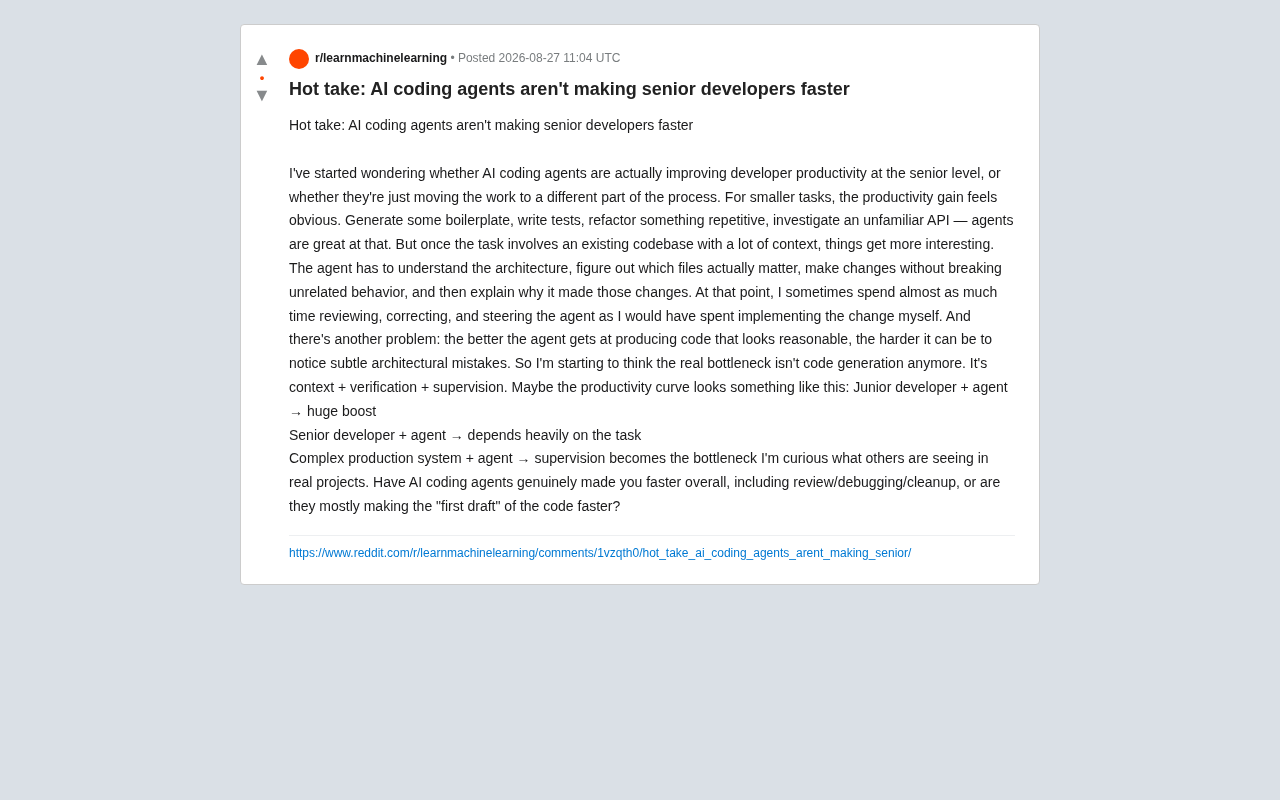
Do AI Coding Assistants Actually Boost Productivity for Senior Developers? The Truth About Bottleneck Migration
Do AI coding assistants truly boost senior developer productivity? This article reveals how productivity bottlenecks migrate from code writing to verification and supervision.

Heteropessimism: Why Modern Dating Feels Increasingly Hopeless
Heteropessimism is becoming a cultural phenomenon: women use self-deprecating humor about relationships with men, reflecting political regression, economic inequality, and emotional struggles.
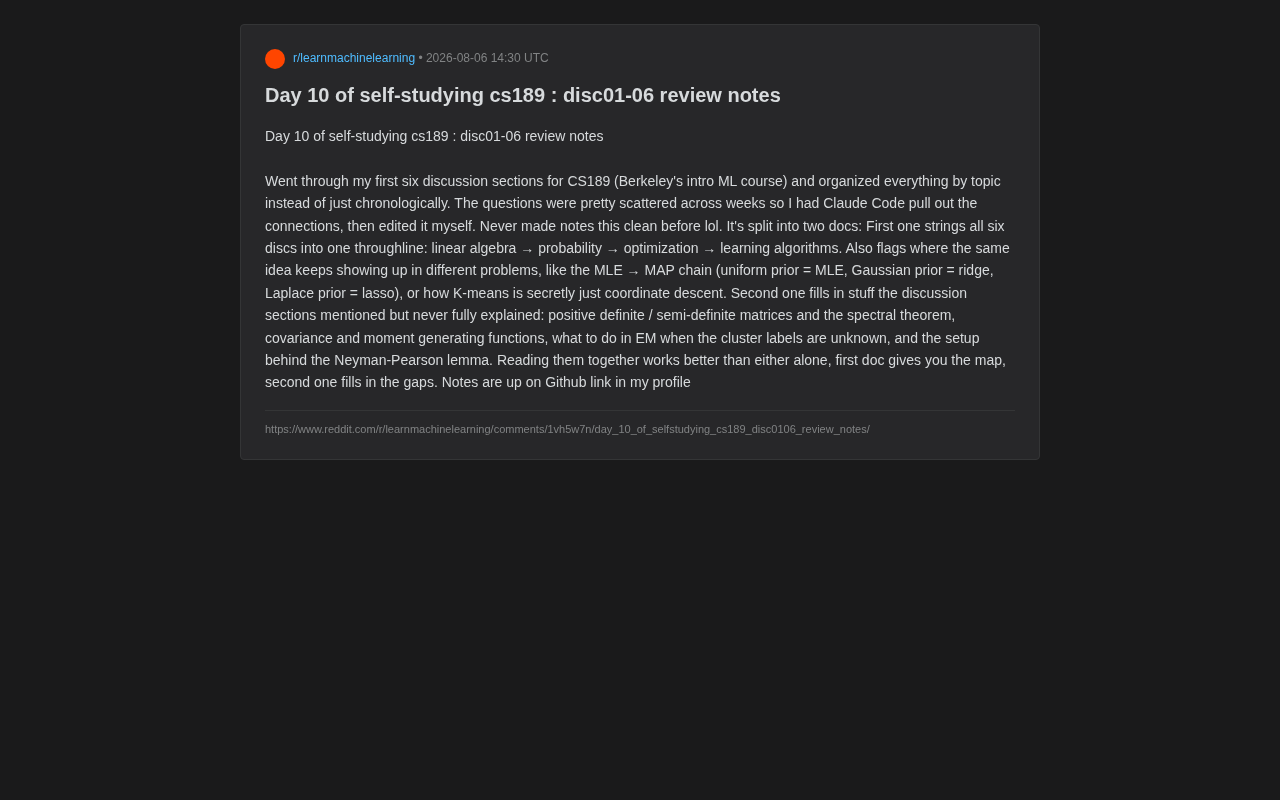
Organizing Machine Learning Notes with Claude Code: Self-Study Practices and Methodology for CS189
A self-learner uses Claude Code to restructure UC Berkeley CS189 machine learning notes by topic, using a dual-document approach to map knowledge connections and fill conceptual gaps.