GPT-5.6 Released: How AI Agents Are Moving from the Screen into the Physical World

GPT-5.6 shifts AI from talking to doing, bringing agents into the physical world with real deployments.
OpenAI's GPT-5.6 launch focuses on real-world impact rather than benchmarks—automating greenhouses via Raspberry Pi, turning brainstorms into deliverables for small businesses, and helping a mathematician disprove a three-year conjecture with Codex 5.6. Its multi-agent architecture and end-to-end autonomous execution mark AI's leap from talking to doing.
GPT-5.6's Core Highlights: Real-World Deployment, Not Just Benchmark Scores
OpenAI has officially released the GPT-5.6 model family. Unlike previous versions, the central narrative of this launch is no longer about benchmark scores or leaderboard rankings, but rather focuses on AI's practical applications in the real world. From farmers in Hokkaido, Japan, to an entrepreneurial couple in New York, to a mathematician in Poland, OpenAI showcased the boundaries of the new model's capabilities through a series of real user stories.
From Farm to Lab: Three Real-World Use Cases for GPT-5.6
Use Case One: AI-Driven Greenhouse Automation—The First Step into the Physical World
The most representative example comes from Hiroki, a farmer in Hokkaido. He used GPT-5.6 to automate the opening and closing of his greenhouse doors—the model not only told him what equipment to buy and how to wire up a Raspberry Pi, but also guided him through the entire motor installation process.
Bridging the Raspberry Pi and AI to the Physical World: The Raspberry Pi is a credit-card-sized single-board computer, originally launched by a UK charity in 2012 to make computer programming more accessible. Its low cost (typically $30-80), open-source ecosystem, and GPIO (General Purpose Input/Output) pin interface make it an ideal platform for connecting software with physical hardware. In Hiroki's case, the Raspberry Pi served as the intermediary layer between GPT-5.6's "brain" and the motor "actuator," receiving AI-generated control logic via Python scripts and driving a relay module to control the motor's opening and closing. This software-defined-hardware model is exactly the core paradigm of the Internet of Things (IoT)—sensors collect environmental data, controllers run decision logic, and actuators change physical states, together forming a complete automation loop.
Throughout the entire process, from zero-experience planning to actual implementation, the AI acted as a professional technical consultant, with the end result being an automation system that genuinely operates in the physical world.

This example shatters the long-held impression that large language models "can only generate text." By bridging hardware, sensors, and actuators, GPT-5.6 begins to have a direct impact on the real environment—precisely the crucial step for AI agents moving into the physical world.
Use Case Two: Turning a Five-Minute Brainstorm into Usable Deliverables, Empowering Small Entrepreneurs
Jake, founder of the cereal brand Three Wishes, demonstrated another use case: he first asked the model to "set a goal for itself to complete a task end-to-end," then instructed it to reference historical launch data and pull the brand's latest visual assets to automatically generate ready-to-use content.

Jake admitted that the input he gives the model is often "the messiest, most disorganized stream of thought," yet GPT-5.6 can transform this five-minute "brainstorm" into a clearly structured data dashboard, presentation, or spreadsheet.
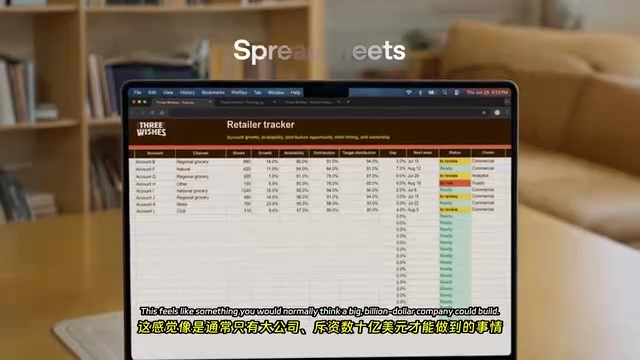
His assessment was striking: "This feels like something you would normally think a big billion-dollar company could build, and now we can have it too." GPT-5.6 is putting capabilities that once required professional teams and significant funding into the hands of individuals and small teams.
Use Case Three: Codex 5.6 Cracks a Three-Year Unsolved Math Problem
In the field of scientific research, GPT-5.6 also demonstrated groundbreaking performance. Polish mathematician Bartosz shared his experience: a mathematical problem that had puzzled him for three years took a turn after he used Codex 5.6—the model proposed a "completely new approach" that ultimately helped him disprove the very conjecture he had been trying to prove for the past three years.

From a technical standpoint, GPT-5.6 can break down complex prompts into multiple parallel workflows, with different AI agents each handling separate parts of the problem.
Multi-Agent Collaboration Architecture: Multi-agent systems are an architectural paradigm that has developed rapidly in the AI field over the past two years. The core idea is to break down a complex task into multiple subtasks, processed in parallel or in sequence by different AI agents, with a coordinator aggregating the results. Compared to the sequential reasoning of a single model, a multi-agent architecture can significantly reduce processing time and improve result reliability through mutual verification between agents. When handling mathematical proofs, Codex 5.6 might simultaneously deploy a code-execution agent, a literature-retrieval agent, and a reasoning-verification agent, each with its own role. The challenge of this architecture lies in the design of inter-agent communication protocols and task-scheduling strategies, which is also one of the core research directions in AI engineering today. The "debate" and cross-verification mechanisms between agents are especially critical in fields like mathematics that require rigorous logical deduction.
Core Capability Upgrade: From Repeated Communication to End-to-End Autonomous Execution
If the user experience of previous generations of models was characterized by "repeated communication, constant correction, and continuous instruction," then the most fundamental change in GPT-5.6 is a shift from passive response to proactive execution.
Hiroki's description captures it vividly: previous models required users to constantly communicate, refine, and give instructions; the new model, however, needs only a single prompt to read the relevant databases, call various tools, and accomplish the final goal on its own. In his words, the model "can think for itself and put things into action."
The Paradigm Shift from Prompt to Agent: Early large language models operated purely on a "prompt-response" loop: the user inputs a question, the model outputs text, and the user adjusts the next instruction based on that output—a mode that required users to have strong prompt-engineering skills. The core of the agent-based shift lies in introducing a closed loop of "planning—tool calling—feedback—iteration": the model can autonomously break down goals, select and call external APIs or tools (such as code interpreters, search engines, and databases), and dynamically adjust its strategy based on execution results until the goal is achieved. The technical foundations of this capability include Function Calling mechanisms, long context windows, and planning abilities trained via reinforcement learning—representing the fundamental leap of large models from "language tools" to "digital employees."
GPT-5.6 is no longer a question-and-answer tool, but an executor capable of understanding goals, autonomously planning steps, calling external tools, and seeing tasks through to completion. This end-to-end capability—"from prompt to finished product"—is exactly what sets it apart from its predecessors.
A Sober Perspective: Beyond the Potential, Verification Is Still Needed
Taken together, the launch of GPT-5.6 sends a clear signal: the value of AI is moving from the virtual to the real. Work output no longer stays confined to the screen, but begins to have a tangible impact on the physical world.
However, a rational assessment is equally necessary. This launch primarily featured carefully curated success stories, which showcase the upper limits of the model's potential—but whether ordinary users can consistently reproduce similar results remains to be tested through broader practice. While multi-agent autonomous execution brings efficiency, it also raises higher demands for the controllability and verifiability of results—especially in rigorous fields like mathematical proof, where the "new ideas" offered by AI must ultimately be strictly verified by human experts.
Regardless, GPT-5.6 marks an important leap for large models from "being able to talk" to "being able to do." When AI truly gains the ability to autonomously complete complex tasks, its reshaping of personal productivity and industry landscapes may only just be beginning.
Related articles

Workbuddy for Absolute Beginners: How a Desktop AI Agent Fits Into Real Workflows
A beginner's guide to the Workbuddy desktop AI agent: installation, claiming credits, file management, and building automated workflows—compared with CodeX for fit and cost, helping professionals shift from AI question-askers to AI managers.

OpenAI's New Agent Stack: Computer Use, Decisions API, and Ultra-Fast Workflows
OpenAI Dev Day unveiled a new agent stack: Computer Use outperforms humans, Decisions API delivers ultra-low-latency classification via Luna, Agents API opens the same Computer Use capabilities, and GPT-6.1 Sol costs only one-seventh of Astra. Core updates, benchmark data, and developer insights.

Liang Wenfeng Open-Sources DeepInfo Inference Framework, Takes On U.S. Ban
DeepSeek open-sources its DeepInfo inference framework after its models, featuring GPU/CPU cross-pipelining, small-model prediction with large-model verification, and full Huawei Ascend and NVIDIA chip support—facing the U.S. federal ban head-on. This article analyzes its significance for AI deployment and open-source strategy.