GPT-5.6 Sol Ultrafast: A Deep Dive into LLM Inference Acceleration Techniques

How LLM inference acceleration techniques are reshaping the race from model capability to deployment efficiency.
As LLM capabilities plateau, the industry focus shifts to inference speed and cost. This article dissects key acceleration techniques behind variants like GPT-5.6 Sol Ultrafast — including quantization, knowledge distillation, MoE, speculative decoding, KV Cache optimization, and operator fusion — and explores how these engineering optimizations are becoming as critical as model intelligence itself.
Introduction: When Inference Speed Becomes the Core Competitive Advantage
As large language models approach practical capability ceilings, the competitive focus in the industry is shifting from "how smart is the model" to "how fast and cheap is it." The recent "Accelerating GPT-5.6 Sol Ultrafast" topic that sparked heated discussion on Hacker News (390 upvotes, 157 comments) is a prime example of this trend.
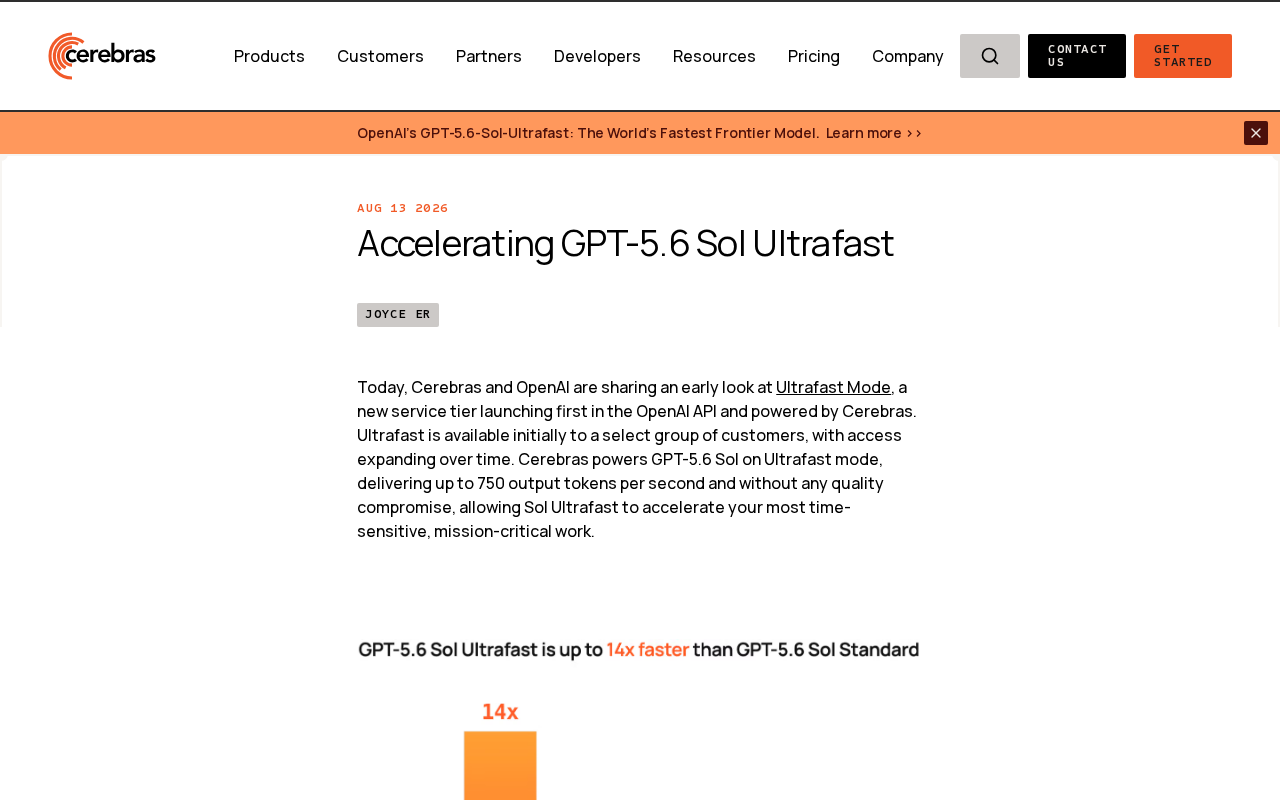
GPT-5.6 Sol Ultrafast refers to a class of model variants optimized for ultra-low latency scenarios. Unlike flagship versions that pursue maximum accuracy, these "Ultrafast" variants prioritize compressing Time To First Token (TTFT) and per-token generation time to their absolute limits while maintaining acceptable quality.
It's worth explaining these two key metrics: Time To First Token (TTFT) is the time interval between a user sending a request and the model outputting its first token. It's primarily constrained by the time the model spends in the prefill phase processing the input prompt — the longer the prompt, the higher the TTFT typically is. Time Per Output Token (TPOT) measures the speed at which the model generates tokens one by one during the autoregressive decoding phase, directly determining how fast text "streams out" and how smooth the reading experience feels. In practice, reducing TTFT relies more on parallelization and compute acceleration during the prefill phase, while reducing TPOT involves memory bandwidth optimization and batching strategies during the decoding phase — the two optimization paths don't fully overlap.
What lies behind all this is an inescapable reality in the commercialization of large models.
Why Inference Speed Matters More Than Model Capability
The Tipping Point for User Experience
For interactive applications, latency is the most direct experience killer. Research consistently shows that once response latency exceeds a certain threshold, users' perception of waiting increases dramatically, which in turn impacts retention and willingness to pay. For use cases like voice assistants, real-time code completion, and customer service chatbots, the marginal return of making models "smarter" is diminishing, while the marginal return of making them "faster" remains significant.
The Dual Pressure of Cost and Throughput
From the service provider's perspective, inference speed directly correlates with hardware utilization and per-request cost. A faster model means serving more concurrent users on the same GPU resources, or handling the same traffic with less hardware. In today's landscape of tight compute availability and high GPU prices, every incremental improvement in inference efficiency translates into substantial economic value. This is the fundamental driver behind why major providers are rolling out variant lines like "turbo," "flash," "mini," and "ultrafast."
Core Technical Approaches to Inference Acceleration
Model-Side Optimizations
Achieving "Ultrafast"-level inference acceleration typically isn't about a single technique but a combination of methods. Common approaches include:
-
Quantization: Reducing model weights from FP16 to INT8 or even lower precision, dramatically cutting memory usage and computation. The core value of quantization is that lower bit-widths mean smaller model footprints, higher memory bandwidth utilization efficiency, and greater compute throughput on hardware that supports low-precision operations. Common quantization methods include Post-Training Quantization (PTQ) and Quantization-Aware Training (QAT). PTQ applies quantization directly after training is complete — it's simple to implement but may incur accuracy loss. QAT simulates quantization effects during training, allowing the model to learn to adapt to low-precision representations, generally achieving better quality preservation. Recent techniques like GPTQ, AWQ, and SmoothQuant have enabled large models to maintain near-original accuracy even at INT4 quantization, drastically reducing the quality cost of quantization.
-
Distillation: Using a large model as a teacher to train a smaller student model, preserving as much capability as possible while significantly reducing parameter count. Knowledge distillation was proposed by Geoffrey Hinton and colleagues in 2015. The core idea is that the student model learns not only from standard hard labels (i.e., the correct answers) but also from the teacher model's soft labels — the probability distributions over all possible outputs. These soft labels contain the teacher model's implicit knowledge about similarities and relationships between different answers, providing richer learning signals than hard labels alone. In the LLM domain, a 70-billion-parameter teacher model can guide the training of a 7-billion-parameter student model that, despite having only one-tenth the parameters, may retain 80-90% of the capability on most tasks while achieving several-fold inference speedups.
-
Sparsity and Mixture of Experts (MoE): Reducing actual compute cost per inference by activating only a subset of parameters. The core idea behind MoE is replacing the model's feed-forward network layers with multiple "expert" sub-networks and using a gating mechanism to activate only a few experts per inference step. For example, Mixtral 8x7B has a total parameter count of approximately 46.7 billion, but only activates about 13 billion parameters per inference, giving it inference speeds comparable to dense models with equivalent active parameters while benefiting from the knowledge capacity of a much larger total parameter count. Key challenges with MoE include training stability, expert load balancing, and the memory footprint issues caused by the large total parameter count.
System-Side Engineering Optimizations
Beyond the model itself, engineering optimizations in the inference system are equally critical:
-
Speculative Decoding: A small model "races ahead" to generate a draft, which the large model then batch-verifies, boosting throughput without sacrificing quality. This technique draws inspiration from branch prediction in CPUs. The specific workflow is: first, a lightweight draft model quickly generates 3-8 candidate tokens, then these candidates are sent to the large model for parallel verification in a single pass. Thanks to the Transformer architecture's properties, the large model can verify predictions at multiple token positions in one forward pass. If the draft model's predictions match the large model's, these tokens are directly accepted — effectively letting the large model generate multiple tokens in one step. Crucially, this method guarantees that the final output's probability distribution is identical to that of using the large model directly, making it a strictly lossless acceleration. In practice, it typically delivers 2-3x speedups.
-
KV Cache Optimization and PagedAttention: More efficient management of attention caches to reduce memory fragmentation and improve batching capability. KV Cache is a core optimization in Transformer autoregressive decoding: by caching previously computed Key and Value vectors, each decoding step only needs to compute attention for the new token, reducing complexity from quadratic to linear. However, KV Cache memory usage grows linearly with sequence length and number of concurrent requests, potentially consuming tens of gigabytes of memory in long-context scenarios. PagedAttention was proposed by UC Berkeley's vLLM team in 2023, borrowing the virtual memory paging concept from operating systems. It splits the KV Cache into fixed-size "pages" that are dynamically allocated on demand, avoiding the memory fragmentation and waste caused by pre-allocating contiguous memory. Experiments show that PagedAttention can push memory utilization close to 100%, increasing serving throughput by 2-4x. vLLM has since become one of the de facto standards for LLM inference serving.
-
Operator Fusion and Compilation Optimization: Reducing scheduling overhead through custom CUDA kernels and graph compilation. In standard neural network execution, each mathematical operation (e.g., matrix multiplication, layer normalization, activation function) typically corresponds to an independent GPU kernel call, each involving launch overhead and memory read/write operations. Operator fusion merges multiple consecutive operations into a single custom kernel, reducing the number of intermediate result round-trips to memory. Graph compilation optimizes at a higher level — typical tools include NVIDIA's TensorRT, PyTorch's torch.compile, and XLA, which generate highly optimized execution code tailored to the specific characteristics of the target hardware, typically delivering 30%-100% inference speedups without changing model logic.
The stacking of these techniques makes it possible to "achieve several-fold acceleration while maintaining near-flagship quality." The high level of attention from the Hacker News community also demonstrates that the engineering world's interest in these deployment-oriented optimizations has become just as intense as the pursuit of model capabilities themselves.
Industry Sentiment Reflected in Community Discussion
Across the 157 comments, discussions consistently revolved around several recurring themes: whether acceleration comes at the cost of quality, whether naming conventions confuse users, and cross-vendor comparisons of different approaches.
Interestingly, "version number inflation" has become a frequently complained-about phenomenon. From GPT-4 to various decimal-point iterations, and then to suffixes like turbo/flash/ultrafast, the increasing complexity of naming has to some extent blurred users' understanding of actual model capabilities and positioning. This serves as a reminder to the industry: as technology evolves rapidly, clarity in product naming and positioning is equally important.
Conclusion: The Dawn of the LLM Efficiency Era
The surge of interest in topics like GPT-5.6 Sol Ultrafast signals that the LLM industry has officially entered a new "efficiency-first" phase. As capability improvements plateau, whoever can deliver "good enough" intelligence at lower latency and lower cost will gain the upper hand in the race toward scaled deployment.
For developers and enterprise users, understanding the speed-quality-cost tradeoffs across different model variants and making informed choices based on specific use cases will become an increasingly important skill. The future competition may no longer be about "who has the most powerful model," but rather "whose model is best suited to actually be put to use."
Related articles

Chain of Thought Isn't Just for AI: How Humans Can Use CoT to Improve Thinking Quality
Chain of Thought isn't just a prompt trick for large models. Starting from a Hacker News discussion, this article analyzes why CoT works for human thinking too, breaks down actionable ways to transfer it, and highlights the key differences between human CoT and machine CoT.
Cloudflare Teams Up with OpenAI: Closi…
Cloudflare Teams Up with OpenAI: Closing the Loop from Vulnerability Discovery to Defense with AI
Cloudflare uses OpenAI Daybreak to investigate security vulnerabilities and generate reviewable remediation plans, while developers use Codex to boost coding efficiency and quality.

Orca Multi-Agent Orchestration in Practice: A Guide to Parallel Collaboration with Claude and Codex
Orca is Stable AI's free open-source agent workbench supporting 34 agents like Claude Code and Codex in parallel. Learn its Git worktree isolation, multi-model orchestration, and mobile management.