GPT-5.6 Three-Model Showdown: Sol vs Terra vs Luna — Which One Should You Pick?

GPT-5.6's three models compared: Sol for peak performance, Terra for balance, Luna for budget tasks.
OpenAI's GPT-5.6 release introduces three models — Sol, Terra, and Luna — targeting different performance and cost tiers. Official benchmarks show Sol sets new SOTA on coding and agentic tasks at a fraction of the cost of competing models, while Terra offers near-flagship performance at half the price. A real-world game generation test confirms Terra as the best all-rounder, Sol as the detail king, and Luna as best suited for lightweight use only.
GPT-5.6 Launches Three Models at Once
OpenAI didn't go with a single flagship this time — instead, they dropped three models simultaneously: Sol, Terra, and Luna. The names map to the Sun, Earth, and Moon respectively, using celestial bodies to signal performance tiers. It's a nod, intentional or not, to the Anthropic naming tradition.
This naming system isn't just marketing. Anthropic's Claude series uses Japanese poetic forms (Haiku, Sonnet, Opus) to differentiate tiers; Google's Gemini uses gemstones. OpenAI's Sol-Terra-Luna system similarly signals to developers: "use the right tool for the right task." Behind the names are real architectural differences — including distillation ratios, maximum reasoning steps, and context window sizes.
The central theme of this release is cost-efficiency — maintaining or improving performance while significantly cutting inference costs and latency. This is a clear departure from previous generations' "just stack more performance" approach, signaling that the LLM competition is shifting from "who's stronger" to "who's more economical."
There's solid market logic behind this shift. Since ChatGPT exploded onto the scene in 2022, LLM competition has gone through three distinct phases: the parameter scale race (GPT-3 to GPT-4), multimodal capability expansion, and the current focus on inference efficiency. Now that the capability gap between top models has narrowed to the point where most users can't perceive a difference, API call costs and response latency have become the deciding factors for enterprise procurement and developer tooling decisions. In a coding assistant scenario, for example, a mid-sized SaaS company might spend tens of thousands of dollars per month on model API calls — a 75% reduction in inference cost translates directly to margin.
This article combines official benchmark data with hands-on testing from Bilibili creator 麦东 to help you understand the real differences between the three models and make a smart selection decision.
Official Benchmarks: Higher Performance, Lower Cost
Long-Horizon Agentic Workflows (Engines Last Exam)
This benchmark evaluates model performance on long tasks and agentic workflows, with cost on the x-axis and score on the y-axis. GPT-5.6 Sol tops the chart with a score of 53.6, beating the reference model Faber-5 by 13.1 points.
Engines Last Exam (ELE) is fundamentally different from traditional single-turn Q&A benchmarks — it's designed specifically for agent scenarios. Agentic workflows require multi-step planning, tool use, self-correction, and long-term context retention, often demanding dozens or even hundreds of rounds of model inference. Token consumption in these tasks can be many times higher than in standard conversations, which is why cost appears as a standalone axis in this benchmark — in long-task scenarios, "total cost to complete one task" is more meaningful than "price per call."
The cost story is even more compelling: at medium reasoning intensity, Sol costs roughly 1/4 of Faber-5; Terra and Luna are even more extreme at around 1/16 the cost, while still outscoring Faber-5. The lighter tiers have an enormous cost advantage in long-task scenarios.
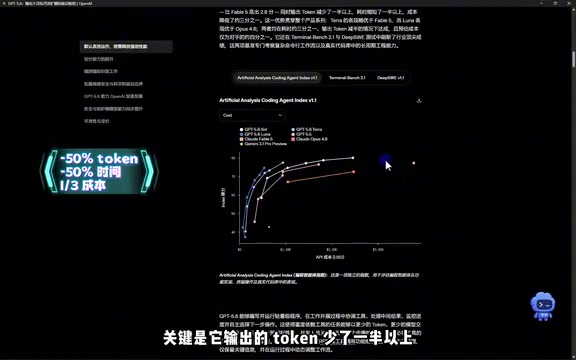
Coding Agent Index
This metric evaluates models on feature implementation, terminal operations, and bug fixing. Sol hits 80 points in full reasoning mode, setting a new SOTA (State of the Art) — 2.8 points above Faber-5.
The Coding Agent Index typically covers three sub-dimensions: feature implementation (can the model write runnable code from requirements?), terminal operations (can it invoke CLI tools, run scripts, and handle output?), and bug fixing (can it analyze error messages and auto-correct code?). The combination of these three capabilities directly determines how usable an AI is in automated software development pipelines.
The efficiency angle is key: Sol outputs more than 50% fewer tokens and costs roughly 1/3 as much. For developers who rely on AI for coding or building agentic systems, "higher scores + fewer tokens" is a high-value combination — coding tasks are notoriously token-hungry, since code generation requires extensive context and complete function bodies, consuming far more tokens than typical conversations.
General Intelligence Index
The General Intelligence Index is composed of 9 independent evaluations covering agentic work, coding, scientific reasoning, general capability, and more. Sol is nearly on par with Faber-5, trailing by only 1 point, but task completion time is reduced by ~61% and cost is cut roughly in half.

One-line summary of the official data: performance stays in the top tier while speed and cost both drop significantly.
Sol, Terra, Luna: How to Choose?
Based on positioning and testing, here's how to think about the three models:
Sol — Peak Performance
Sol is the most capable of the three, with a clear improvement over the previous GPT-5.5. It's built for complex coding, heavy agentic applications, and long-horizon tasks. Priced on par with GPT-5.5, it's the go-to for users who want to squeeze out every bit of performance.
Terra — The Balanced Champion
Terra's performance approaches or slightly exceeds GPT-5.5, at roughly half the price. For everyday medium-to-high-intensity use cases, this is the most recommended option — it hits the sweet spot between capability and cost.
Luna — Maximum Value
Luna is the fastest and cheapest of the three, with overall performance slightly below GPT-5.5 and Terra. It's better suited for casual conversation and lightweight tasks. When budget is tight and the task isn't complex, Luna is the optimal choice.
Real-World Test: Neon City Racing Game — Four-Way Showdown
To evaluate real-world performance, the creator used the same prompt to have all three new models build a "Neon City Racing" game, with GPT-5.5 included as a baseline, creating a four-way comparison.
Using "generate a playable mini-game" as a cross-model benchmark is a well-regarded informal testing method in the AI evaluation community. Unlike multiple-choice standardized tests, game generation tasks simultaneously stress-test multiple capabilities: logical consistency (collision detection, scoring systems), spatial reasoning (steering, acceleration physics simulation), code runnability (correct syntax, complete dependencies), and detail completion (sound effects, visual effects). This kind of "black-box stress test" can reveal real weaknesses that benchmarks tend to mask.
GPT-5.5 (Baseline)
Road and background effects are decent. Acceleration, nitro boost, and drifting work as expected. The main issue is sluggish gear changes — you need to switch lanes well in advance to avoid obstacles, and it doesn't always work. Overall, it meets a "playable" standard.
Luna: Noticeable Logic Flaws
Luna's visuals are relatively weak, but the bigger issue is inverted steering logic — pressing left steers the car right. Turning speed is slower than GPT-5.5, and drifting doesn't trigger properly. Technically, this type of error stems from a coordinate axis direction confusion — a classic sign of insufficient spatial reasoning rather than random code noise. As the lowest-priced tier, this result is within expectations, but it confirms Luna isn't suitable for complex generation tasks.
Terra: Best Playability
Terra's scene detail is slightly less polished than GPT-5.5, but it proactively adds environmental elements (a falling snow or rain effect). The real highlight is the controls — steering precision is noticeably better than the previous two, and the drift effect is smooth and satisfying. Overall, it delivers the most exciting and fun driving experience.

Sol: Most Complete in Detail
Sol is the only one of the four with sound effects — you can hear the engine roar, with volume that scales with acceleration. Environmental details are the most refined: roads, backgrounds, and rain all have texture, and the nitro and drift effects are excellent. The only minor downside is that steering precision is slightly below Terra, though still far better than GPT-5.5 and Luna.

Final Assessment and Selection Guide
Based on the combined test results, the capability ranking is: Sol > GPT-5.5 > Terra > Luna.
Notably, Terra ranks close to GPT-5.5 on benchmarks, but in this specific game task, GPT-5.5 actually edged it out on completion quality — while Terra won on "playability" thanks to better controls and environmental detail. This is a reminder: benchmark rankings don't equal real-world performance across all scenarios. Standardized benchmarks capture statistically averaged capability, while actual business use cases often have different distributions of requirements — which is exactly why hands-on developer testing is just as important as official data.
On pricing: Sol is on par with GPT-5.5, while Terra and Luna are considerably cheaper. Here's the bottom line:
- Pushing for maximum performance, complex development work → Sol
- Everyday primary use with good cost efficiency → Terra
- Lightweight tasks, mostly chatting → Luna
The biggest value of the GPT-5.6 update isn't raising the performance ceiling — it's bringing down the price and time cost required to achieve equivalent performance. For most developers and everyday users, a "balanced" option like Terra may be the model that genuinely changes how people work. Tools will keep iterating, but choosing the right model for your actual use case remains the most important judgment you can make.
Key Takeaways
Related articles
ChatGPT Space Launches: Team Collaboration and New Pages Features Explained
ChatGPT Space is OpenAI's new team collaboration feature with Pages, real-time collaboration, and Slack/Google Drive sync. We break down its privacy design, multi-platform integration, and the full workflow from conversation to document.

Migrating Apache Spark UDFs to GPU Acceleration with AI Agents
NVIDIA developer blog explains how AI Agents rewrite Apache Spark UDFs for GPU acceleration, covering migration criteria, agent rewriting and verification workflows, plus pitfalls like result consistency and CPU-GPU transfer overhead.
Zed Editor v0.40.4-rc2 Released: Usage Credits Now Available Without Upgrading
Zed editor releases v0.40.4-rc2, allowing users to use usage credits for AI features without upgrading to a paid plan, lowering the trial barrier.