GPT-6.1 Sol Early Testing: Performance Rivals Astra at Sonnet-Level Pricing

GPT-6.1 Sol delivers near-top-tier performance at Sonnet-level prices, excelling at code review but lagging on long rewrites.
OpenAI released GPT-6.1 Sol just one week after GPT-6 Sol, pricing it at $2/M input tokens with dramatically reduced cache read fees. It scores close to Astra on DeepSWE and claims the Terminal Bench 4 top score. Its biggest improvement over Astra is stability — reliable enough for the reviewer to trust with wire transfers. It outperforms Sonnet on code review and root cause analysis in both quality and cost, but falls clearly behind Opus 5.5 on long, unattended rewrites. The reviewer recommends pairing both models and warns that the aggressive pricing may signal the end of the AI API subsidy era.
An Unexpected Model Iteration
Just one week after Anthropic's Opus 5.5 sent shockwaves through the industry, OpenAI quietly released both GPT-6 Sol and GPT-6 Luna — to a muted reception. What actually turned heads was GPT-6.1 Sol, which slipped out shortly after: a model that's absurdly cheap yet surprisingly capable. According to the reviewer who got early access, GPT-6.1 Sol arrived just one week after GPT-6 Sol — an unusually short gap between a .0 and .1 release.
That abnormal gap is itself a signal. The reviewer puts it plainly: 6.1 Sol "probably was never meant to be called 6.1 Sol" — it's noticeably smarter than GPT-6 Sol, and noticeably slower to generate tokens (which typically indicates a larger model). All signs point to this being a fundamentally different model, not a minor patch.
Performance: Approaching Astra, Exceeding Expectations
On Terminal Bench 4 — a benchmark the reviewer describes as "insane" — GPT-6.1 Sol claimed the current state-of-the-art score. Even more notable is its DeepSWE performance: at both low and high budget settings, 6.1 Sol scores close to Astra's high-budget results, but at a fraction of the cost.
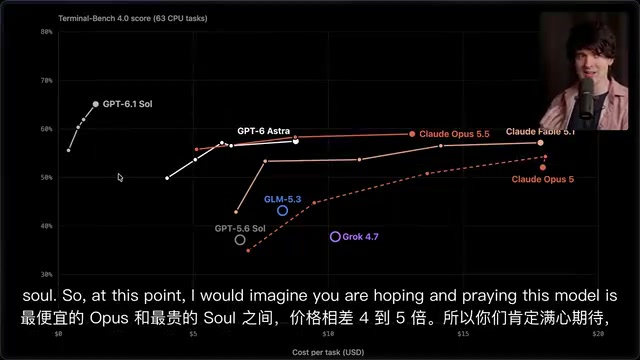
The price comparison is striking: a single low-budget DeepSWE run costs $0.21 with 6.1 Sol, versus $1.46 for Astra at the same setting, and $14.65 for Opus 5.5 at max settings to hit a comparable score. The reviewer acknowledges that DeepSWE is far from a perfect proxy for real-world coding ability, but the fact that "6.1 Sol scores close to Astra's high-budget results" is hard to ignore.
In practical per-task costs, 6.1 Sol tops out around $1.38, while even the cheapest Opus 5.5 runs cost $5.12 — a 4–5× gap.
DeepSWE is a benchmark specifically designed to evaluate AI models on software engineering tasks, requiring models to autonomously fix bugs and implement features in real codebases, measured by pass rate. Its "low/high budget" settings refer to different inference budget or maximum step configurations: the low setting constrains the model's reasoning steps and tool calls, reducing cost but limiting exploration; the high setting lifts those constraints, enabling deeper multi-step reasoning at higher cost. Terminal Bench 4 is an evaluation suite focused on complex task automation in command-line environments, covering scenarios that involve system tool calls, file handling, and multi-step operations — widely considered a demanding test of real-world engineering deployment capability. Both benchmarks are grounded in realistic development workflows, making them more reflective of production-environment usability than pure math or QA-style tests.
What the Pricing Says About the Business
GPT-6.1 Sol is priced at $2 per million input tokens and $10 per million output tokens — on par with GPT-6 Sol, and one-fifth of Astra's price. But the real kicker is the cache read pricing: cut from the usual 10% of standard input price (i.e., $0.20) down to $0.10, effectively halving the cache cost and pushing the discount from 90% to 95%.
The reviewer notes this may be the first time OpenAI has changed its cache read pricing logic. Since roughly 96% of tokens in real-world agentic workloads are cache reads, this change makes the model "absurdly cheap" for practical coding use cases.
A deeper signal comes from shifts in subscription policy — the $200 Pro plan is back, but with a new usage calculation that effectively cuts the API quota to half of the old plan's value. The reviewer speculates this may mark the end of the subsidy era: the old $200 Codex plan reportedly delivered over $12,000 worth of usage. As new models launch and margins compress, OpenAI's ability to subsidize usage is declining. Industry rumor pegs these models' gross margins at 95%, yet they're now voluntarily cutting into their own margins.
Cache Read is a billing optimization mechanism in large language model APIs: when the same context (such as a system prompt or a large codebase) appears across multiple requests, the provider caches it so subsequent calls read from cache rather than reprocessing it, and charges at a lower "cache read" rate instead of the full input token price. For agentic workflows, where every step carries the full history and tool definitions, cache hit rates are extremely high — the reviewer notes roughly 96% of real-world workload tokens are cache reads, meaning the vast majority of tokens in actual bills are charged at the cache rate. Cutting the cache read price from 10% to 5% of standard input pricing compresses the real per-agent-step cost to roughly one-twentieth of the list price, which explains why 6.1 Sol is "absurdly cheap" in real coding workflows — the headline rate doesn't reflect what developers actually pay.
Spikiness Mostly Fixed, But Peak Still Below Astra
The reviewer's biggest complaint about GPT-6 Astra wasn't that it wasn't smart enough — quite the opposite. Astra was smarter than Anthropic's top models in many respects. The problem was that it was "both smart and stupid," capable of dropping into "the dumbest mistakes I've seen all year" without warning. That unpredictable spikiness ultimately drove the reviewer to nearly abandon it.

6.1 Sol has "largely" solved this: stability is significantly improved, and while its peak doesn't hit Astra's "revolutionary 3D capabilities," it's reliable enough to trust. The reviewer even let it handle all their email, identify unpaid invoices, and open Chrome tabs for each investment with the relevant details pre-filled — "not a single error," and it even caught items the reviewer would have missed. "I genuinely trust this model to wire funds on my behalf."
Feedback from other testers reinforces this: Julius called it "incredible," Ben called it "incredibly boring" — and for this kind of model launch, "boring" is the highest praise.
The "spikiness" the reviewer refers to describes highly inconsistent output quality: the model performs brilliantly at times, then makes elementary mistakes on trivially simple tasks, with no predictable pattern. This is categorically different from having a lower average capability — a slightly weaker but highly consistent model is far more usable in production, because engineers can establish clear expectations and design appropriate verification mechanisms. A model that occasionally produces catastrophic failures forces users to manually review every output, effectively negating the efficiency gains of automation. For unattended agentic pipelines, spikiness is especially dangerous — a single bad tool call can trigger cascading failures that only surface dozens of steps later as irreversible actions.
Good at Review, Weak at Implementation
6.1 Sol demonstrates the classic OpenAI "Rottweiler" digging instinct — latching onto a problem and worrying at it until every flaw is found. On a code review task auditing Orchestrator V2, its performance nearly matched Astra's at half the cost ($2.97 vs. $5.84). On a T3 Code improvement task, it scored 87.4 — above Astra's 83.8 — at just $2.15, compared to $5 for Opus 5.5 and nearly $9 for Sonnet 5.5.
Efficiency is a key differentiator: 6.1 Sol averages around 110K input tokens per request, versus 360K for Sonnet 5 — less than a third of the input token usage. The reviewer even had Opus 5.5 evaluate the model blind; Opus described it as "frontier-level for scoped work" and guessed the pricing at $5 per million input tokens. When told the actual price was $2, Opus called it "very aggressive pricing."
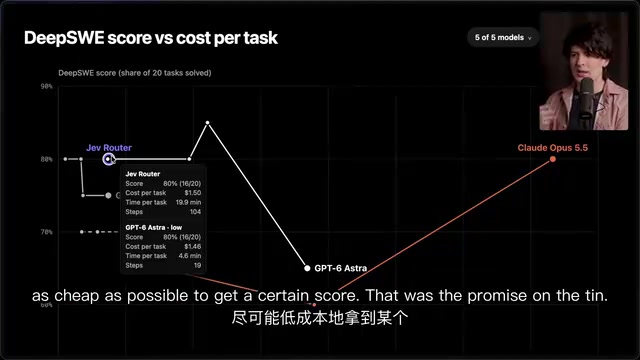
But the weaknesses are equally clear: on heavy, long-running unattended rewrites, 6.1 Sol "will stick rigidly to process rules even when making no progress, and won't ask for help." The reviewer's months-long, hundreds-of-thousands-of-tokens TS-to-Rust migration project stumped 6.1 Sol, Astra, and 5.6 Sol alike — Opus 5.5 rewrote it from scratch overnight. On long-horizon, heavy-rewrite tasks, "Anthropic is miles ahead."
Fish Slop Test: Stunning Graphics, Terrible UI
In the reviewer's signature "Fish Slop" game generation test, 6.1 Sol showed a contradictory profile. The 3D graphics were "stunning" — fish models, submarines, propellers, and aquatic plants all rendered with far more detail than the Sonnet version. But gameplay feel was noticeably worse, frame rates were lower, and the model plastered over twenty instances of completely unnecessary UI copy (things like "catch your breath" and "your little world can wait").

"This model has unacceptably bad taste in UI... it has no taste, you have to bring your own." That said, it excelled at Blender modeling — given a screenshot and asked to build a 3D model via CLI, it delivered. Given that the entire game generation cost roughly $5, the reviewer sees this as a sign that "game development is about to be turned upside down," as models are finally beginning to understand three-dimensional space and the associated toolchains.
Verdict: An Excellent Complement, Not Yet the New Primary
The reviewer's final take is clear: 6.1 Sol is a "damn good model" at a remarkable price, and it can easily become your default coding model. It has almost entirely replaced Sonnet in the reviewer's workflow — "I have basically no reason to use Sonnet anymore." But it's not ready to displace Opus 5.5 as the primary daily driver: Opus is a more enjoyable collaborator and clearly stronger at continuously implementing code without getting stuck.
The ideal setup is using both in tandem — Opus 5.5 for implementation and long-horizon construction, 6.1 Sol for review, root cause analysis, codebase investigation, and task triage. The reviewer has already configured their Cloud Config so Opus can call Sol to review its own work.
One lingering concern is worth every developer's attention: these "stunning prices" may signal the beginning of the end of the subsidy era. OpenAI voluntarily cutting into its own margins and restructuring subscription calculations both hint that the "extreme value-for-money" on models like this may not last.
Related articles

Chain of Thought Isn't Just for AI: How Humans Can Use CoT to Improve Thinking Quality
Chain of Thought isn't just a prompt trick for large models. Starting from a Hacker News discussion, this article analyzes why CoT works for human thinking too, breaks down actionable ways to transfer it, and highlights the key differences between human CoT and machine CoT.
Cloudflare Teams Up with OpenAI: Closi…
Cloudflare Teams Up with OpenAI: Closing the Loop from Vulnerability Discovery to Defense with AI
Cloudflare uses OpenAI Daybreak to investigate security vulnerabilities and generate reviewable remediation plans, while developers use Codex to boost coding efficiency and quality.

Orca Multi-Agent Orchestration in Practice: A Guide to Parallel Collaboration with Claude and Codex
Orca is Stable AI's free open-source agent workbench supporting 34 agents like Claude Code and Codex in parallel. Learn its Git worktree isolation, multi-model orchestration, and mobile management.