GPT-6.1 Sol Hands-On: Can It Beat Claude Sonnet 5.5 at the Same Price?

GPT-6.1 Sol matches Sonnet 5.5's price but trades 3D game quality for superior speed and token efficiency.
OpenAI's GPT-6.1 Sol, launched at Developer Day, matches Claude Sonnet 5.5's exact pricing ($2/$10 per million tokens). Bijan Bowen's hands-on tests show it falls short of Sonnet 5.5 in 3D game generation and character modeling, but excels at static scene modeling (Seinfeld apartment, RuneScape UI) and demonstrates strong visual comprehension. It's notably faster and far more token-efficient — consuming just 3% of a $200 allowance across extensive high-tier testing. A robotic arm failure was handled with surprising grace. Its true strengths may lie in edge device and low-level software domains yet to be explored.
OpenAI unveiled the new GPT-6.1 Sol model at its developer day, and tech blogger Bijan Bowen put it through a comprehensive series of tests right away. The model's biggest selling point is that OpenAI claims it approaches the intelligence level of its current flagship Astra — at just one-fifth the price. This article summarizes GPT-6.1 Sol's real-world performance on 3D modeling and game generation tasks based on Bijan's full testing process, with a side-by-side comparison against Claude Sonnet 5.5, which had launched just the day before.
Pricing and Specs: A Direct Shot at Sonnet 5.5
GPT-6.1 Sol is priced at $2 per million input tokens and $10 per million output tokens — identical to Anthropic's Claude Sonnet 5.5. In other words, OpenAI is going head-to-head with Sonnet on price using a flagship-tier model.
On the specs side, the model features a context window exceeding one million tokens, a maximum output of 128k tokens, a knowledge cutoff of April 30, and support for text and image input modalities. Despite being only a 0.1 version bump from the previous GPT-6 Sol, it delivers a noticeable capability improvement.
The tester highlighted an interesting observation: on the DeepSWE benchmark, the model performed best at the high reasoning tier — not the higher max or ultra tiers. This confirms a recent industry pattern where greater reasoning intensity doesn't always produce better results, sometimes causing the model to "do more than what the benchmark measures" and lose points.
DeepSWE is a benchmark specifically designed to evaluate LLMs on software engineering tasks, testing their ability to complete end-to-end programming work in real codebases — including understanding requirements, modifying code, and running tests. Reasoning tiers (such as fast, high, max, and ultra) are compute-scaling mechanisms offered by OpenAI and others for reasoning models — the higher the tier, the more "thinking steps" the model takes before generating an answer, theoretically better suited for complex problems, but at the cost of higher latency and token usage. The fact that high outperformed max/ultra reflects a nonlinear return on reasoning: over-reasoning can cause the model to drift from the task goal, leading to lower scores in strict automated evaluation frameworks that penalize off-target responses.
3D Game Generation: The Pool Party Test Falls Short
One of the core test tasks was the newly introduced "Backyard Pool Party" prompt, which required generating a 3D diving game using Blender and Godot. Because this was a brand-new prompt, there was no chance the model had seen it before, ruling out any benchmark-gaming concerns.
The results were underwhelming. Bijan ran the test twice — once in ultra+fast mode and once in pure max mode — and fully cleared all system caches each time to ensure no residual results from prior runs. Both outputs were nearly identical, and the visual quality was noticeably worse than what Claude Sonnet 5.5 had produced just a day earlier — particularly in character modeling. He put it bluntly: "Compared to Sonnet, it got dragged across the floor."
That said, he also highlighted a clear strength: speed. Compared to Sonnet's runs that sometimes took two hours, GPT-6.1 Sol delivered results quickly even at its highest reasoning tier — a non-trivial engineering advantage.
Blender is a professional open-source 3D modeling and rendering tool, while Godot is an open-source game engine. Together, they represent a complete pipeline from asset creation to game execution. Asking a model to simultaneously wield both tools and produce a runnable 3D game involves Python/GDScript scripting, scene graph management, physics collision configuration, and more — far beyond simple code generation. The tester cleared the cache to prevent certain inference services from reusing intermediate results within the same session, ensuring the two runs were completely independent and validating the model's genuine generative capability rather than a cache hit.
Halo OS and Multiple Games: Competitive but Not Impressive
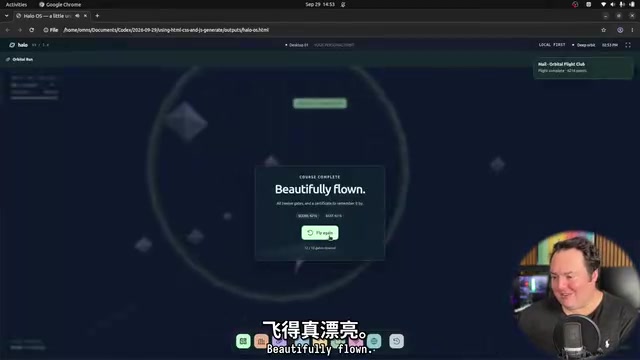
For "browser OS"-style tasks, the model generated a desktop environment called Halo OS, complete with a command center, file manager, adjustable wallpapers, and random seed features. Notably, it deliberately omitted a right-click context menu — interpreted as behavior designed to avoid looking like it was "playing to the benchmark."
Across the various games tested afterward, Orbital Run received the highest praise. Details like audio pitch rising with speed, an email app that could launch the game, and a post-flight status report all landed well. The tester also noticed an interesting convergence phenomenon across models from different vendors: independently, multiple models chose to link an email app to in-game functionality.
Skateboarding Game Replay Feature: A Standout Moment
The self-contained C++ skateboarding game test incorporated a new audience-suggested requirement — pressing Z to trigger a cinematic trick replay. This became the highlight of the entire session.

The initial output was fairly skeletal, with a New York street scene lacking pedestrian interaction. But after being told to "reference Sonnet's output and drop the single-file constraint," the model made significant improvements: water surface effects, architectural reflections in the water, and a time-graded trick replay camera all reached a level of polish the tester described as "X Games Pro Skate" quality. He called the iteration "a genuinely massive improvement."
Robotic Arm Grasping: A Failure with Grace
In the physics simulation test requiring a robotic arm to grasp a car, the model worked for about 18 minutes before voluntarily giving up. While this counts as a failure on the scorecard, Bijan gave it credit: compared to Claude Sonnet 5.5's near-brute-force, destructive motions that "barely got lucky," GPT-6.1 Sol's arm movements were more refined and less damaging, and it chose to stop when it judged the task uncompletable rather than flailing chaotically.
Scene Modeling Surprises: Seinfeld Apartment and RuneScape
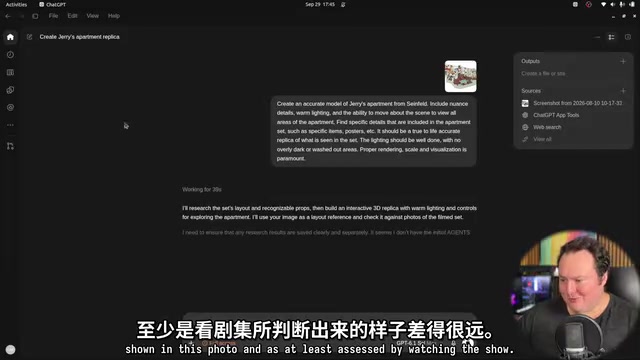
If the game tests were disappointing, the static scene modeling results turned things around. The model's recreation of Jerry's apartment from Seinfeld was described as "absolutely stunning": the door, bicycle chain, on-screen dialogue Easter eggs ("What's the deal with airplane peanuts"), exterior building views, and even citations of set reference materials — the level of detail was remarkable. While the overall layout wasn't a perfect match for the show, the quality of individual elements was excellent.
The RuneScape 2007 PVP scene recreation was equally impressive, with UI elements, weapon icons, and potion slots rendered with near pixel-perfect accuracy — leading the tester to suspect the model had "directly extracted" the reference image. This hints that GPT-6.1 Sol may have particularly strong visual comprehension capabilities.
Complex 3D Modeling: The Saab 900 Turbo Challenge

The tester intentionally chose the oddly shaped Saab 900 Turbo because it can't be approximated with a generic sports car template. The result wasn't a perfect replica, but details like the engine bay, strut towers, battery, wheel hubs, and bumper trim were quite accurate. The web interaction features — hood opening, color swapping, driver's seat view, and multiple camera presets — were also fully realized, showing potential as a game asset.
Token Efficiency Is the Hidden Advantage
The entire test session — covering a large number of ultra and max tier runs — consumed only about 3% of a $200 subscription allowance (dropping from 98% to 95%). This indicates that GPT-6.1 Sol is exceptionally token-efficient. Given that it's priced at one-fifth of the flagship model, this combination of "cheap and frugal" is highly attractive for real-world deployment.
Token efficiency measures the ratio between the number of tokens a model consumes to complete a given task and the quality of its output. For complex tasks requiring extensive context and multiple iterations — like 3D code generation — token consumption is often the core cost variable in actual deployment, far more reflective of real-world expense than the nominal per-token price. Consuming only 3% of a $200 allowance means the same budget could support roughly 33 complete test runs of equivalent scale — implying lower iteration costs and greater concurrency potential for developers and enterprise users who need to iterate frequently. Combined with its $2/million input token pricing, GPT-6.1 Sol's cost advantage is further amplified in high-frequency usage scenarios.
Conclusion: Its Strengths Lie Elsewhere
The tester's overall verdict was refreshingly honest: on the 3D visualization tasks this channel favors, GPT-6.1 Sol doesn't match the impressiveness of Claude Sonnet 5.5 at the same price point. By its previous positioning, Sol should have been an Opus competitor — but now that it's priced the same as Sonnet, it hasn't fully outperformed it across the board.
That said, this doesn't make it a "bad" model — it simply doesn't excel in the specific test types this channel prefers. It's fast, token-efficient, affordable, strong at visual comprehension and static modeling, and knows when to bow out gracefully when a task is beyond reach. Its real strengths may lie in areas not yet fully explored — edge device optimization, low-level software, and similar domains. It's too early to pass final judgment on this model.
Related articles

Building Approval Workflows with SCIM Manager Attributes
Learn how to build dynamic approval workflows using SCIM manager attributes (manager_id, manager_name, manager_email), including field mapping, multi-level approval chain design, and no-manager fallback strategies.

The Android Lockdown Countdown: Your Phone Is About to Stop Being Yours
keepandroidopen.org sparks Hacker News debate, warning that Android's openness is tightening. We analyze the 70-day countdown, the security-vs-openness tug-of-war, and three realistic actions users can take.

AI Math Capabilities Advance Rapidly, Underlying Pattern Revealed
AI math capabilities continue to break through, with a common pattern emerging behind success cases: models are better at math problems decomposable into subproblems. This article analyzes the implications of this pattern for research, education, and predicting AI capabilities.