GPT-6.1 Sol Hands-On Review: Matches Sonnet 5.5 on Price, But Falls Short on 3D

GPT-6.1 Sol matches Sonnet 5.5 on price but trails on 3D visuals while shining on detail tasks.
OpenAI's GPT-6.1 Sol launches at the same price as Claude Sonnet 5.5 ($2/$10 per million tokens), claiming near-Astra intelligence at a fraction of the cost. Blogger Bijan Bowen's hands-on testing reveals a split personality: clearly behind Sonnet 5.5 on visual 3D generation tasks like the pool party and GTA clone tests, yet surprisingly impressive on detail-heavy tasks like the Seinfeld apartment recreation and RuneScape UI replication. Token efficiency is a genuine strength — a full high-intensity session used only 3% of quota. Overall, GPT-6.1 Sol looks more like a specialist in fine-grained detail and software tasks than a generalist 3D visual powerhouse.
OpenAI moved quickly after its developer day to release GPT-6.1 Sol, a model positioned to deliver near-top-tier intelligence at a significantly lower price. Tech blogger Bijan Bowen put it through its paces immediately, focusing on the 3D generation, game building, and modeling tasks his channel is known for. The verdict is nuanced: the model holds its own in many areas, but it launched just 24 hours after Claude Sonnet 5.5 hit the market at the exact same price point — an awkward coincidence that colors every comparison.
Pricing and Specs: A Direct Rival to Sonnet 5.5
The headline claim from OpenAI is that GPT-6.1 Sol approaches Astra-level intelligence (Astra being their current most capable model) at one-fifth the cost. The pricing lands at $2 per million input tokens and $10 per million output tokens — identical to Claude Sonnet 5.5, which launched the day before.
Spec-wise, the model has a knowledge cutoff of April 30, 2026, a context window just over 1 million tokens, a maximum output of 128k tokens, and supports text and image inputs. On the DeepSWE benchmark, it shows a notable capability jump over its predecessor despite only a 0.1 version bump from GPT-6 Sol.
Bowen flagged an interesting nuance: cranking up the reasoning effort (to max or ultra) doesn't always yield better results — benchmark scores can actually dip when the model goes beyond what the evaluation is measuring. He ran most tests at max effort anyway, to probe the model's true ceiling.
The pricing shift also changes the competitive framing. Back in the GPT-5.6 and Sonnet 5 era, Sol was more of an Opus-tier contender. Now that Sol and Sonnet sit at the same price, Sol has effectively stepped down from Opus rival to Sonnet rival — a repositioning that sets the tone for every test that follows.
What is DeepSWE? DeepSWE (Deep Software Engineering Benchmark) is a benchmark designed to evaluate large language models on real-world software engineering tasks — bug fixes, feature implementation, and code refactoring across multi-file codebases. Compared to traditional benchmarks like SWE-bench, DeepSWE places greater emphasis on long-context reasoning, multi-file coordination, and engineering judgment, making it a strong proxy for "real-world coding" ability. The meaningful improvement GPT-6.1 Sol shows on this benchmark suggests its gains in handling complex software tasks outpace what the version number implies.
Games and 3D Generation: Clearly Behind Sonnet
The centerpiece of the testing was a series of custom game generation tasks. First up was a brand-new "Backyard Pool Party" test — introduced in the Sonnet video the day before specifically to avoid any benchmark gaming. Bowen cleared all cached and temp folders beforehand to ensure no prior results could influence the output.
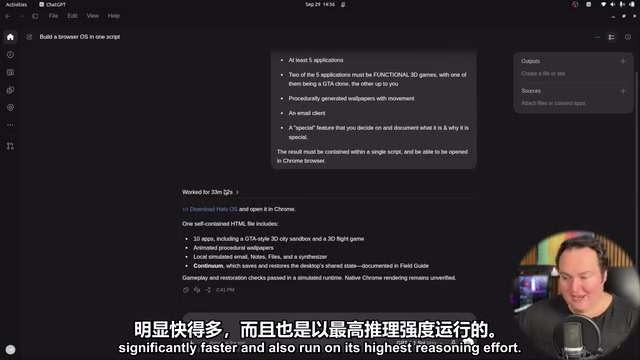
The results were underwhelming. Whether run in ultra+fast or a clean max-effort re-run, the output looked nearly identical to the previous generation, with visual quality clearly trailing Sonnet 5.5 — especially in character modeling. Bowen put it bluntly: "It's not even close. Sonnet mopped the floor with it." The one edge GPT-6.1 Sol had was speed — it finished significantly faster, even at max reasoning effort.
The GTA clone, Orbital Run, and Halo-inspired desktop OS tests were rated as "competent but unspectacular." One curious observation: multiple models from different vendors converged on similar behaviors, like linking an email app to in-game functionality. That kind of cross-model convergence is itself an interesting data point.
The robotic arm grasping test produced a memorable moment: after about 18 minutes, the model gave up, left the arm in a vertical position, and returned a "I can't do this" message. Bowen actually respected that call. Sonnet 5.5 had completed the task, but in a way he described as "chaotic and mostly luck" — GPT-6.1 Sol's movements were noticeably more deliberate and precise, and it knew when to stop.
A note on reasoning effort levels: "Ultra+fast" and "max effort" refer to different settings on OpenAI's reasoning intensity dial. Higher effort means more internal "thinking steps" before generating a response — better for complex logic, but slower and more token-intensive. "Fast" mode prioritizes speed and efficiency. Bowen chose max effort to rule out any capability underestimation caused by insufficient reasoning depth, which also explains why the same task can produce dramatically different output quality and runtimes.
Where It Shines: Surprisingly Sharp on Detail Work
Despite the generally weaker showing, a few tests revealed genuine strengths. A C++ skateboarding game (early 2000s New York streets, no raylib) with a replay feature suggested by commenters turned out well: the cinematic trick replay triggered by the Z key was called "X Games pro mode" by Bowen, with polished water effects and building reflections.
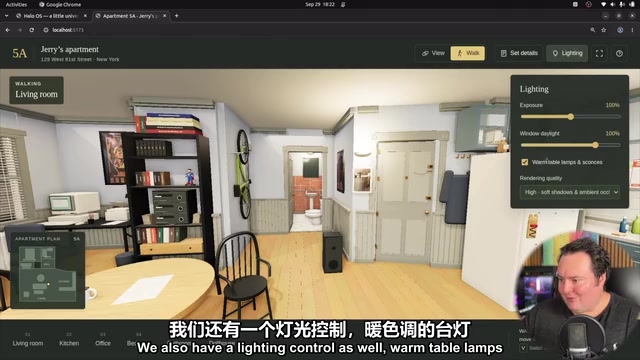
The standout result was the Seinfeld Jerry's apartment recreation. Bowen called it "absolutely excellent — a massive leap over anything before it." Multiple locks on the door, text easter eggs on the computer screen ("What's the deal with airplane peanuts," "New material Thursday"), chain detail on the green Klein bicycle, a Porsche poster in the bedroom, and even cited reference sources — the individual prop details were remarkably faithful. That said, it still couldn't perfectly reproduce the actual spatial layout of the apartment from the show — a challenge no model has cracked yet.
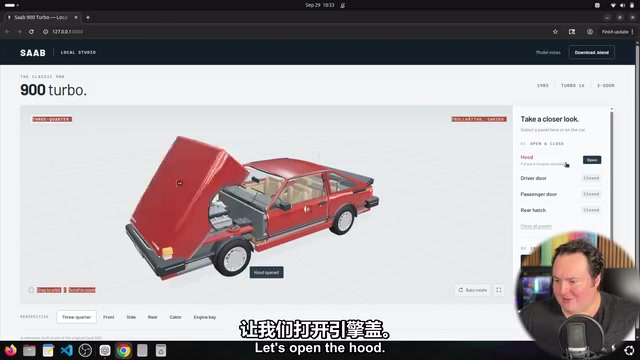
The RuneScape 2007 PVP recreation was equally impressive, with UI elements (sharks, potion icons, inventory slots) so pixel-accurate that Bowen half-joked the model must have copy-pasted assets from somewhere. The Saab 900 Turbo 3D modeling test showed the model handling an unconventional car shape well — a vehicle that resists the standard sports car template. Engine bay details, strut towers, battery, and wheels were all faithfully reproduced, with working hood-open interaction and color-swap support.
Why is the Seinfeld apartment a classic AI test? Jerry's apartment from Seinfeld appears so frequently across so many episodes, with so much fan documentation of its props and layout, that it's become an ideal benchmark for testing two things at once: long-tail knowledge recall and spatial reasoning. The challenge is that a model must simultaneously remember scattered prop details (the Klein bike, the Porsche poster, the deadbolts) and correctly reconstruct their spatial relationships in 3D. The former tests knowledge breadth; the latter tests layout understanding. No model has nailed the real floor plan yet, suggesting that even strong memory doesn't automatically translate to accurate spatial reconstruction.
Efficiency and Positioning: Lean on Tokens, Fuzzy on Identity
A full high-intensity test run — including multiple ultra-mode tasks — consumed only about 3% of Bowen's usage quota (dropping from 98% to 95%). He called the token efficiency "quite respectable." Combined with the competitive pricing, the value proposition is real.
Bowen offered a rare moment of self-awareness in the video: his channel is built around 3D and game generation, and that may not be where GPT-6.1 Sol excels. He speculated the model might have real advantages in lower-level software tasks or edge device optimization — areas he didn't get to test. He did attempt a physical device interaction test using an old Pentium III laptop, but it fell apart due to a USB-to-USB connectivity issue and model degradation during the session.
His conclusion is measured: he's not willing to write the model off based solely on visual 3D tasks. But with Sonnet 5.5 having just delivered a "jaw-dropping" showing, GPT-6.1 Sol doesn't land with the same visual punch at the same price point. "It's capable, it doesn't eat your quota, and it's relatively affordable" — that's the bottom line he lands on, with the implicit suggestion that this model's real value may be hiding in software tasks beyond the world of game generation.
Related articles

Workbuddy for Absolute Beginners: How a Desktop AI Agent Fits Into Real Workflows
A beginner's guide to the Workbuddy desktop AI agent: installation, claiming credits, file management, and building automated workflows—compared with CodeX for fit and cost, helping professionals shift from AI question-askers to AI managers.

OpenAI's New Agent Stack: Computer Use, Decisions API, and Ultra-Fast Workflows
OpenAI Dev Day unveiled a new agent stack: Computer Use outperforms humans, Decisions API delivers ultra-low-latency classification via Luna, Agents API opens the same Computer Use capabilities, and GPT-6.1 Sol costs only one-seventh of Astra. Core updates, benchmark data, and developer insights.

Liang Wenfeng Open-Sources DeepInfo Inference Framework, Takes On U.S. Ban
DeepSeek open-sources its DeepInfo inference framework after its models, featuring GPU/CPU cross-pipelining, small-model prediction with large-model verification, and full Huawei Ascend and NVIDIA chip support—facing the U.S. federal ban head-on. This article analyzes its significance for AI deployment and open-source strategy.