GPT-6.1 Terra Hands-On Analysis: Cheaper but Slower — Worth Switching?

GPT-6.1 Terra boosts workflow capability notably but isn't an all-around champion — validate with blind tests.
OpenAI released GPT-6.1 Terra under ChatGPT Work and Codex, not standard chat. Official demos show full workflows but are curated. Independent tests show nearly 4x longer tasks at lower cost in an architectural scenario; Agent's Last Exam scores 57.6% at medium effort, with cost per task dropping from 84 to 29 cents. Yet it scores only 48 on Artificial Analysis's cross-vendor index, below Claude Opus at 58, while its hallucination rate fell from 88% to 38%. The article stresses that cost per task excludes human review time and recommends blind tests with real tasks, including revision requests, judged by useful work surviving review.
OpenAI has released GPT-6.1 Terra. In the official demos, a tram takes shape inside the software, and a winter village under a glass dome slowly fills with snow. But the real question isn't whether it can generate stunning clips — it's whether that work is usable, how much it costs to complete, and in which scenarios stronger models remain irreplaceable. The official charts and the first batch of independent tests offer different angles on the answer.
Product Positioning: Part of a Workflow, Not Ordinary Chat
One easily overlooked detail: this release belongs to ChatGPT Work and Codex, not the standard chat interface. According to OpenAI's documentation, access covers Plus, Pro, Business, Enterprise, and Education plans, with workspace controls and gradual rollouts affecting actual visibility. Developers can also call it via the API model identifier.
So not finding Tera in a regular chat window doesn't mean something is broken — it's a different product surface. Understanding this is a prerequisite for evaluating its value.
ChatGPT Work is OpenAI's workspace product for enterprise teams, emphasizing shared projects, admin controls, and data isolation; Codex is its developer-facing coding agent environment, supporting code execution in a sandbox, tool invocation, and producing runnable projects. The key differences from the ordinary chat interface lie in the permission model, auditability, and integrability — ordinary chat targets personal, immediate Q&A, while Work/Codex targets production workflows that require retention, collaboration, and compliance review. As a result, the same model may differ across product surfaces in availability, toolset, and context management strategy; when evaluating it, first confirm which entry point you're in.
Official Demos: Showing Intent, Not a Random Sample
OpenAI's demo shows the full chain from a request through a series of actions inside the software to a visible final result. This workflow perspective matters for creative work: a convincing final image can't tell us whether the underlying project is well organized, editable, or easy to modify next time.
This is a curated company demo showing an intended workflow, not a random sample of all the tasks the model might attempt. For 3D projects, it's worth asking: are objects independent? Does changing a material require rebuilding the scene? Can a small change preserve the rest of the project? These questions separate "admiring the demo" from "deciding to adopt the result."
Independent Creator Comparison: A Counterexample That's Slower but Cheaper
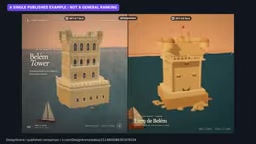
Design Arena tried a related scenario: golden hour at Bellum Tower in Lisbon. Its public comparison asked the new Tera and the older 5.6 to generate architectural details — water, sailboats, a distant bridge. The creator reported that 6.1 took nearly four times as long but actually cost less.
This comparison breaks a common assumption: a model marketed as "fast" doesn't necessarily win every stopwatch test. Prompts, effort levels, tool settings, and result selection all matter, and a single scenario can't settle it. The author reported the two runs cost about $0.05 and $0.08; we did not independently reproduce the billing. But the example shows that cheaper tokens can leave room for more refined results, even when the job takes longer.
Another creator, Mr. Tactical, posted a three.js snow globe comparison with Claude Haiku 5.5, saying both used high effort levels and the same prompt. But even identical effort-setting names don't guarantee equal compute across companies. Such comparisons should preserve the prompt, source files, timing, and failed attempts, then be re-tested in another scenario — short videos often omit information, and we can appreciate the result while keeping its evidence in proportion.
Design Arena is a public model-comparison platform for design tasks, where creators submit the same prompts and assets, and different models generate results with published timing, cost, and output. The value of such platforms is providing third-party samples beyond official demos, but their limitations are equally obvious: a single run is affected by prompt wording, effort level, tool configuration, and result selection, and different vendors don't define "high effort" the same way. So it's suitable as directional reference, not sufficient evidence for a procurement decision; when reading, pay attention to whether the full prompt, failed attempts, and billing screenshots are disclosed.
Benchmark Charts: Direction and Boundaries
OpenAI published six chart series: professional computer tasks, visual reasoning, desktop operation, factual errors, terminal coding, and scientific workflows. Note the scale direction — higher success rates are better, lower factual error rates are better. These are company-reported measurements and should be treated as a map of "where to investigate," not a guarantee for any single task.
Core Numbers and Cost Basis
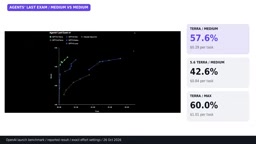
On Agent's Last Exam, Terra at medium effort scores 57.6%, up from 42.6% for the previous Terra — a 15 percentage-point gain. The chart estimates the new model at 29 cents per task versus 84 cents for the old one. At maximum effort it reaches 60%.
The key word is "task." Price per token measures the rate you pay, while cost per task also depends on how much work the model does. Neither includes your own time checking the deliverable.
In the visual reasoning chart, Terra reaches 85.5% at maximum effort. Desktop operation is another challenge: 74.2% on the offline OS World 2.1. Reading a screen and successfully completing a series of actions are related but not interchangeable — when a familiar app suddenly pops up a dialog covering the "next" button, understanding the documentation is only part of the task.
OpenAI's Difficult Prompt Test reports factual errors dropping from 53.6% at low effort to 16.7%, and to 4.3% at maximum effort. These numbers describe that test, not the probability of any given answer being wrong. In everyday research, important claims should still be traced to sources — fluent answers can err on dates, product limitations, or comparisons.
Terminal coding reaches 50.3% at maximum effort, versus 21.5% for the previous Terra at maximum effort; scientific terminal workflows reach 58.3%. These tests involve doing things with tools rather than just choosing answers, but they still cover defined tasks and environments. A score is not a promise that an agent can safely manage an unfamiliar production system.
"Cost per task" and "price per token" are two different measures. Price per token is the API billing rate; multiplied by the input and output tokens actually consumed, it gives the cost of a single call. Cost per task, by contrast, is the total cost of completing one defined evaluation task, including the model's multiple calls, tool use, and retries within that task, so it fluctuates with how much work the model does. A model may have a lower token price but cost more per task because of longer reasoning chains — or the reverse. Neither accounts for the human time spent checking the deliverable, which is often the largest hidden cost in real workflows.
Cross-Company Comparison: Terra Is Not an All-Around Champion
Artificial Analysis offers a broader cross-company comparison. In the leaderboard snapshot it captured, Terra at maximum effort scores 48, Sol tops out at 52, Astra and Gemini 4 Argon at high effort are around 53, Kimi C 3.1 Pro is 55, and the Claude Opus and Sonnet configurations shown are 58 and 57 (note Claude's fallback conditions). These index values are not percentages. Terra is competitive on cost but is not the highest-scoring model overall.
The same snapshot also includes DeepSeekAd, GLM, Qwen, Minimax, Grok, Mistral, and Meta models. Showing the selected configurations along with settings and costs is more meaningful than collecting isolated headline scores from each launch event.
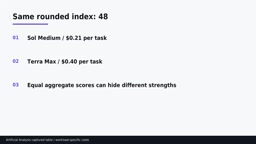
A useful check: Sol at medium effort and Terra at maximum effort both round to 48, but the displayed task costs differ. The same overall score doesn't mean the same strengths.
Artificial Analysis's independent analysis makes this clearer: Terra's low and medium settings sit on the intelligence-cost-efficiency frontier, while higher settings fall behind it. At maximum effort, the new Terra improves 6 index points over the previous version, with task cost dropping from $1.40 to $0.40. Its independent Coding Agent Index scores 48, versus 54 for Sol and 31 for Luna. This is another methodology — don't mix it with the intelligence score just because the numbers happen to be close.
That index combines 10 evaluations, mostly text-based English suites, with visual understanding and multilingual ability measured separately. The methodology weights are: agentic 30%, coding 20%, general tasks 30%, scientific reasoning 20%. An overall gain can mask a large change in one area and a small one in another. Procurement decisions should open the relevant task breakdown, along with the evaluation version.
There's also an independent reliability result: in Artificial Analysis's private knowledge test, the hallucination rate dropped from 88% for the previous Terra to 38% for the new version. Here the rate describes how often the model guesses when it doesn't know the answer, not the proportion of all answers that are wrong. This test differs from OpenAI's difficult-prompt error chart and the two are not interchangeable. It's encouraging that unsupported guessing has decreased, but source checking remains part of the job.
Artificial Analysis is an independent model-evaluation organization that maintains multiple leaderboards across vendors, including an intelligence index, a cost-efficiency frontier, and a coding agent index. Its intelligence index is a weighted composite of several evaluations (e.g., agentic 30%, coding 20%, general tasks 30%, scientific reasoning 20%), so similar overall scores don't mean the same strengths; its Coding Agent Index uses a separate methodology and its values cannot be directly mixed with the intelligence index. The value of such third-party leaderboards is horizontal comparison under a unified framework, but evaluation version, weight settings, and test language coverage all affect conclusions; when procuring, open the task-level breakdown rather than looking only at the overall score.
API Cost Arithmetic and a Reality Check
Standard API rates are $1 per million input tokens and $5 per million output tokens, with a separate lower rate for cached input. An illustrative task: 20,000 input tokens and 5,000 output tokens comes to 4.5 cents in standard text-token charges. This calculation excludes tool fees, retries, and special pricing conditions, and is not a measured Terra run.
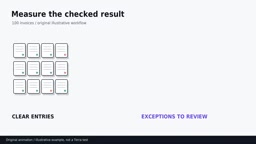
Imagine processing 100 invoices: most are clear, but a few lack a purchase order, have duplicate numbers, or contain handwritten corrections. The useful result isn't 100 confident entries, but correct entries plus a clear exception queue for a human to check. If the assistant saves 10 minutes generating work but adds 15 minutes of review, the apparent saving disappears. Measure time "to a result that passes review," not time until the model stops talking.
The model page has another distinction: Terra accepts text and images and returns text, and can use supported tools, but that doesn't make it a native audio or video generation model. The context window is 1 million and 50,000 tokens, with a maximum output of 128,000. A large context is capacity, not proof that every detail will be remembered correctly.
Speed drew early attention. Ruben Soto posted a time-and-cost comparison of Terra, Sol, and Opus, which we treat as a creator report rather than our own benchmark. Before drawing conclusions from it, check the quality of the materials used, the instructions, the tools, the completion criteria, and the final project. A fast attempt that misses requirements is not equivalent to a slower attempt that meets them.
The system card is also worth a look. Under OpenAI's framework, Terra's cybersecurity capability is treated as critical, and biological and chemical capabilities as high. These are capability assessments, not claims that every ordinary use is dangerous. The documentation also reports tests for prompt injection, scope control, and misleading completion reports. The evaluation environment may differ from your product. Sensitive workflows should be kept narrow, actions with consequences checked, and saved results verified.
Comparison Tests to Run Before Switching Workflows
Choose a small set of real tasks with known answers, and add a few hard exceptions. Give each model the same starting files and explicit requirements. Record the exact model, effort level, tool permissions, cost, and time. Score the saved outputs without telling the model.
Include one revision request, not just the first attempt. The last step reveals whether the assistant understands the project well enough to continue working, rather than just producing a convincing first result.
My reading: Terra is worth watching for repetitive visual and computer tasks with checkable results; harder reasoning and complex coding should still keep Sol and Astra in the comparison; other model families remain relevant in their areas of strength. Don't force every task through one model. Start with small, verifiable handoffs, keep an upgrade path, and judge results by how much useful work survives review.
Related articles

Anthropic's IPO Crisis: Why $16.8B in Revenue Can't Buy a High Valuation
Anthropic posted $16.8B in Q3 revenue with 85% gross margin yet faces a cut to its IPO valuation. A deep dive into halved growth, the token price war, circular financing, and the clash between safety ideals and capital reality.

Anthropic Races Toward the Largest IPO in History: Can a $100 Billion Raise Ignite the AI Investment Boom?
Anthropic may file its prospectus as early as October 23, aiming to raise up to $100 billion at a valuation of up to $2 trillion, potentially the largest IPO ever. Q3 revenue hit $16.8 billion, up nearly 50% quarter over quarter, with adjusted profitability, but slowing growth has led some investors to cut valuation to $1.5 trillion. The IPO is a key test of whether the AI investment boom can continue.

Bessemer Partner on Anthropic IPO: The Public's First Direct Investment in AI Software
Bessemer partner Byron Theta on the Anthropic IPO: why it's called the moment everyone's been waiting for, the $650M four-round investment, the LP liquidity bind, and expectations of a 2027 IPO wave—plus open-source model pricing pressure, existential risk disclosures, and what the founders' 50.1% voting structure means for ordinary investors.